

What if the reason your recovery has stalled isn't a lack of strength, but a lack of alignment? You're likely tired of waking up with that familiar, stubborn joint stiffness that makes simple tasks feel like a chore. It's frustrating to feel trapped in your own body. You might fear that you'll never truly restore mobility after injury or that surgery is your only remaining option. You want to move without hesitation. You deserve to return to the field or get through a workday without pain.
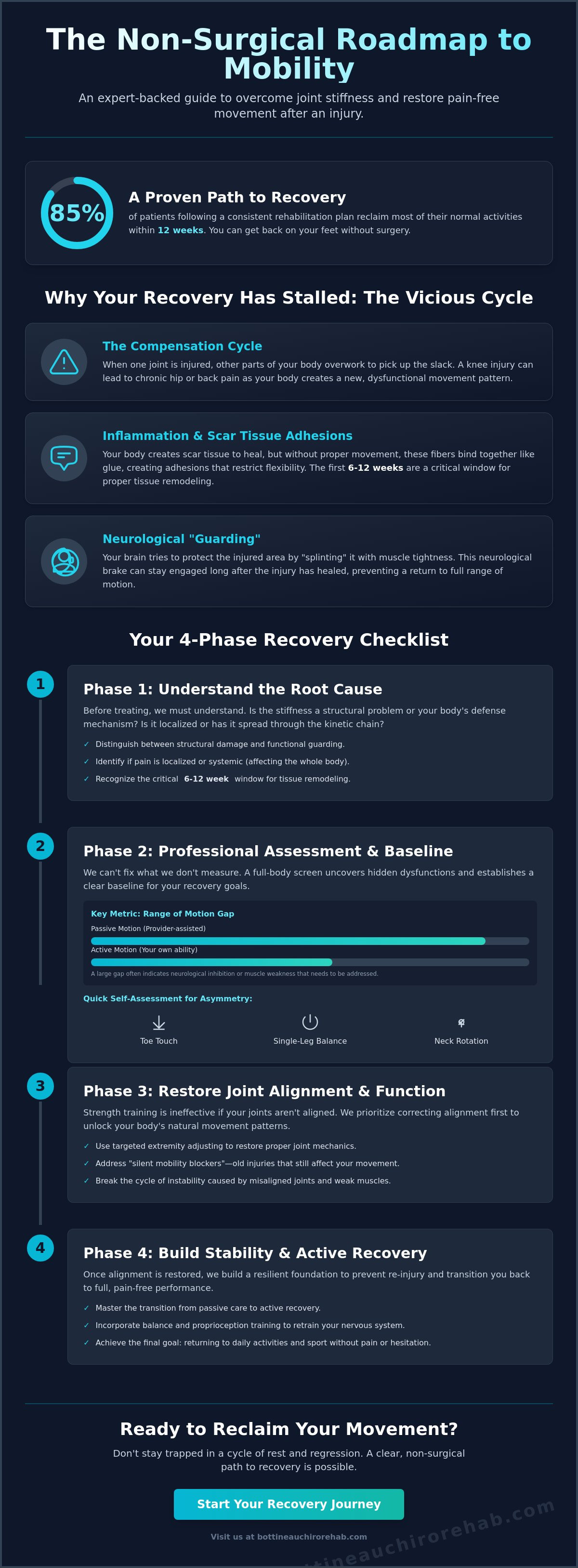
The good news is that 85% of patients who follow a consistent rehabilitation plan reclaim most of their normal activities within 12 weeks. You don't have to stay stuck in a cycle of rest and regression. This guide provides a clear, non-surgical roadmap to get you back on your feet. We've compiled an expert-backed checklist that prioritizes joint alignment and functional movement. You'll learn exactly how to transition from initial stability to full, pain-free performance. Let's get you moving again.
Key Takeaways
- Identify the "compensation cycle" where healthy joints overwork to protect your injury, leading to secondary pain.
- Learn why a full-body movement screen is essential to uncover hidden dysfunctions that standard tests might miss.
- Discover how targeted extremity adjusting can restore mobility after injury by correcting joint alignment first.
- Master the transition to active recovery with balance and proprioception training to prevent future relapses.
- Follow a clear, non-surgical roadmap designed to move you from persistent stiffness back to your daily activities.
Phase 1 Checklist: Understanding the Root of Mobility Loss
To restore mobility after injury, you must first understand why your body stopped moving correctly. Stiffness isn't just a side effect of trauma; it's often a deliberate defense mechanism. Your recovery begins by distinguishing between actual structural damage and functional guarding. While a torn ligament is structural, the tightness you feel in the surrounding muscles is usually your brain's way of "splinting" the area. This neurological brake stays engaged long after the initial threat has passed. If you don't address this guarding, your range of motion will remain restricted regardless of how much you stretch.
You also need to determine if your stiffness is localized or systemic. Is the pain strictly in your ankle, or has it radiated up your leg? Identifying where your movement is blocked across the entire kinetic chain is the only way to build a successful recovery roadmap. Without this clarity, you're simply treating symptoms instead of the cause.
The Inflammation and Scar Tissue Cycle
When an injury occurs, your body rushes to repair the site by laying down collagen fibers. Think of this as internal patchwork. This scar tissue is necessary for healing, but it's often messy and haphazard. Without proper intervention, these fibers create adhesions that bind your muscles and fascia together like glue. This is why "rest only" is a dangerous strategy. While you need initial downtime, total inactivity allows scar tissue to set in a way that limits permanent flexibility. The first 6 to 12 weeks are the critical window for tissue remodeling. During this time, the right movements ensure these new fibers align correctly, allowing for a return to fluid motion.
Compensatory Movements: Why Your Whole Body Feels Stiff
Your body is a single, interconnected unit. It's common to see a knee injury sustained on a field in Rugby, ND, lead to chronic hip or lower back pain by the time a patient seeks care in Bottineau. This happens because of the compensation cycle. When one joint is compromised, the joints above and below it must overwork to pick up the slack. Physical therapy and clinical rehabilitation focus on breaking this cycle by looking at the body as a whole. Warning signs of overcompensation include an altered gait, uneven shoe wear, or new aches in areas that weren't originally injured. Recognizing these shifts early prevents a single injury from becoming a full-body problem.
Phase 2 Checklist: Professional Assessment and Baseline Setting
You can't fix what you haven't measured. After understanding the root cause of your pain, you must establish exactly where you stand today. A full-body movement screen is the gold standard to restore mobility after injury. It identifies hidden dysfunctions that standard X-rays often miss. We verify joint integrity through orthopedic and neurological testing to ensure every connection is firing correctly. This process also rules out contraindications, making sure your recovery path is safe and effective.
Establishing a baseline for "active" versus "passive" range of motion is a vital part of this phase. Active motion is what you can do yourself; passive is how far a provider can move the joint for you. A large gap between these two often indicates a neurological "lockdown" or significant muscle weakness. By measuring these metrics now, you can set specific, measurable goals. Don't just aim to "feel better." Aim for "walking up the stairs pain-free" or "reaching the top shelf without hesitation."
Self-Assessment vs. Professional Evaluation
While you shouldn't self-diagnose, you can check for joint asymmetry at home. Try these three simple tests:
- The Toe Touch: Can you reach your toes without bending your knees or feeling sharp back pain?
- Single-Leg Balance: Can you stand on one leg for 30 seconds without significant wobbling?
- Neck Rotation: Can you touch your chin to your shoulder comfortably on both sides?
Asymmetry in these tests suggests your body is compensating. A professional exam detects the subtle misalignments that cause these issues. We focus on both spinal and extremity screening because a problem in your foot often stems from a bypass in your hips or spine. Getting an expert opinion ensures you aren't just guessing with your health.
Identifying Silent Mobility Blockers
Old, unhealed injuries are often the biggest hurdle to your current progress. A sprained ankle from years ago can change your gait, eventually leading to knee or hip issues. Your nervous system may still be "protecting" that old injury by limiting your movement today. "A joint that cannot move correctly will eventually cause the muscles around it to weaken." This weakness creates a cycle of instability and pain.
Our goal is to help you sustain your mobility after physical therapy or chiropractic care has concluded. We look for these silent blockers to ensure your recovery is permanent. If you're ready to stop guessing and start measuring, a professional movement assessment is your next logical step toward a pain-free life.
Phase 3 Checklist: Restoring Joint Alignment and Function
Most recovery plans fail because they rush into exercise before the joints are actually ready to move. If you try to strengthen a misaligned joint, you're simply reinforcing a bad pattern. This leads to more wear, tear, and eventual setbacks. To truly restore mobility after injury, you must prioritize joint decompression first. This step reduces immediate nerve pressure and signals to your brain that it's safe to let go of the "guarding" reflex we discussed in Phase 1. Once the pressure is off, your body can begin the real work of functional repair.
Our approach focuses on restoring the natural "slide and glide" of your joints. We address the entire kinetic chain, ensuring that every piece of the puzzle is in its proper place. This includes addressing spinal alignment to keep the lines of communication open between your brain and the injury site. Without a clear signal from the nervous system, your muscles won't fire correctly, and your range of motion will remain limited.
The Role of Extremity Adjusting in Mobility
Many patients assume chiropractic care is strictly for the back or neck. However, extremity adjusting is a vital tool for total body recovery. This practice involves precise adjustments to the "outer" joints, such as the ankles, knees, hips, and shoulders. If your ankle is stuck after a sprain, it ruins your gait. You'll start limping, which then throws off your knee and hip. By adjusting the ankle directly, we restore its proper motion immediately. This synergy between spinal health and limb mobility is the secret to a fast, non-surgical recovery.
Soft Tissue Mobilization and Flexibility
Scar tissue acts like glue in your internal gears. We use soft tissue mobilization to "melt" these adhesions and improve localized blood flow. This isn't a standard massage; it's a clinical technique designed to break up restrictive fibers that limit your reach. You must also distinguish between "good" movement and "dangerous" overstretching. Pushing too hard into a sharp pain threshold can cause micro-tears in healing tissue. Instead, follow this 3-step guide for safe early-stage mobility:
- Circular Motion: Move the joint in slow, controlled circles within its current pain-free range.
- Muscle Activation: Gently squeeze the muscles around the joint for 5 seconds to "wake them up" without moving the bone.
- Incremental Expansion: Slowly try to reach 1 to 2 percent further each day, stopping the moment you feel a sharp pinch.
By focusing on alignment and tissue quality before adding heavy loads, you create a foundation that lasts. This ensures your return to activity is permanent rather than a brief window of relief followed by another injury.
Phase 4 Checklist: Building Stability and Active Recovery
Once your joints are properly aligned, you must teach them to handle the stress of daily life again. This is where many people experience a relapse. They feel a reduction in pain and immediately return to high-impact activities before the supporting structures are ready. To successfully restore mobility after injury, you need to build functional stability. This phase ensures your joints stay in place under pressure and during complex movements. It's about moving from passive relief to active performance.
Establishing a daily maintenance routine is the final piece of this puzzle. Think of your joints like a hinge that needs regular oiling. Consistent, controlled movement keeps the area lubricated and prevents the return of the stiffness we addressed in Phase 1. By following a structured progression, you can return to your favorite activities with total confidence.
Low-Impact Loading for Joint Health
Motion is lotion for your joints. Movement stimulates the production of synovial fluid, which acts as a natural lubricant. However, you must avoid trauma during this delicate stage. Low-impact loading allows you to strengthen the joint without the jarring force of running or jumping. In North Dakota, our long winters can make staying active a challenge. Indoor swimming or using a stationary bike are excellent ways to keep moving when it's too cold for outdoor walks.
You must also respect your "threshold of pain." A 2 out of 10 on the pain scale is often an acceptable sign of tissue adaptation. If you hit a 5 out of 10, it's a clear signal to stop and adjust your intensity. Pushing through sharp pain during this phase will only set your recovery back.
Proprioception: Retraining Your Brain to Move
Injury often "unplugs" the communication between your brain and your joints. Your nervous system loses its ability to sense the joint's position in space, which significantly increases your risk of re-injury. Proprioception training "re-wires" these connections. Spinal rehab supports this process by ensuring your central nervous system is clear of interference, which improves overall balance and coordination. Try these two simple exercises to sharpen your joint awareness:
- The Stork Stand: Balance on your injured leg for 30 seconds. Once that feels easy, try doing it with your eyes closed to force your joint to work harder.
- The Tandem Walk: Walk in a straight line, placing the heel of one foot directly against the toe of the other. This mimics a tightrope walk and builds lateral stability.
Teaching your brain to trust your body again is the final hurdle in your recovery journey. If you are ready to move from simple pain relief to peak performance, our sports injury rehab programs are designed to bridge that gap and get you back in the game.
The Local Solution: Restoring Mobility in Bottineau
Living in rural North Dakota requires a body that can handle hard work and unpredictable conditions. Whether you're managing a farm near Rolla or enjoying the outdoors at Lake Metigoshi, physical limitations aren't just an inconvenience. They're a barrier to your way of life. You don't have to accept persistent stiffness as your new normal. We offer a local, expert-backed solution to help you restore mobility after injury without the need for invasive surgery or long-distance travel to a major city.
Dr. Daniel Pozarnsky utilizes a "full-body" approach that looks beyond the isolated site of your pain. By integrating the movement screens we discussed in Phase 2 with the precise extremity adjustments from Phase 3, we create a recovery plan that is as unique as your lifestyle. We understand that a knee injury for a local athlete or a back strain for a tradesman requires a decisive, results-driven intervention. Our goal is to move you through the recovery phases quickly so you can return to the activities that matter most.
Boundless Full Body Chiropractic & Rehab’s Unique Approach
We pride ourselves on a clinical model that combines full-body adjustments, physical therapy, and specialized spinal rehab under one roof. This integrated approach ensures that no part of your recovery is left to chance. We focus on non-surgical, drug-free solutions that prioritize the long-term health of your family. Our clinic serves the entire Turtle Mountain region, providing a welcoming environment for patients from Rugby to Bottineau. We don't just treat symptoms; we restore the functional integrity of your entire kinetic chain. This ensures that once you regain your movement, you have the stability to keep it.
Your First Step: The $47 New Patient Special
The path to a pain-free life shouldn't be blocked by financial uncertainty or confusion. We've removed the barrier to professional care by offering a $47 New Patient Special. This is a comprehensive entry point into our care model designed to give you total clarity on your condition. It includes a full orthopedic and neurological exam, a functional movement screen to identify hidden dysfunctions, and a private consultation with Dr. Pozarnsky.
You'll walk away with a clear, actionable roadmap for your recovery. This special offer ensures that every resident in our community has access to a professional assessment without the stress of high initial costs. Stop guessing about your health and stop waiting for the pain to disappear on its own. Reclaim your movement and your lifestyle. Schedule your $47 New Patient Special today and take the first step toward a stronger, more mobile future.
Start Your Journey to Pain-Free Movement
Recovery is a deliberate process, not a waiting game. You now have the tools to move beyond persistent stiffness and functional guarding. By identifying the root cause of your pain and prioritizing joint alignment before adding heavy loads, you create a foundation for lasting health. This phased approach is the most effective way to restore mobility after injury and regain your independence. Whether you're an athlete or simply want to wake up without joint pain, a clear roadmap makes all the difference.
Dr. Daniel Pozarnsky and the team at Boundless Full Body Chiropractic & Rehab are ready to help you execute this plan. We specialize in non-surgical sports injury rehab for the Bottineau community and surrounding North Dakota areas. Don't let another day pass in frustration. Take the first step toward a more active, vibrant life right now.
Claim Your $47 New Patient Special and Restore Your Mobility Today
Your body is capable of incredible healing when given the right direction. We look forward to seeing you in the clinic and helping you move with confidence again.
Frequently Asked Questions
How long does it typically take to restore mobility after a sports injury?
Most patients reclaim their normal daily activities by the 12 week mark with consistent rehabilitation. While you'll likely feel initial relief within the first few visits, full tissue remodeling takes time. Your specific recovery timeline depends on the severity of the trauma and how closely you follow your prescribed checklist. We focus on efficient, results-driven protocols to get you back to work or sports as quickly as possible.
Can chiropractic care help with mobility if I don’t have back pain?
Yes; chiropractic care is designed for total body function, not just spinal issues. We use extremity adjusting to treat ankles, knees, wrists, and shoulders that have become stiff or misaligned. Even if your back feels fine, a restricted joint in your leg can throw off your entire gait. Correcting these "silent" issues is a vital step to restore mobility after injury and prevent future complications.
Is it better to use ice or heat for joint stiffness after an injury?
Use ice for new injuries and heat for lingering stiffness. Ice is the best tool during the first 48 to 72 hours to control inflammation and numbing pain. Once the acute phase passes, heat helps increase blood flow and relax the "guarding" muscles that cause stiffness. If you're unsure which to use, our team can provide a specific schedule based on your current stage of recovery.
Will I need surgery if my range of motion hasn’t returned after a month?
Not necessarily; many mobility limitations are functional rather than structural. If you're still stiff after 30 days, your body might be stuck in a compensation cycle or dealing with restrictive scar tissue. These issues often respond well to non-surgical sports injury rehab and targeted adjustments. We prioritize conservative, non-invasive methods to help you avoid the operating room whenever possible.
What is extremity adjusting, and how does it help with my ankle or shoulder?
Extremity adjusting is the clinical alignment of joints outside of the spine. When an ankle or shoulder is injured, the small bones can shift slightly, creating a "stuck" sensation. We use precise, gentle adjustments to restore the natural "slide and glide" of these joints. This immediately reduces nerve pressure and allows the surrounding muscles to function without the constant need to protect the area.
Do you accept insurance for physical rehabilitation in Bottineau?
We work with many insurance providers and can help you understand your specific coverage limits. For patients using Medicare in 2026, the therapy threshold is $2,480 for physical therapy and speech-language pathology services combined. Our office staff will verify your benefits during your first visit so there are no surprises. We're committed to making professional care accessible for all Bottineau families.
How is chiropractic different from traditional physical therapy for mobility?
We integrate both disciplines to ensure a more complete recovery. Traditional physical therapy often focuses on strengthening muscles, but if the joint underneath is misaligned, those exercises can cause more wear and tear. Our approach uses full body adjustments to fix the alignment first, then utilizes physical therapy to stabilize that new motion. This combination addresses both the "hinge" and the "motor" of your body.
What should I bring to my first appointment at Boundless Full Body Chiropractic & Rehab?
Bring your ID, insurance card, and any recent imaging like X-rays or MRI results. Wear comfortable clothes that allow for a full range of motion. During your first visit at Boundless Full Body Chiropractic & Rehab, we'll perform the movement screens and baseline tests discussed earlier to build your custom recovery plan. You don't need a referral to get started.


