

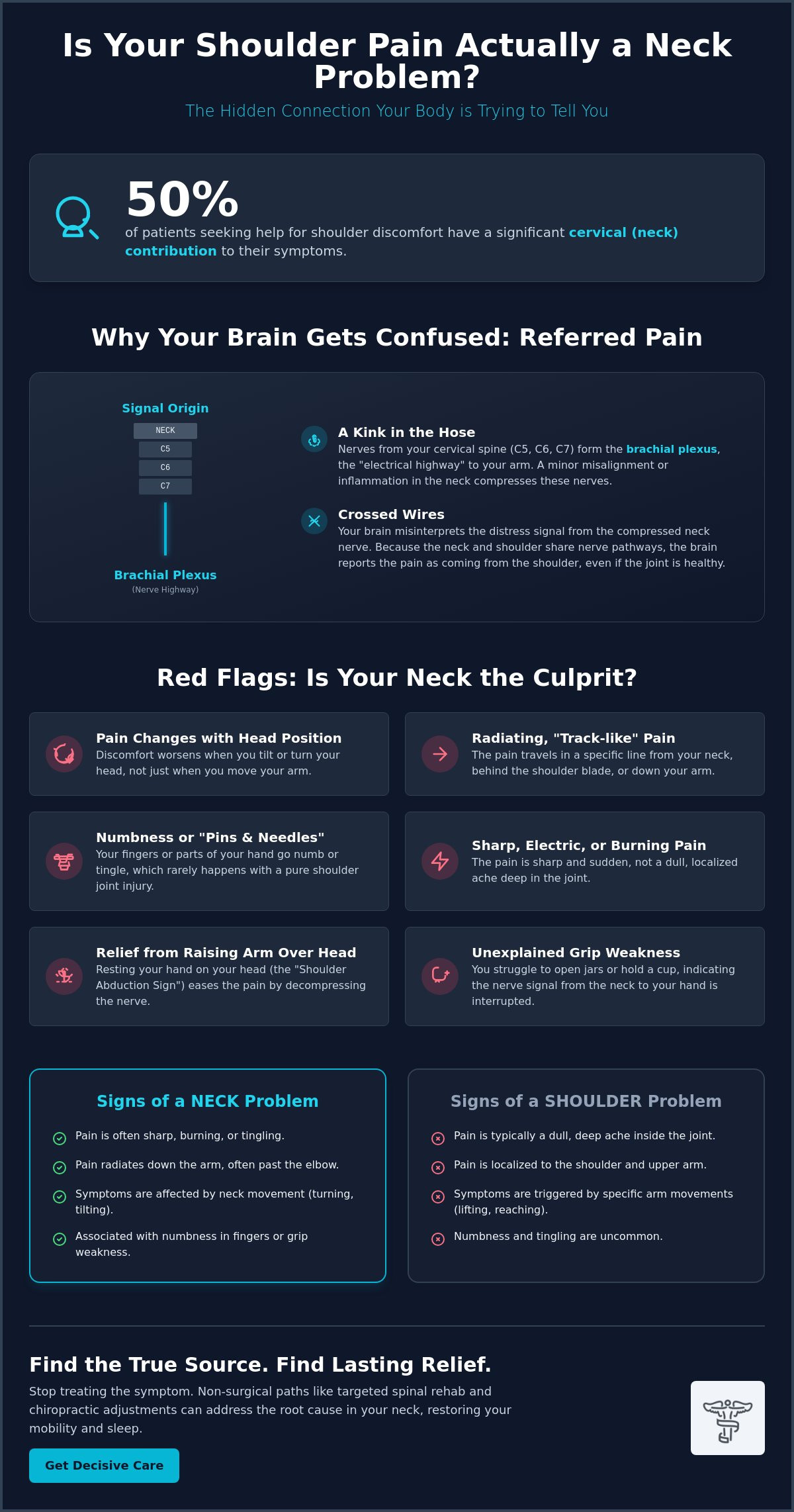
What if the stabbing pain in your shoulder blade isn't actually a shoulder injury at all? Research indicates that 50% of patients seeking help for shoulder discomfort have a significant cervical contribution to their symptoms. You've likely tried every stretch, ice pack, and massage targeting your rotator cuff, yet the dull ache in your deltoid persists. It's exhausting to deal with sleep disruption because you can't find a comfortable position for your arm. We understand that frustration. You deserve a clear path to recovery that addresses the root cause.
This article explains why shoulder pain could be a neck issue and how referred pain mimics common joint injuries. We'll show you how to identify the true source of your discomfort so you can stop guessing and start healing. Understanding this connection is the first step toward avoiding unnecessary surgery and regaining your mobility. Our team in Bottineau and Minot is ready to help you move from physical frustration to lasting momentum. Let's get you back to your daily life with the decisive care you need.
Key Takeaways
- Understand the "brachial plexus" connection and how your brain often misinterprets spinal nerve signals as shoulder pain.
- Learn to spot red flags like numbness or pain that intensifies when you move your head rather than your arm.
- Discover why shoulder pain could be a neck issue by looking at how cervical disc herniations and spinal stenosis mimic rotator cuff injuries.
- Use our self-assessment framework to test your range of motion and pinpoint whether the true source of your discomfort is in your neck or your shoulder.
- Explore non-surgical paths to relief through targeted spinal rehab and extremity adjustments that restore your vitality and sleep.
The Hidden Connection: How Your Neck Controls Your Shoulder
Your shoulder doesn't operate in a vacuum. It relies on a complex network of nerves that originate in your cervical spine. When you feel a sharp jab or a dull ache in your arm, it's easy to assume the joint is the problem. However, understanding why shoulder pain could be a neck issue starts with looking at your spine as the power source. If the power source is flickering, the light bulb in your shoulder will never stay bright. Cervical radiculopathy is a primary driver of shoulder symptoms, occurring when a nerve root in the neck becomes compressed or inflamed.
The cervical vertebrae labeled C5, C6, and C7 are the command centers for your upper extremities. Each level governs a specific territory. The C5 nerve root primarily controls the deltoid muscle and the outer shoulder. C6 manages the biceps and the thumb side of the hand. C7 oversees the triceps and the middle finger. When any of these levels are compromised, the pain doesn't stay in the neck. It travels. It radiates. It mimics a rotator cuff tear or bursitis even when the shoulder joint itself is perfectly healthy.
The Brachial Plexus: Your Body’s Wiring
Think of the brachial plexus as the main electrical highway connecting your neck to your arm. This bundle of nerves exits the spinal canal through narrow openings between your vertebrae. From there, it weaves under the collarbone and into the shoulder complex. It's a tight fit. A minor misalignment in the neck creates a "kink in the hose" for these vital signals. This mechanical pressure stops the flow of information. Inflammation in the neck then radiates downward, causing the shoulder to feel heavy, weak, or painful. Without addressing the "kink" at the source, your shoulder symptoms will keep coming back.
Why the Brain Gets Confused
Your nervous system is incredibly efficient, but it isn't perfect. Referred pain occurs when your brain misinterprets nerve signals from the spine as limb pain. Because the neck and the deltoid share the same nerve pathways, the brain sometimes struggles to tell them apart. It's like a crossed wire in a switchboard. You feel the "fire" in your shoulder, but the actual "match" was lit in your neck.
This is why localized shoulder rubs or cortisone shots in the joint often fail to provide lasting relief. They're treating the symptom, not the cause. In our region, "Tech Neck" from long North Dakota drives between Bottineau and Minot can trigger these symptoms. Staring at the horizon or a dashboard for hours puts immense pressure on the C5-C7 levels. This posture-driven stress creates a cycle of chronic discomfort that feels like a shoulder injury but requires a spinal solution.
Classic Signs Your Shoulder Pain is Actually a Neck Issue
Identifying the true source of your discomfort is the first step toward effective treatment. While you might feel the sensation in your deltoid, the root cause often hides inches away in your cervical spine. This is exactly why shoulder pain could be a neck issue. If your symptoms change based on your head position, your neck is likely the culprit. Pay attention to how your pain behaves during simple daily movements. Does it intensify when you tilt your head or turn to look at a passenger? This is a classic indicator of nerve compression. Unlike a dull, aching joint injury, nerve-related pain often feels like an electric shock or a burning sensation. It's sharp. It's sudden. It doesn't stay put.
Another unmistakable sign is the "shoulder abduction sign." If you find relief by resting your arm on top of your head, you're likely decompressing a pinched nerve root. This specific movement shortens the path of the nerve, reducing tension and providing temporary comfort. You won't find this type of relief with a standard rotator cuff tear. Additionally, keep an eye on your grip strength. If you struggle to open a jar or hold a coffee cup, the "electrical" signal from your neck to your hand is being interrupted. Weakness in the arm that accompanies shoulder discomfort is a decisive sign that your spine needs attention.
Radiating vs. Localized Pain Patterns
Localized pain typically stays deep inside the shoulder joint. It hurts when you reach for a seatbelt or lift a heavy box. Radiating pain is different. It follows a specific line or "track" from the base of your skull down into your arm. If you feel persistent aching behind your shoulder blade, consider it a major red flag. This area is a primary landing zone for referred pain from the lower cervical spine. Don't ignore a "track" of pain that refuses to stay in the joint.
The Role of Numbness and Tingling
True shoulder joint injuries rarely cause your fingers to go numb. If you experience "pins and needles" in your thumb and index finger, the C6 nerve root in your neck is likely under pressure. These Common Neck Conditions often go undiagnosed when providers only look at the shoulder joint. If these neurological symptoms are interfering with your sleep or work, it's time to seek a professional evaluation in Bottineau. Our team provides comprehensive spinal rehab to identify these patterns and restore your function quickly. We focus on moving you from physical frustration to a clear path of recovery.
Common Neck Conditions That Mimic Shoulder Injuries
Several distinct spinal conditions are responsible for misleading symptoms in the arm and deltoid. Understanding these pathologies clarifies why shoulder pain could be a neck issue for so many patients. A cervical disc herniation occurs when the gel-like center of a spinal disc pushes through its tougher outer layer. This material can compress the specific nerve roots that provide sensation and strength to your shoulder. Similarly, spinal stenosis involves the narrowing of the spinal canal. This condition is common among older adults in our community. It often creates a persistent, heavy feeling in the upper limbs that many mistake for simple aging of the shoulder joint.
Wear and tear also play a significant role in your daily comfort. Degenerative Disc Disease reduces the height between your vertebrae, leaving less room for nerves to exit the spine cleanly. When these exits are cramped, the shoulder is often the first place you feel the fallout. Facet Joint Syndrome involves inflammation in the small, stabilizing joints of your neck. While the problem is strictly spinal, the pain patterns frequently skip the neck entirely and settle deep in the shoulder blade area. This creates a confusing cycle of treatment that fails to address the root cause.
Disc Herniation vs. Rotator Cuff Tear
A rotator cuff tear usually follows a specific event, such as a fall or a sudden heavy lift. In contrast, a cervical disc issue often presents as a progressive, nagging ache that worsens over time. Both conditions can lead to significant arm weakness, which is why they are frequently confused during initial evaluations. Clinicians must be precise in differentiating shoulder pain from referred neck pain to avoid ineffective treatments or unnecessary surgery. We prioritize a full-body assessment to ensure we aren't just looking at the "smoke" while the "fire" remains in your cervical spine.
Posture and the "North Dakota Commute"
Living in North Dakota often means long hours behind the wheel. The commute between Minot, Rugby, and Bottineau can take a toll on your posture. When you drive, your head tends to drift forward. This "forward head posture" can effectively double the weight your neck must support. For every inch your head moves forward, it adds approximately 10 pounds of pressure to the cervical spine. To protect your neck, adjust your car seat so the headrest is centered with the back of your head. Keep your chin tucked slightly to maintain a neutral spine. This simple adjustment reduces the strain that eventually radiates into your shoulders.
Shoulder vs. Neck: The Self-Assessment Framework
You don't have to wait for an appointment to begin observing your body's signals. Taking a moment to analyze your movement patterns can clarify why shoulder pain could be a neck issue. Use these four tests to differentiate between a local joint injury and referred spinal pain. Be gentle with your movements. Stop immediately if you feel a sharp increase in discomfort.
- Test 1: Neck Range of Motion. Sit upright with your shoulders relaxed. Slowly look up at the ceiling, then tuck your chin toward your chest. If these specific neck movements trigger "stabs" or electricity in your shoulder, your cervical spine is the likely source.
- Test 2: Shoulder Range of Motion. Lift your arm slowly to the side. Does the pain only start when the arm reaches a certain height, or does your neck react instantly? If you can move the arm freely while your neck is supported, the joint itself may be healthy.
- Test 3: Pain Location. Point to the exact spot that hurts. Pain deep inside the "socket" or on the outer "point" of the shoulder often points to a joint issue. Pain that sits on top of the shoulder or travels toward your shoulder blade is a hallmark of neck involvement.
- Test 4: Response to Rest. Lie flat on your back. Support your neck with a contoured pillow or a rolled-up towel. if the aching in your arm vanishes when your neck is in a neutral, supported position, you are likely dealing with nerve compression rather than a shoulder tear.
The "Top of the Shoulder" Rule
Location is one of the most decisive factors in self-assessment. Pain located on the very top of the shoulder, specifically in the trapezius area, is almost always referred from the cervical spine. This muscle acts as a landing zone for signals traveling down from compressed nerves. In contrast, joint-related pain typically stays on the outer edge of the arm. Track which movements provide even a few seconds of relief. These clues are vital for your provider to build an accurate recovery plan.
When to Stop Self-Testing
Self-assessment has its limits. You must stop testing and seek immediate professional help if you experience "Red Flag" symptoms. These include a sudden loss of bladder or bowel control, extreme weakness that makes you drop objects, or a total loss of sensation in the arm. These signs indicate severe nerve compromise that requires a decisive intervention. For a clear diagnosis, take advantage of our $47 New Patient Special. This low-risk diagnostic step includes a comprehensive evaluation and a personalized plan for spinal rehab in Bottineau. Don't let physical frustration turn into a chronic limitation. Let's find the true source of your pain today.
Non-Surgical Solutions: Chiropractic and Spinal Rehab
Surgery is often a last resort, not the first step. For those wondering why shoulder pain could be a neck issue, the data is encouraging. Research indicates that 75-90% of patients with cervical radiculopathy experience significant symptomatic improvement through non-operative care. We focus on restoring function without invasive procedures or a lifetime of pain medication. Our clinical approach uses precise manual interventions to address the structural root of your discomfort. We believe in proactive care that validates your pain while offering a confident path forward.
- Full-Body Adjustments: Realigning the cervical spine is essential. It decompresses pinched nerves and restores the "electrical highway" that connects your neck to your arm.
- Extremity Adjusting: We don't ignore the shoulder joint. Once the neck is cleared as the primary cause, we adjust the shoulder itself to resolve any lingering local tension.
- Spinal Rehab: Stability is the key to long-term health. We strengthen the deep neck flexors to provide the support your spine needs to prevent the recurrence of radiating pain.
- Physical Therapy: Movement is medicine. We use targeted protocols to restore range of motion and get you back to work or play without the use of invasive drugs.
The Boundless Approach to Shoulder Pain
We look at the whole body. From the spine to the fingertips, every connection matters. Our team in Bottineau doesn't settle for surface-level fixes. We utilize specialized spinal rehabilitation programs that are rooted in clinical expertise. Whether you are seeking family care for a loved one or non-surgical sports injury rehab to get back on the field, we provide the decisive expert guidance you need. We understand the physical frustration of chronic pain. Our goal is to transform that frustration into hope and momentum. We prioritize immediate solutions that respect your time and well-being.
Starting Your Recovery Journey
Your path to relief begins with a definitive answer. During our $47 New Patient Special, we conduct a comprehensive evaluation to identify exactly why shoulder pain could be a neck issue in your specific case. We value your time. Our process is streamlined to move you from initial pain relief to full functional mobility restoration as efficiently as possible. Stop letting neck issues masquerade as shoulder injuries. Claim your $47 New Patient Special and find the source of your pain. We are ready to help you return to your daily life with confidence and vitality.
Take the First Step Toward Lasting Relief
Persistent shoulder discomfort shouldn't be a permanent part of your life. You now understand the mechanical link between your cervical spine and your arm. Identifying why shoulder pain could be a neck issue is the breakthrough you need to avoid unnecessary surgery. Whether it's a postural strain from a long commute or a deeper disc issue, targeted care makes the difference.
Led by Dr. Daniel Pozarnsky, our team specializes in full-body and extremity adjustments. We provide non-surgical sports injury rehab tailored for the people of rural North Dakota. You don't have to navigate this recovery process alone. Our decisive approach removes the complexity from your healing journey.
Get Started with Our $47 New Patient Special to pinpoint the true source of your pain. It's time to move from physical frustration to a feeling of momentum. We're ready to help you return to the activities you love with confidence.
Frequently Asked Questions
Can a pinched nerve in the neck cause pain in the shoulder blade?
Yes, the nerves in the C5 through C7 region of the neck travel directly through the shoulder blade area. When these nerves are compressed, the brain often perceives the pain as being located in the scapula. This is a common reason why shoulder pain could be a neck issue rather than a localized muscle strain. Correcting the spinal alignment is necessary to stop the radiation and provide lasting relief.
How do I know if my shoulder pain is serious enough for a chiropractor?
If your pain persists for more than 72 hours or is accompanied by numbness, tingling, or weakness, you should seek a professional evaluation. You don't need to wait for a "serious" injury to benefit from care. Proactive assessments can identify minor misalignments before they lead to chronic nerve damage or significant sleep disruption. We focus on immediate solutions to prevent long term frustration.
Will a neck adjustment help with my rotator cuff symptoms?
A neck adjustment can significantly reduce symptoms if the rotator cuff pain is actually referred from the cervical spine. If the shoulder joint itself is injured, we combine spinal care with extremity adjusting to ensure the entire limb heals correctly. Addressing the neck ensures the neurological "power" to your shoulder muscles is fully restored, which is essential for a complete recovery.
Why does my shoulder hurt more when I am sitting at my desk?
Prolonged sitting often leads to "forward head posture," which places excessive strain on the lower cervical vertebrae. This posture compresses the nerve roots that supply the shoulder and arm. Adjusting your workstation and receiving regular spinal rehab can help mitigate this constant mechanical stress. It's a common example of how daily habits contribute to spinal issues that manifest as limb pain.
Can neck issues cause weakness in my hand and grip?
Yes, the nerves exiting the C6 and C7 levels of your neck control the muscles in your forearm and hand. Compression at these levels can interrupt the signal to your fingers, making it difficult to grip objects or perform fine motor tasks. This is a clear indicator that the issue originates in the spine rather than the shoulder joint. Restoring spinal health is the key to regaining your strength.
What is the "Shoulder Abduction Sign" and what does it mean?
The "Shoulder Abduction Sign" occurs when you find relief from pain by placing your hand on top of your head. This movement physically reduces the tension on the compressed nerve roots in your neck. If this action lessens your discomfort, it's a decisive clinical sign that your shoulder pain is actually a cervical issue. It indicates that the nerve needs more space to function without interference.
How long does it take for chiropractic care to relieve referred shoulder pain?
Many patients experience a reduction in sharp symptoms within the first few visits. Full recovery depends on how long the nerve has been compressed and the severity of the underlying spinal condition. Consistent care focuses on both immediate relief and long term functional stability. This approach explains why shoulder pain could be a neck issue that requires a series of corrective adjustments to fully resolve.
Do I need an MRI before visiting Boundless Full Body Chiropractic & Rehab?
No, you do not need an MRI or a referral to begin your recovery journey with us. We conduct a comprehensive physical and neurological exam during our $47 New Patient Special to determine if imaging is necessary. Our goal is to provide a clear diagnosis and a decisive path toward improvement without delay. We value your time and prioritize getting you back to your daily life quickly.


