

What if improving steadiness starts with understanding how you move, not simply trying to avoid another fall? If you’re searching for fall prevention physical therapy ND, you may be dealing with unsteadiness, weakness, or a recent fall and wondering whether rehabilitation could help. These concerns are worth discussing, especially when everyday movement starts to feel less certain.
Movement-focused physical therapy and rehabilitation may address balance, strength, and daily function, with care guided by your needs and examination findings. At Boundless Full Body Chiropractic & Rehab in Bottineau, a consultation and examination help determine appropriate next steps. This guide explains what an assessment may involve, how rehabilitation can relate to everyday movement, and when medical evaluation is needed. The goal is to help you make a practical, informed decision without assuming one approach fits everyone.
Key Takeaways
- Notice and describe stumbles, near-falls, or changes in walking confidence instead of dismissing them.
- Fall prevention physical therapy ND may address balance, strength, mobility, and movement goals, but cannot guarantee that falls will never happen.
- Home-safety steps, supervised rehabilitation, and medical evaluation serve different purposes. Choose a next step based on your symptoms and needs.
- Prepare for a rehabilitation conversation by noting incidents, affected activities, relevant health information, and current medications.
- A consultation and examination at Boundless in Bottineau can help clarify movement concerns and guide appropriate next steps.
Fall Prevention Physical Therapy in ND: When Balance Changes Deserve Attention
A stumble, near-fall, or sudden hesitation on a familiar path can shake your confidence. You might start gripping the counter while moving through the kitchen or avoid an activity you used to do without thinking. These changes deserve attention, but they don’t identify a cause on their own. A previous fall is useful context to share during an assessment, not a diagnosis or proof that another fall is inevitable.
Fall prevention means identifying and addressing risks that may be changed. It can involve movement-focused rehabilitation, practical adjustments to daily routines, or other appropriate care. No approach can promise that falls will never happen. The goal is to understand what may be affecting steadiness and choose sensible next steps. A general overview of strategies and risk factors is available in Fall Prevention.
Watch for changes such as:
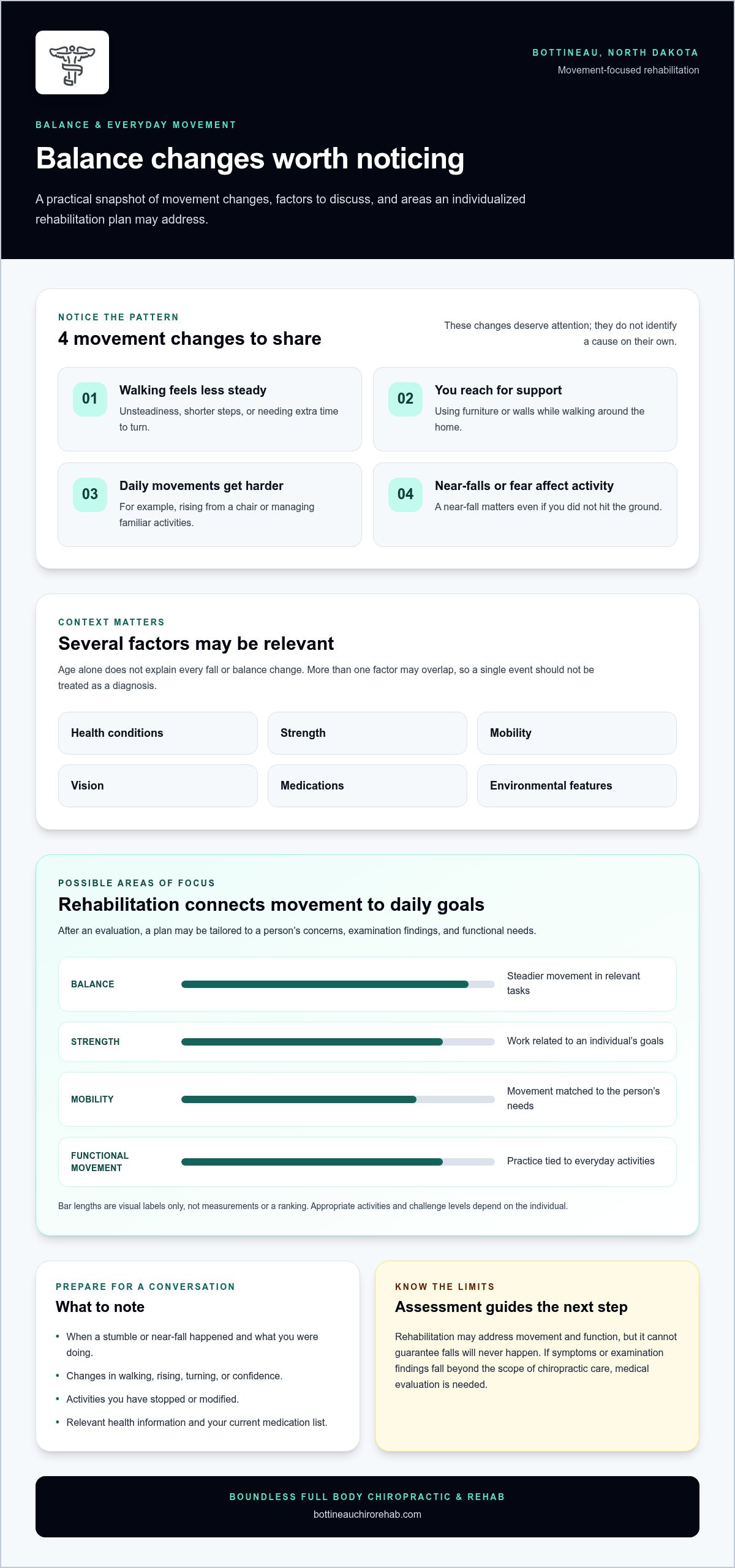
- Feeling unsteady, taking shorter steps, or needing extra time to turn.
- Using furniture or walls for support while walking around the home.
- Having more difficulty rising from a chair or managing familiar daily movements.
- Experiencing near-falls or becoming increasingly afraid to move around.
Share what you notice, when it happens, and which activities feel different. These details help frame a conversation without assuming that one symptom points to a specific condition.
Which changes in balance or movement should prompt a conversation?
Consider discussing a change when it persists, recurs, or starts affecting everyday choices. You might avoid carrying laundry because turning feels uncertain, or pause before stepping off a curb. A near-fall matters even if you didn’t hit the ground. So does growing fear that keeps you from moving as freely as you’d like. A fall prevention physical therapy ND conversation can help you explore whether an evaluation of movement and function is a reasonable next step.
Is falling an unavoidable part of getting older?
No. Age alone doesn’t explain every fall or change in balance. Health conditions, strength, mobility, vision, medications, and environmental features may all be relevant, and several factors can overlap. A single event shouldn’t be used to diagnose the cause or dismissed as “just aging.” If instability keeps returning or familiar movements become harder, seek a timely assessment.
Keep a simple record before the conversation. Note when a stumble or near-fall occurred, what you were doing, and whether anything felt different. Describe changes in walking, rising, turning, or confidence, along with activities you’ve stopped or modified. Bring relevant health information and a current medication list. This context can help a clinician decide whether movement-focused rehabilitation is appropriate or whether findings call for medical evaluation beyond chiropractic care.
How Physical Therapy May Support Balance, Strength, and Safer Movement
Movement-focused rehabilitation starts with the person, not a standard fall-prevention routine. The aim is to understand how balance, strength, mobility, and everyday movement relate to the individual’s concerns and functional needs. After an evaluation, physical therapy may focus on daily goals, such as moving between sitting and standing or feeling steadier while changing direction. These are possible areas of focus, not promised outcomes.
Depending on examination findings and a person’s needs, a plan may include balance tasks, strengthening, mobility work, or practice of functional movements. One person’s goal might be managing a turn during a household task; another may want to work on a movement that has become difficult. Appropriate activities and challenge levels depend on the individual, so a general article shouldn’t be treated as a personalized exercise prescription.
What might an individualized rehabilitation plan address?
Connect the concern to a useful function goal. Is standing up difficult? Is it walking across a room or moving through a familiar routine? That context helps identify which movement areas deserve attention. A rehabilitation plan may work on balance, strength, or mobility in ways related to those goals. It should reflect the person’s presentation, rather than rely on a one-size-fits-all list of exercises.
General education can offer ideas about movement and healthy activity, but it can’t determine which exercises are appropriate for a particular person or explain the cause of a balance change. The National Council on Aging Falls Prevention Resources provides broader fall-prevention information. Individual exercise recommendations call for an evaluation that considers the person’s needs and findings.
Why does an evaluation matter before choosing exercises?
Similar concerns can have different contributing factors. Feeling unsteady doesn’t by itself reveal why balance has changed or whether rehabilitation is the right next step. An evaluation makes the conversation more specific: which movements are difficult, what functions matter, and what care is appropriate?
At Boundless Full Body Chiropractic & Rehab in Bottineau, physical therapy and rehabilitation focus on movement and function. A consultation and examination help discuss your concerns and determine fit and next steps. If findings fall beyond the scope of chiropractic care, medical evaluation is needed. Rehabilitation can be one part of a person’s care, but it isn’t a substitute for medical assessment when symptoms or examination findings call for it.
If you’re considering fall prevention physical therapy ND, use an evaluation to understand the options rather than expecting a preset program. A conversation about physical therapy and rehabilitation in Bottineau can help clarify how movement goals may fit your needs and whether medical evaluation should come first.
Physical Therapy or Home Exercises: How to Choose the Right Next Step
Home adjustments and general exercise advice can be useful, but they answer different questions. Clearing walkways may reduce an environmental obstacle. It can’t explain why your balance has changed or tell you which exercises fit your needs. If unsteadiness keeps returning, near-falls occur, or daily movement becomes harder, consider a clinical conversation rather than relying on general tips alone.
Use this comparison as a starting point, not a diagnosis:
| Option | May be useful for | What it cannot determine |
|---|---|---|
| General home-safety steps | Noticing obstacles, improving lighting, and keeping common walkways clear. | Whether a personal balance change has a health or movement-related cause. |
| Supervised rehabilitation | Discussing recurring movement difficulty and exploring goals based on an individual evaluation. | Whether symptoms need medical assessment beyond the rehabilitation provider’s scope. |
| Medical evaluation | Assessing unexplained or concerning changes, especially when symptoms are sudden or worsening. | A specific cause cannot be assumed from a fall or symptom alone. |
When may general home-safety steps be a useful starting point?
Look around the spaces you use most. Keep walkways clear, check that lighting is adequate, and notice obstacles such as loose items or clutter near a regular route. These are sensible general steps, but they don’t eliminate every fall risk or replace assessment if instability or movement difficulty persists.
When should a person seek clinical or medical evaluation?
Recurring unsteadiness, near-falls, or new limits in everyday movement are good reasons to discuss your concerns with a clinician. A fall by itself doesn’t reveal its cause, and it shouldn’t automatically be attributed to weakness or poor balance. Describe what happened and what has changed to help guide an appropriate next step.
Supervised rehabilitation may be relevant when an evaluation indicates that movement and function goals are appropriate for care. In Bottineau, Boundless Full Body Chiropractic & Rehab offers physical therapy and rehabilitation focused on function and movement. A consultation and examination can help discuss your concerns and determine fit and next steps. If findings exceed the scope of chiropractic care, medical evaluation is needed.
Don’t treat urgent or unexplained symptoms as routine exercise concerns. Sudden or severe changes, or symptoms that are worsening, warrant prompt medical evaluation. If you’re unsure whether a recurring movement concern calls for rehabilitation or another kind of assessment, describe the pattern, its timing, and how it affects daily activities. That information can make the next conversation more focused and useful.
Preparing for a Fall-Prevention Rehabilitation Conversation in Bottineau
You don’t need to arrive with a diagnosis or a perfect account of what happened. A few clear observations can make a conversation about balance and movement more useful. The goal is to describe your experience, not prove what caused it. Don’t postpone medical evaluation for concerning symptoms just to collect more details.
What details help explain a fall or near-fall?
Before your visit, jot down what you remember. Note when the event happened, what you were doing, and whether you noticed symptoms afterward. Add recurring changes, such as feeling less steady during turns, or tasks that have become harder. Include daily activities you’ve adjusted or avoided. These details help explain how movement concerns affect your routine.
- Incident: Record the date or approximate time and what was happening.
- Movement: Describe the action involved, such as standing, turning, or walking.
- Effect: Note any symptoms, repeated episodes, or changes to daily activities.
Bring relevant health information and a current medication list, if available. Don’t change or stop medication based on a fall or balance concern without guidance from the appropriate healthcare professional. If symptoms are urgent, sudden, or otherwise concerning, seek medical evaluation promptly rather than waiting to prepare notes for a routine rehabilitation conversation.
What should patients expect from the first discussion?
The first step is a conversation about your concerns and an examination. You don’t have to know whether the issue comes from balance, strength, or something else. At Boundless Full Body Chiropractic & Rehab in Bottineau, the $47 new-patient special includes a consultation and examination to determine fit and next steps. Recommendations depend on the findings and your needs, so don’t assume a particular therapy, timeline, or outcome in advance.
Keep exercise guidance general until your individual needs and examination findings are understood. A movement that seems straightforward for one person may not fit another person’s situation. Discussing your concerns helps make the next step more informed, whether that means considering movement-focused rehabilitation or recognizing that medical evaluation is appropriate when findings exceed the scope of chiropractic care.
To make your notes easy to use, organize them around three questions: What happened? What movement feels different now? Which daily activities are affected? Brief answers can help keep the conversation focused. If someone helps you with daily activities or witnessed an incident, their observations may also help clarify what changed.
Ready to discuss your movement concerns and possible next steps? Schedule a consultation and examination in Bottineau with Boundless Full Body Chiropractic & Rehab.
Fall-Related Rehabilitation in Bottineau: How Boundless Can Help You Start
If balance concerns are affecting how you move through your day, a local conversation can help clarify possible next steps. Boundless Full Body Chiropractic & Rehab provides physical therapy and rehabilitation in Bottineau, North Dakota. Care is conservative, non-invasive, and focused on movement and function. Recommendations follow an evaluation, so your concerns and findings guide the next step rather than a preset plan.
What Boundless offers for movement and rehabilitation concerns
Physical therapy, rehabilitation, and whole-body chiropractic care can be considered in relation to your movement and function needs. A consultation and examination help determine whether care at the clinic is a fit and what next steps are appropriate. The clinic helps patients recover from injuries, avoid surgery, and get back to work, sports, and life. These are goals of care, not guaranteed outcomes, and fall-risk reduction isn’t promised.
The $47 new-patient special includes a consultation and examination to determine fit and next steps. It gives you a place to discuss what feels different, how movement concerns affect your routine, and what the evaluation indicates. If findings exceed the scope of chiropractic care, medical evaluation is needed. This helps keep recommendations focused on appropriate care rather than treating every balance concern as a rehabilitation issue.
For readers looking into fall prevention physical therapy ND, Boundless offers a local starting point for discussing movement and function. Recommendations are based on your evaluation, and medical evaluation is needed when symptoms or findings call for care beyond chiropractic.
How to contact the Bottineau clinic
Boundless is located at 116 E. 6th St., Bottineau, ND 58318. Call or text (701) 566-0666. Office hours are:
- Tuesday, 9:00 AM to 6:00 PM
- Wednesday, 9:00 AM to 4:00 PM
- Thursday, 9:00 AM to 6:00 PM
- Friday, 9:00 AM to 6:00 PM
- Saturday, 9:00 AM to 1:00 PM
- Sunday and Monday, closed
The clinic is in Bottineau, North Dakota. Readers in Bottineau, Rugby, Rolla, Rollette, Dunseith, St. John, Sherwood, Mohall, Willow City, Lake Metigoshi, Belcourt, Kenmare, Minot, and Velva can find the practice at its Bottineau location.
Keep the first conversation straightforward. Explain that you’ve noticed a change in balance or movement and want to understand whether an evaluation may help identify appropriate next steps. You don’t need to arrive with a diagnosis or decide in advance which care you need. If your concern is beyond chiropractic care, medical evaluation is the appropriate direction.
Take a practical next step in Bottineau: call or text Boundless to discuss a consultation.
Take the Next Step Toward More Confident Movement
Unsteadiness can make ordinary activities feel uncertain, but you don’t have to figure out the cause or the right care on your own. Share what you’ve noticed and discuss whether an evaluation makes sense. The aim isn’t to promise that falls can be prevented. It’s to make informed decisions about movement, function, and support that fits your needs.
For fall prevention physical therapy ND, choose a conversation that starts with your concerns and recognizes when medical evaluation is needed. Dr. Daniel Pozarnsky brings more than 20 years of chiropractic experience to care in Bottineau. If you’re ready to talk through your next step, schedule a consultation with Boundless in Bottineau.
Start with a clear description of what feels different. A practical plan can begin with that conversation, with next steps guided by your needs.
Frequently Asked Questions
Can physical therapy help prevent falls?
Physical therapy may address movement needs related to balance, strength, and functional mobility, which can be relevant to fall risk. The right focus depends on the person’s needs and evaluation findings. No plan can guarantee that someone will avoid falls. An evaluation can help clarify appropriate next steps. When findings exceed chiropractic care, medical evaluation is needed.
Is falling a normal part of aging?
No. A fall shouldn’t be dismissed as inevitable just because someone is older. Balance or mobility changes may have several contributing factors, and age or a symptom alone can’t identify the cause. If unsteadiness keeps happening or affects a routine activity, discuss the change with a qualified clinician. When findings call for care beyond chiropractic scope, seek medical evaluation rather than assuming rehabilitation alone is the answer.
What happens during a fall-prevention physical therapy evaluation?
A clinician may ask about falls or near-falls, movement concerns, and activities that have become difficult, then use examination findings to guide next steps. You don’t need to identify the cause yourself. Boundless’s $47 new-patient special includes a consultation and examination to determine fit and next steps. The discussion can help clarify whether movement-focused care is appropriate or whether medical evaluation is needed.
Can balance improve with rehabilitation exercises?
Rehabilitation exercises may address balance, strength, and functional movement when those goals fit the person’s needs. Results vary, and no particular improvement can be promised. Exercises should be selected based on examination findings, not copied from a universal routine. A movement that feels manageable for one person may not suit someone with different symptoms or limitations. New or concerning symptoms may require medical evaluation.
Should I seek help after a near-fall even if I was not injured?
A near-fall can be useful information, particularly if unsteadiness recurs or begins to change how you manage daily activities. Note what you were doing and whether similar moments have happened before, then discuss the pattern with a clinician. A near-fall doesn’t automatically mean a serious condition is present. If findings exceed the scope of chiropractic care, medical evaluation is needed to guide appropriate care.
Does Boundless offer fall-prevention physical therapy in Bottineau, ND?
Boundless offers physical therapy and rehabilitation in Bottineau, with recommendations guided by consultation and examination findings. The $47 new-patient special includes a consultation and examination to determine fit and next steps. Care focuses on individual movement and function needs. Outcomes aren’t guaranteed, and medical evaluation is needed if findings exceed the scope of chiropractic care.
How do I contact Boundless Full Body Chiropractic & Rehab in Bottineau?
Visit Boundless at 116 E. 6th St., Bottineau, ND 58318, or call or text (701) 566-0666. Hours are Tuesday 9:00 AM to 6:00 PM, Wednesday 9:00 AM to 4:00 PM, Thursday and Friday 9:00 AM to 6:00 PM, and Saturday 9:00 AM to 1:00 PM. The clinic is closed Sunday and Monday. Call or text to take a local next step.


