

Are recurring aches a reason to seek an adjustment, or a signal that something deserves a closer look? The signs you need a chiropractic adjustment aren’t proof that an adjustment is right for you. Ongoing back or neck discomfort, stiffness, limited movement, or recurring headaches may be reasons to seek an assessment, especially when symptoms affect everyday activities.
It can be hard to tell whether discomfort will ease on its own or worsen if you ignore it. An assessment can help identify what may be contributing to your symptoms and whether chiropractic care, rehabilitation, or another next step is appropriate. This checklist explains which common symptoms may warrant an evaluation, which warning signs call for urgent medical attention, and what details to share during an appointment.
Tracking symptom duration, triggers, and changes in movement can help inform an assessment without requiring you to diagnose yourself. In Bottineau, Boundless Full Body Chiropractic & Rehab provides chiropractic care, physical therapy, and rehabilitation. The next step should reflect your needs, not the assumption that every ache calls for an adjustment.
Key Takeaways
- The signs you need a chiropractic adjustment can be reasons to seek an assessment, but symptoms alone don’t determine which care is appropriate.
- Recurring discomfort, stiffness, and changes in comfortable movement are worth paying attention to, especially when they affect daily activities.
- Severe, worsening, unexplained, or persistent symptoms may call for professional evaluation rather than an adjustment.
- Track when symptoms began, where you feel them, what changes them, and how they affect your routine to help guide an assessment.
- Boundless Full Body Chiropractic & Rehab in Bottineau provides chiropractic care, physical therapy, and spinal rehabilitation.
What Does a Chiropractic Adjustment Do, and What Signs Can It Address?
Pain, stiffness, or a change in how easily you move can disrupt everyday tasks and leave you wondering what to do next. It’s reasonable to look for clues, but discomfort alone can’t tell you what’s causing it or whether an adjustment is the right response.
A chiropractic adjustment is a technique a chiropractor applies to selected joints, with the aim of addressing joint movement. It’s one possible part of care, not a diagnosis or a guaranteed solution. The broader practice of Chiropractic includes different approaches, so the specific method and purpose depend on an individual assessment.
What happens during a chiropractic adjustment?
A chiropractor uses controlled techniques on selected joints. A spinal adjustment focuses on joints in the spine, while other care may involve joints outside the spine, such as those in an arm or leg. The location and approach depend on your symptoms and clinical assessment. An adjustment isn’t a routine step for every ache. First, the clinician needs to understand what you’re experiencing and whether this type of care may fit.
Why symptoms are clues, not a diagnosis
Similar symptoms can have different causes. Neck stiffness, for example, may follow prolonged positioning or physical strain, while discomfort in the same area may have another explanation. A headache or a change in posture also doesn’t automatically mean a joint is involved. Symptoms are clues that help guide questions and evaluation, not proof of a specific problem.
Symptoms can prompt an assessment, but they can’t identify the right treatment on their own. A checklist can help you decide whether to seek advice, but it can’t determine what care you need.
An assessment connects what you feel with what may be appropriate. A clinician can ask when symptoms began, where they occur, what seems to change them, and how they affect movement or daily routines. They may also review relevant health history and examine your movement before discussing possible next steps.
This process can help clarify whether chiropractic care is a reasonable option or whether another response is more suitable. If symptoms are persistent, worsening, or difficult to explain, an evaluation can help you make a more informed decision than guessing from a symptom list.
As you read the signs below, treat each one as a reason to pay attention, not a verdict. Notice the pattern, consider its impact, and bring useful details to an assessment. Care should fit the person and the findings, not just the symptom’s name.
Checklist: 7 Signs You May Benefit from a Chiropractic Evaluation
These signs are reasons to consider an assessment, not proof that you need an adjustment. The Mayo Clinic’s overview of chiropractic adjustment explains the procedure and why it may be used. A qualified professional can help determine whether chiropractic care fits your symptoms and circumstances.
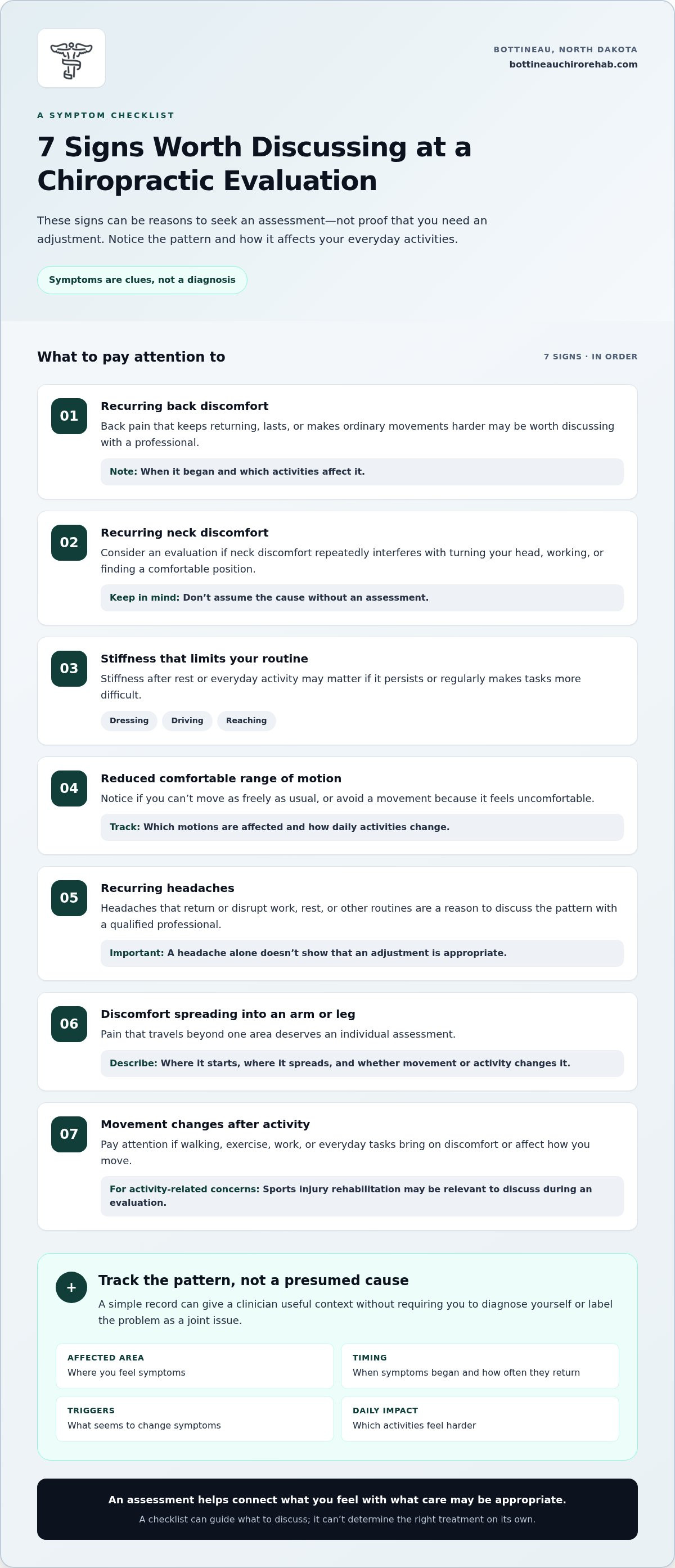
- Recurring back discomfort. Back pain that keeps returning, lasts, or makes ordinary movements harder may be worth discussing with a professional. Note when it began and which activities affect it.
- Recurring neck discomfort. If neck discomfort repeatedly interferes with turning your head, working, or finding a comfortable position, consider an evaluation. Don’t assume the cause without an assessment.
- Stiffness that limits your routine. Stiffness after rest or everyday activity may matter if it persists or regularly makes tasks such as dressing, driving, or reaching more difficult.
- Reduced comfortable range of motion. If you can’t move as freely as usual, or avoid a movement because it feels uncomfortable, note which motions are affected and how that changes your daily activities.
- Recurring headaches. Headaches that return or disrupt work, rest, or other routines are a reason to discuss the pattern with a qualified professional. A headache alone doesn’t show that an adjustment is appropriate.
- Discomfort spreading into an arm or leg. Pain that travels beyond one area deserves an individual assessment. Describe where it starts, where it spreads, and whether movement or activity changes it.
- Movement changes after activity. If walking, exercise, work, or everyday tasks bring on discomfort or affect how you move, pay attention to the pattern. For activity-related concerns, sports injury rehabilitation may be relevant to discuss during an evaluation.
Track the pattern, not a presumed cause
Keep a simple record of the affected area, when symptoms began, how often they return, possible triggers, and which activities feel harder. This gives a clinician useful context without requiring you to label the problem as a joint issue or “misalignment.”
Symptoms in the hands, feet, or other areas outside the spine can also affect grip, balance, or comfortable movement. An assessment can help determine what kind of care may fit. Extremity adjusting is one option to discuss when those joints are involved.
The phrase “signs you need a chiropractic adjustment” can sound conclusive, but a checklist can’t decide treatment. If recurring symptoms are changing how you move or manage daily tasks, consider arranging an evaluation. In Bottineau, a chiropractic evaluation in Bottineau is a practical way to discuss your concerns and individual needs.
When Symptoms Do Not Mean You Need an Adjustment
A symptom on a checklist is a reason to pay attention, not an instruction to get adjusted. Back discomfort, stiffness, headaches, or restricted movement can have different causes and may call for different responses. Even if a symptom seems related to a joint, that alone doesn’t establish what’s happening or which care is appropriate.
Take worsening, severe, unexplained, or persistent symptoms seriously. A professional evaluation can help determine whether chiropractic care may fit or whether another kind of medical assessment is more appropriate. The National Library of Medicine’s overview of chiropractic care describes the broader context of chiropractic and related approaches. Choose care based on your situation, not on a symptom list alone.
Symptoms that call for urgent medical attention
Some changes need urgent medical attention, not a routine chiropractic appointment. Seek emergency medical assessment for sudden weakness, significant new loss of sensation, or a new loss of bladder or bowel control. These symptoms can indicate a serious problem. Don’t wait to see whether an adjustment helps.
- Sudden weakness in an arm or leg
- Significant, new loss of sensation
- Loss of bladder or bowel control
- Severe symptoms or symptoms that are rapidly getting worse
If any of these occur, seek emergency care now. If symptoms feel severe or change quickly, treat the situation as urgent rather than trying to decide whether it belongs on a chiropractic checklist. Emergency evaluation is separate from deciding whether to book a routine appointment.
When an adjustment may not be the right next step
An adjustment isn’t automatically suitable for every person or symptom. Health history and an examination help a clinician understand what may be safe and appropriate. Share relevant diagnoses, previous injuries or procedures, and any recent changes in your health. These details can affect a care plan, even when the symptom itself sounds familiar.
The right next step depends on your symptoms, health history, and examination. That may mean discussing chiropractic care, considering another approach, or seeking medical evaluation first. You don’t need to identify the cause yourself. Focus on describing what has changed and how it affects you.
If symptoms are ongoing but not urgent, note when they began, whether they’re getting better or worse, and which daily activities they limit. Then arrange an appropriate evaluation. In Bottineau, a chiropractic assessment can help you discuss your concerns and consider a suitable next step. If urgent warning signs are present, seek emergency medical care instead.
How to Decide Whether to Book a Chiropractic Assessment
Uncertainty doesn’t have to keep you stuck. Use a simple process: check for urgent warning signs, record what you’ve noticed, consider how symptoms affect your routine, then arrange an appropriate evaluation if needed. This helps you share clear information without trying to diagnose yourself or deciding in advance that an adjustment is the answer.
- Assess urgency. If symptoms are severe or rapidly worsening, or you have sudden weakness, significant loss of sensation, or loss of bladder or bowel control, seek urgent medical care. Don’t wait for a routine appointment.
- Write down the pattern. Note when symptoms began, where they occur, how often they return, and whether they’re changing over time. Record what seems to aggravate or ease them.
- Consider the impact. Think about whether discomfort affects sleep, work, walking, exercise, or family routines. The effect on your day can help explain why you’re seeking care.
- Arrange an evaluation. If symptoms are persistent, recurring, or interfering with normal activities, discuss them with a qualified professional. An assessment helps determine whether chiropractic care or another approach may be appropriate.
What to record before seeking care
A short note on your phone or paper is enough. Include the affected area, when the issue started, how frequently it occurs, how intense it feels, and whether it has improved, worsened, or stayed about the same. Add specific examples, such as discomfort after a certain movement or stiffness that makes walking, lifting, or sitting through work harder.
Also list relevant health history, previous injuries, past procedures, and current concerns. Include changes you’ve noticed, even if you’re unsure whether they’re connected. These details give the clinician useful context and can help keep the conversation focused on your needs.
Questions to raise during an evaluation
You can ask what the examination suggests, which care options may be appropriate, and why. Before treatment, discuss expected benefits, potential risks, and alternatives. It’s reasonable to ask how progress will be reviewed and when the care plan should be reconsidered if symptoms don’t change as expected or your needs shift.
An assessment should guide the decision, not simply confirm a choice you’ve already made. Share what you’ve recorded, ask for clear explanations, and speak up if you have concerns. The signs you need a chiropractic adjustment may prompt you to book, but a clinician’s evaluation helps determine whether an adjustment or another response fits.
If recurring symptoms are affecting your daily life, schedule a chiropractic assessment with Boundless Full Body Chiropractic & Rehab in Bottineau to discuss a suitable next step.
Chiropractic Adjustment in Bottineau: A Supportive Next Step
Recognizing a symptom is a useful start. Deciding what to do about it takes a closer look at your movement, concerns, and health history. Boundless Full Body Chiropractic & Rehab provides chiropractic care and rehabilitation in Bottineau, North Dakota. An assessment gives you an opportunity to discuss what’s bothering you and consider what type of care may fit. A checklist isn’t a diagnosis, and it doesn’t mean an adjustment is automatically needed.
How Boundless approaches symptoms and movement concerns
Bring the details that matter to you: where you feel discomfort, which movements are difficult, and how symptoms affect work, exercise, or daily routines. That conversation connects your concerns to your personal goals and helps focus on an appropriate next step.
Boundless provides full-body and extremity adjustments, physical therapy, spinal rehabilitation, and sports injury rehabilitation. These are care options, not a prescribed package for everyone. Depending on the assessment, one approach or a combination may be discussed. The goal is an informed decision based on your circumstances, not the assumption that every ache calls for an adjustment.
If symptoms followed a change in activity or are affecting how you move, mention that context. Explain what you were doing when the discomfort began and which tasks you’ve changed or avoided since. Clear details make the conversation more useful and keep it focused on what matters to you.
A local next step for Bottineau-area readers
You don’t need to arrive with a diagnosis or a firm decision about treatment. Bring your questions, describe what you’ve noticed, and discuss appropriate options. If you’re still exploring the signs you need a chiropractic adjustment, remember that symptoms can guide a conversation, while an individual assessment helps inform the care decision.
Boundless offers a $47 new patient introductory special. Learn about the practice’s care options and decide whether an evaluation is the right next step for you.
Explore chiropractic care at Boundless
Choose Your Next Step With Confidence
Noticing possible signs you need a chiropractic adjustment can raise a practical question: what kind of care fits your situation? You don’t have to decide based on a checklist alone. An assessment can help turn uncertainty into a clearer conversation about your concerns, your goals, and the options that may suit you.
You’re also allowed to ask questions and take time to understand a proposed plan. A useful next step reflects your individual needs and leaves room to review how things are going. Your symptoms matter, but they don’t have to dictate a treatment choice before you’ve had a chance to discuss them with a professional.
When you’re ready to explore care in Bottineau, explore chiropractic care at Boundless. A thoughtful conversation can help you move forward with more confidence and a clearer understanding of your options.
Frequently Asked Questions
How do I know if I need a chiropractic adjustment?
You can’t determine that from symptoms alone. Recurring discomfort or difficulty moving may be a reason to seek an assessment, but the signs you need a chiropractic adjustment don’t confirm that an adjustment is right for you. Consider whether the issue affects a specific activity, such as turning to check your blind spot or lifting a bag. Share that example with a qualified professional to discuss suitable care options.
Can you need a chiropractic adjustment without being in pain?
Not having pain doesn’t automatically mean you need an adjustment. You might notice stiffness, reduced movement, or a change in how you perform an activity without feeling pain. Discuss those observations during an evaluation, especially if they’re new or affecting your routine. The purpose is to understand what you’ve noticed and whether any care is appropriate, not to seek an adjustment simply because movement feels different.
Is neck pain a sign that I need a chiropractic adjustment?
Neck pain may be a reason to discuss your symptoms with a qualified professional, but it doesn’t prove you need an adjustment. Note whether it began after a particular activity, whether turning or looking up feels limited, and whether the discomfort is changing. Be specific about what you can and can’t do comfortably. An assessment can help determine whether chiropractic care is suitable or another response makes more sense.
Can headaches mean you should see a chiropractor?
Recurring headaches can be worth discussing with a healthcare professional, but they don’t automatically call for chiropractic care. Keep track of how often they occur, how long they last, and whether you’ve noticed a pattern around sleep, activity, or other circumstances. Describe any changes from your usual headache pattern. That context helps guide the conversation without assuming that a headache comes from the neck or joints.
Are chiropractic adjustments safe for everyone?
No single approach is appropriate for everyone. Health history and an examination matter when deciding whether an adjustment is suitable and what technique, if any, to consider. Tell the clinician about relevant diagnoses and past health concerns. For example, conditions such as severe osteoporosis or spinal cancer may require particular caution and professional judgment. Ask about potential risks and alternatives before deciding whether to proceed.
When should I seek medical care instead of a chiropractic adjustment?
Seek urgent medical care for sudden weakness, significant new loss of sensation, loss of bladder or bowel control, or severe or rapidly worsening symptoms. These signs need urgent assessment rather than a routine chiropractic appointment. If you’re unsure whether a symptom is an emergency, choose prompt medical evaluation. Don’t delay urgent care to see whether an adjustment changes the symptoms.
What should I tell a chiropractor before an adjustment?
Describe the concern in your own words, including when it began, where you feel it, what affects it, and how it changes your routine. Share relevant health history, previous injuries, and any concerns about treatment. You can also ask what the examination suggests, what options are available, and how progress will be reviewed. Boundless Full Body Chiropractic & Rehab serves Bottineau, Rugby, Rolla, Rollette, Dunseith, St. John, Sherwood, Mohall, Willow City, Lake Metigoshi, Belcourt, Kenmare, Minot, and Velva. To discuss your concerns and explore care, contact Boundless Full Body Chiropractic & Rehab.


