

What if protecting your back starts before you bend down? A box that feels manageable can become harder to control when it’s awkward, held far from your body, or lifted in a hurry. If you’re wondering how to lift properly to avoid back injury, you’re not alone. Everyday lifting advice can sound contradictory, especially when it comes to squatting, bending, and keeping your back straight.
Your concern makes sense. A single lift can feel like a big risk when you’ve had back pain before, but safer lifting is a sequence, not one perfect posture. Prepare the load and your path, keep the object close, avoid twisting while carrying it, and set it down with control.
This guide walks you through each step, from deciding whether to lift alone to carrying awkward objects and adjusting your form for gym exercises. You’ll also learn when to stop rather than push through pain, and when persistent symptoms or trouble with everyday movement deserve a clinical evaluation. Practical habits can help you move with more confidence, without promising that any technique can prevent every injury.
Key Takeaways
- Learn how to lift properly to avoid back injury with a simple sequence that adapts to the object and task.
- Use a quick pre-lift check to assess the load, grip, route, and destination before committing.
- Adjust your approach for household chores, work tasks, and gym weights to reduce repeated reaching and awkward movement.
- Know when pain, weakness, or loss of control means you should stop rather than continue lifting.
- Recognize when ongoing pain or difficulty with everyday movement may warrant a clinical evaluation.
Why Proper Lifting Matters: Reduce Back Strain Without Expecting a Guarantee
If you’ve had back pain before, picking up a laundry basket or shifting a box can feel risky. That worry is understandable. Proper lifting isn’t about finding one perfect pose or keeping your back rigid. It means planning the task, positioning the load sensibly, and controlling how you move it. These choices may reduce avoidable strain, but they can’t remove every risk or guarantee that an injury won’t happen.
Back strain can have different causes, and lifting heavy objects is one factor discussed in this Back Strain overview. A single controlled lift is different from repeatedly moving heavy, awkward items, especially when you’re tired or rushing. Repetition leaves less time to recover between efforts. An awkward grip or a load held away from your body can make each movement more demanding. Consider the whole task, not just the weight.
How lifting position changes the demand on your back
Holding a load farther from your body increases the leverage your muscles must manage. A light object held at arm’s length may feel harder to control than the same object held close. That doesn’t mean one position automatically causes an injury. It does mean you can often make a lift easier to manage by stepping closer and keeping the object near your midsection.
Your hips and knees bend as your legs help you rise, while your trunk helps steady your body and the load. These parts work together. You don’t need to force an exaggerated squat or maintain a perfectly straight back. Choose a balanced stance and a comfortable range of motion, then move smoothly. If you have to twist, reach far, or strain to keep the object steady, adjust the setup or get help instead of forcing the lift.
Why the same object can feel different to lift
Weight is only one part of handling. A wide box may block your view or force your arms apart. A slippery, tiny, or poorly placed handhold can make an object hard to secure. Contents that shift can throw off your balance. Before lifting, consider whether you can see where you’re going, hold the object securely, and keep it close as you move.
The task matters, too. Carrying one item across a clear room is different from moving repeated loads through a cluttered space. Fatigue can make it harder to coordinate movement, while obstacles can force sudden turns or extra reaching. Clear the route, move supplies closer where practical, or break up repeated tasks with a change of activity.
Load position and task setup both matter: bring the object closer and make the movement easier to control. That practical principle is a useful starting point for how to lift properly to avoid back injury, without treating any single technique as a guarantee.
Before You Lift: Assess the Load, Clear Your Route, and Make a Plan
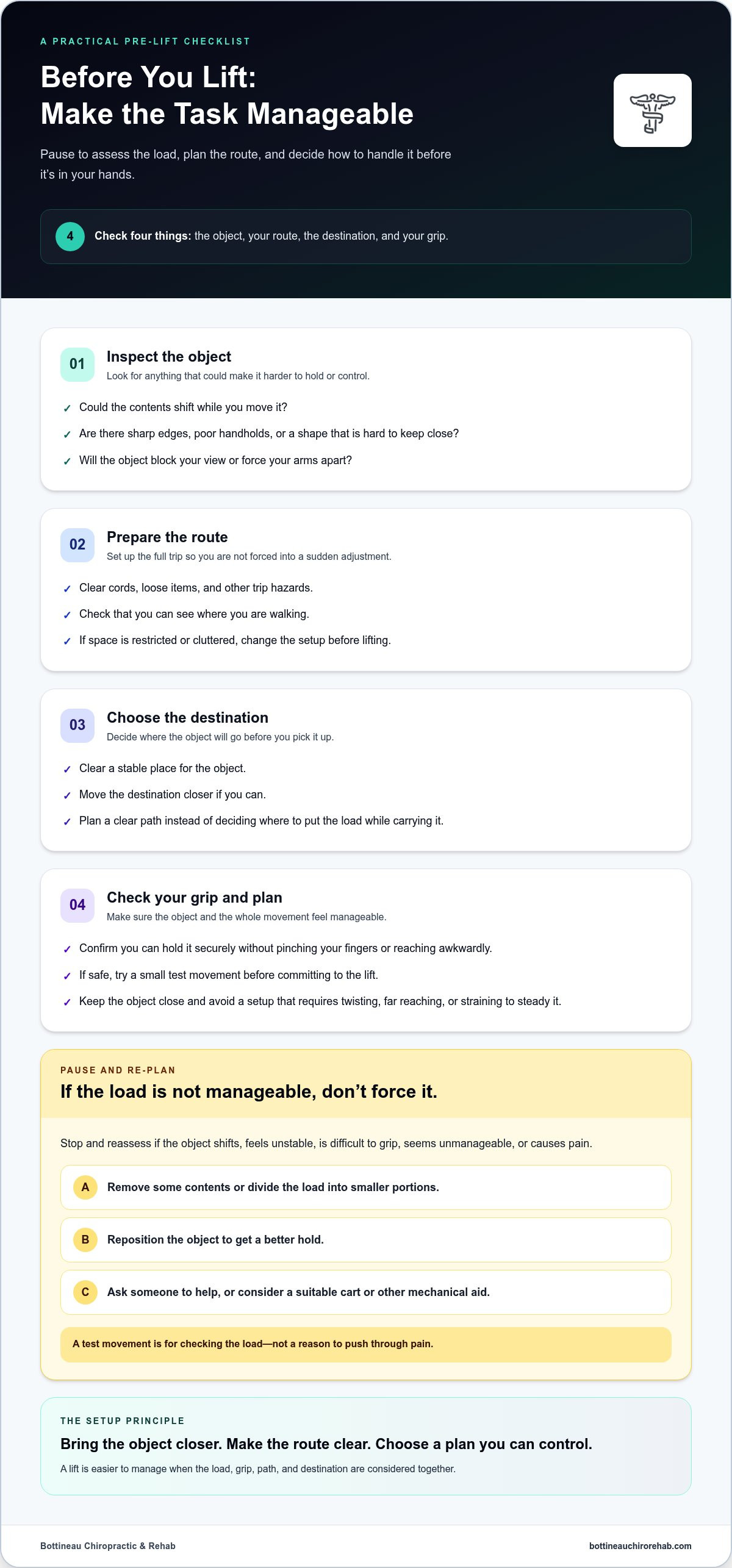
A safer lift starts with a pause. Before you pick anything up, check what you’re moving, where it needs to go, and whether you can manage the full trip without rushing. A box that seems manageable at rest may become difficult if its contents shift, your grip slips, or the destination is across a cluttered room.
Use this quick check:
- Object: Look for shifting contents, sharp edges, poor handholds, or a shape that’s hard to hold close.
- Route: Clear cords, loose items, and other trip hazards. Make sure you can see where you’re walking.
- Destination: Decide where the object will go and clear a stable place for it before lifting.
- Grip: Check that you can get a secure hold without pinching your fingers or reaching awkwardly.
Check the object and the path first
Don’t start carrying and then decide where to put the load. Move the destination closer if you can, or plan a clear route to it. For a bulky item that blocks your view, consider whether you can change your hold or move it another way. A suitable cart or other mechanical aid may help with a load that’s difficult to carry safely by hand.
MedlinePlus also recommends assessing a load and planning the movement before lifting. Its proper lifting guidance covers practical steps such as using a stable base and avoiding twisting. The goal is to set up the task so you’re not forced to make a sudden adjustment once the object is in your hands.
Decide whether to lift, split, or get assistance
If it’s safe, try a small test movement before committing to a full lift. Stop if the load shifts, feels unstable, is difficult to grip, or seems unmanageable. Don’t use a test as a reason to push through pain. Reassess instead: remove some contents, divide the load into smaller portions, reposition it for a better hold, or ask someone to help.
Restricted space matters, too. If there isn’t room to get close or move without bumping into obstacles, change the setup before lifting. Help from another person or a suitable mechanical aid may be a better choice than attempting a difficult solo carry. If recurring lifting tasks are affected by pain or reduced function, an evaluation at Boundless Full Body Chiropractic & Rehab in Bottineau can help assess your movement and appropriate next steps.
Pause and change the plan if the load is unstable, hard to grip, awkward to move, painful, or blocked by a cluttered route. A clear destination can also prevent a rushed carry or last-second turn. Once the route and load are manageable, you’re ready to move through the lift with control.
How to Lift and Set Down an Object: A Controlled Step-by-Step Method
Once the load and route are manageable, move through the lift as one connected task. Your hips and knees can bend in different combinations depending on the object, your body, and the space available. You don’t need to force a deep squat or hold your back in a stiff, unnatural position. Aim for a stable stance, a secure grip, and smooth movement within a comfortable range.
- Approach the object. Stand close enough to reach it without stretching your arms far forward. Position your feet for balance, with room to move.
- Set your grip. Hold the object securely. If it has handles, use them; if not, choose a hold that feels stable and keeps your fingers clear of pinch points.
- Bend to reach. Let your hips and knees bend as needed. Keep the object near your body rather than reaching down and pulling it toward you from a distance.
- Get ready to move. Check that your stance feels balanced and the load hasn’t shifted. Breathe normally. Don’t hold your breath or jerk the object upward.
- Rise smoothly. Push through your feet and let your legs, hips, and trunk work together. Keep the load close as you stand, moving only as far as feels controlled.
- Carry and turn with your feet. Keep the object near your midsection and your route in view. To change direction, take small steps and pivot instead of twisting your trunk under load.
- Set it down with control. Get close to the destination, bend your hips and knees comfortably, and lower the load steadily. Place it securely before releasing your grip.
Lifting from the floor or a low surface
Start by bringing your feet into a stable position and moving close enough to reach without overextending. Bend your hips and knees in a combination that suits the height of the object and feels comfortable. Secure the load near your body, then stand smoothly. If you can’t rise without pulling, losing balance, or straining, pause and change the task rather than forcing the movement.
Carrying, turning, and setting the load down
Before walking, make sure the load doesn’t block your view. Take steady steps and keep it close, rather than carrying it with your arms stretched out. If you need to turn, step and pivot so your feet and body change direction together. At the destination, move close before lowering the object. Avoid reaching across a surface or twisting to place it.
A controlled lift is close, balanced, and unhurried. If the object shifts or the movement stops feeling steady, set it down if you can do so safely, then reassess. There’s no single squat depth that fits every lift. To learn how to lift properly to avoid back injury, choose a comfortable movement you can control from the first reach through the final set-down.
Adapt Proper Lifting Technique to Work, Home, and Gym Tasks
The same lifting principles apply across settings, but the challenge changes with the task. A grocery bag has a different grip from a box on a high shelf. A gym weight has a predictable shape, but picking it up and returning it safely still takes attention. Adapt your position to the object and surroundings instead of forcing one textbook posture.
| Setting | Practical adjustment |
|---|---|
| Home chores | Split groceries into balanced bags. Bring laundry or storage items close before lifting. |
| Work tasks | Keep frequently handled supplies within easy reach. Vary tasks or positions when practical. |
| Gym weights | Choose a load you can control, and stop if your form starts to break down. |
Everyday lifting at home or work
For boxes going onto a shelf, get close and avoid reaching far forward while holding the load. If the shelf is above shoulder height or the item blocks your view, reposition it or get assistance rather than stretching to place it. With groceries, divide a heavy or awkward load into smaller bags you can carry securely. At work, position frequently used supplies closer to waist height where practical. For repeated handling, alternate tasks or briefly change position when the workflow allows. These adjustments can make the task easier to manage, though they can’t guarantee that pain or injury will be avoided.
Bulky objects call for practical decisions, not a perfect-looking stance. Prioritize a secure grip, a clear view, enough room to move, and an uncluttered route. If you can’t hold the item close or see where you’re going, ask for help or use an appropriate aid instead of trying to compensate with an awkward posture.
Lifting weights during exercise
Separate getting a weight into position from performing the exercise. Before a set, lift or carry the dumbbell into place with control; when finished, return it deliberately rather than dropping it or twisting to reach the floor. Start with a manageable load. Increase it only while you can keep each repetition controlled and comfortable. Stop the set if you lose control, your posture changes unexpectedly, or pain makes the movement feel unsafe.
Gym technique also depends on the exercise. A deadlift, a dumbbell row, and a loaded carry involve different movement patterns, so one cue won’t fit them all. If you’re returning to training after an injury or want guidance on sport-related movement, sports injury rehabilitation guidance can help you understand how rehabilitation may support a return to activity.
If pain or limited function is making everyday or exercise lifting difficult, schedule a movement evaluation in Bottineau. Boundless Full Body Chiropractic & Rehab provides chiropractic care and rehabilitation in Bottineau, with recommendations based on your needs and examination findings. The goal is to identify appropriate next steps, not to push through a task that doesn’t feel safe.
Back Pain After Lifting: When to Stop and Consider an Evaluation in Bottineau
Pain after lifting can be unsettling, especially if it interrupts work, sleep, or ordinary movement. Stop the task if pain, weakness, or loss of control makes it unsafe to continue. Don’t repeatedly test the lift or push through symptoms that are worsening. Move to a comfortable position and avoid handling the load again until you can reassess what happened.
Some symptoms need urgent medical attention, not a routine appointment. Seek emergency care promptly for new loss of bladder or bowel control, numbness around the groin or inner thighs, or rapidly worsening weakness in a leg. These can signal a serious problem. Severe back pain after a major fall or other significant injury also needs prompt medical evaluation. If you’re unsure whether symptoms are urgent, contact emergency services or a medical professional for guidance.
What to do when lifting triggers or worsens pain
For symptoms without urgent warning signs, note what you were doing when they began. Record the task, the movement, the load’s position, and whether pain travels into a leg or affects your ability to walk or manage daily activities. This information can help a clinician understand the situation. Don’t try to diagnose the cause yourself.
If pain persists, worsens, or limits normal function, arrange an appropriate clinical evaluation. A clinician can assess your symptoms and determine whether further medical evaluation is needed. Physical therapy and spinal rehabilitation may be part of care when appropriate. Advice on how to lift properly to avoid back injury can help you make safer choices, but it isn’t a substitute for an assessment when symptoms raise concern.
How local conservative care may fit into next steps
An evaluation helps clarify possible next steps; you don’t need to arrive with a diagnosis. Boundless Full Body Chiropractic & Rehab provides conservative chiropractic care and rehabilitation in Bottineau, North Dakota. Whole-body chiropractic care or rehabilitation may be considered when clinically appropriate. If findings suggest a concern beyond chiropractic care, the appropriate next step is referral for medical evaluation.
The clinic helps patients recover from injuries, avoid surgery, and get back to work, sports, and life, but individual outcomes aren’t guaranteed. Seek medical evaluation for symptoms that require care beyond the clinic’s scope. When conservative chiropractic care or rehabilitation fits your needs, an evaluation in Bottineau can help determine appropriate next steps. Contact Boundless Full Body Chiropractic & Rehab.
Build Confidence in Your Next Lift
Make safer movement a habit, not a test of whether you can push through discomfort. Give yourself permission to pause, change the setup, or choose another way to move a load. That judgment is part of learning how to lift properly to avoid back injury, especially when pain or uncertainty changes what feels manageable.
If lifting-related symptoms linger or make work, exercise, or daily tasks harder, an evaluation can help clarify your next step. At Boundless Full Body Chiropractic & Rehab in Bottineau, Dr. Daniel Pozarnsky brings more than 20 years of chiropractic experience. Conservative chiropractic care and rehabilitation are available in the same office. Recommendations depend on your individual needs and examination findings, and care can’t guarantee a particular outcome.
New patients can start with the $47 new-patient special, which includes a consultation and examination to determine appropriate next steps. Call or text (701) 566-0666 or visit Boundless Full Body Chiropractic & Rehab at 116 E. 6th St., Bottineau, ND 58318 to get started.
Frequently Asked Questions
Can lifting properly guarantee that I will not injure my back?
No, even good technique can’t guarantee an injury won’t happen. Learning how to lift properly to avoid back injury is one part of safer handling, not a promise of protection. An object may shift unexpectedly, or repeated lifting may become harder as you tire. Pay attention to the whole task, including how often you lift and whether you can maintain control, and adjust or stop when the situation changes.
Is it always safer to bend your knees when lifting?
No single knee bend or squat depth works for every person and object. Bending your knees can help you reach a low item, but forcing a deep squat may feel uncomfortable or unsteady. For a small parcel on a low shelf, you might bend your hips and knees only as much as needed to get close. Keep the movement comfortable, and change the setup or ask for help if it feels painful or unstable.
What should I do if my back hurts after lifting something?
Stop lifting if pain worsens or makes movement feel unsafe, and don’t repeat the same lift to see whether it still hurts. Note what you were doing, the load’s position, and which movements affect your symptoms. If pain persists or interferes with daily activities, seek an appropriate clinical evaluation. Concerning symptoms or findings beyond chiropractic care need medical evaluation. A clear description of what happened can help a clinician decide what to assess next.
How much weight is safe to lift by myself?
There isn’t one weight that’s safe for everyone or every task. A compact container with secure handles may be easier to manage than a lighter, wide box that blocks your view. Consider your current ability, the grip, balance, carrying distance, and whether you’ll need to lift repeatedly. If you can’t control the object comfortably, reduce its contents, reposition it, or get assistance instead of treating a number as permission to proceed.
Should I twist while carrying a heavy object?
Avoid twisting your trunk under load if you can turn by stepping instead. Before you start, think about where you’ll need to go, including doorways or tight corners. Take small steps to change direction while keeping your feet and body facing the route. If an object blocks your view or the space is too narrow to turn comfortably, put it down safely and clear the path or arrange help before continuing.
Can I keep weightlifting if my back feels sore?
Don’t push through soreness that worsens, changes how you move, or makes a repetition feel uncontrolled. Stop the set and consider whether the exercise, load, fatigue, or setup contributed. For example, if you have to shorten your movement or shift position to finish a repetition, end the set rather than forcing more. Persistent symptoms or pain affecting daily activities deserve an evaluation. There’s no single return-to-training timeline that fits everyone.
When should back pain after lifting be evaluated urgently?
Seek emergency medical evaluation for new loss of bladder or bowel control, numbness around the groin or inner thighs, or rapidly worsening leg weakness. These symptoms may signal a serious problem and shouldn’t wait for a routine appointment. Major trauma followed by severe back pain also needs prompt medical attention. Chiropractic care doesn’t replace emergency assessment; if you’re uncertain about urgent symptoms, contact emergency services or a medical professional for guidance.


