

What if the exercises that helped you in physical therapy need to change as you return to everyday activity? Finishing treatment can bring relief, but it can also leave you wondering which exercises to do after physical therapy and whether to keep doing them exactly as before. Your therapist’s plan is a starting point for what comes next, not a one-size-fits-all workout. Some soreness can happen, but it doesn’t automatically mean an exercise is safe or appropriate for you.
The goal is to keep building strength, mobility, and confidence without pushing beyond what your body can manage. This guide explains how to follow your therapist-prescribed exercises, make changes only as advised, and recognize when it’s time to pause and seek guidance.
You’ll also find practical ways to make exercise manageable in daily life, from choosing a realistic time to noticing how your body responds. If you need continued support, Boundless Full Body Chiropractic & Rehab provides physical therapy and sports injury rehabilitation in Bottineau, North Dakota. The practice serves people in Bottineau and nearby communities, including Rugby, Rolla, Rollette, Dunseith, St. John, Sherwood, Mohall, Willow City, Lake Metigoshi, Belcourt, Kenmare, Minot, and Velva.
Key Takeaways
- Choose exercises by the movement goal they support, such as mobility, strength, balance, or everyday function.
- Use your clinician’s instructions to decide which exercises to do after physical therapy instead of copying a generic online routine.
- Build consistency around a realistic time, and follow the frequency and progression recommended for your plan.
- Notice how your body responds, and revisit your approach if your symptoms or exercise goals change.
- Physical therapy and sports injury rehabilitation in Bottineau can help when you need guidance adjusting your routine.
Post-Physical Therapy: What Changes After Your Last Session?
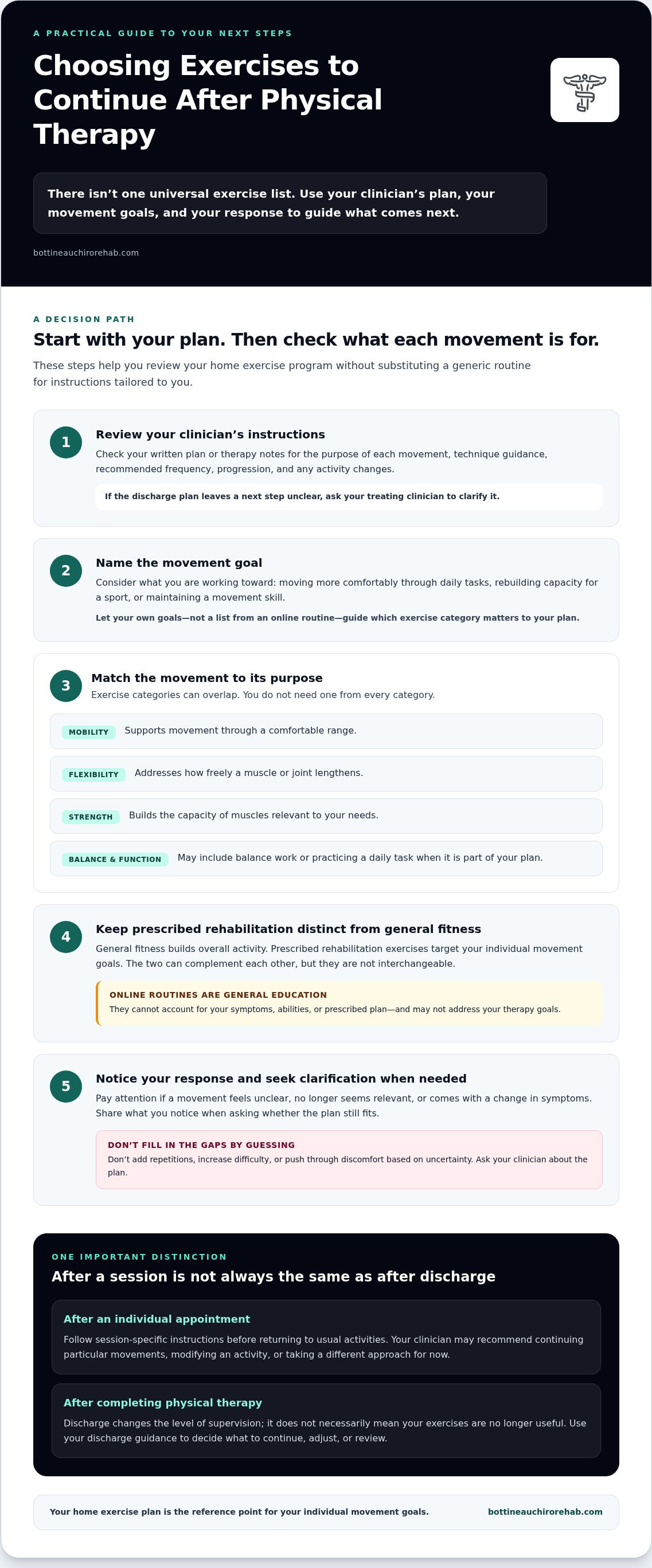
It’s common to leave physical therapy unsure what comes next. Should you repeat the exercises from your last appointment, return to your usual workouts, or keep following your home plan? The answer depends on whether you’ve finished one session or completed your course of care. Follow the instructions your clinician gave you, and treat your exercise plan as guidance for your needs, not a template to copy from a video.
Physical therapy addresses different movement needs, so exercise goals and progression vary from person to person. After therapy, ongoing exercise means staying active in line with your goals and your treating clinician’s advice. Online examples may explain general concepts, but they can’t account for your symptoms, abilities, or prescribed plan.
After a session versus after completing physical therapy
After an individual appointment, follow any session-specific instructions before returning to your usual activities. Your clinician may have recommended continuing particular movements, modifying an activity, or taking a different approach for now. Don’t assume that guidance for the hours or days after a session is the same as a long-term exercise routine.
Discharge means a change in supervision, not necessarily that your exercises are no longer useful. Use your clinician’s instructions to decide what to continue, what to adjust, and whether a reassessment would help. If your discharge plan doesn’t explain those next steps, ask the treating clinician to clarify them.
Why a continuing home exercise plan can matter
Regular, appropriate movement can help you maintain the mobility and everyday function you’ve worked on in therapy. The right exercises to do after physical therapy depend on your goals, whether that means moving more comfortably through daily tasks, rebuilding capacity for a sport, or maintaining a movement skill. A routine that suits one person may not suit another, even when their symptoms seem similar.
General fitness builds overall activity; prescribed rehabilitation exercises target your individual movement goals. The two can complement each other, but they aren’t interchangeable. A general online routine might not address the reason you received therapy, or it may include movements that don’t fit your current plan. Use online content for general education, not as a substitute for instructions tailored to you.
Start by reviewing your discharge guidance, including any notes about frequency, progression, or activity changes. If your symptoms, goals, or daily demands have shifted, don’t guess at a new routine. A clinician can help determine whether your current exercises still fit or whether your plan needs review. That keeps your next steps practical and connected to your care.
Choosing Which Exercises to Continue After Physical Therapy
There isn’t one universal list of exercises to do after physical therapy. Instead, consider what each movement is meant to support in your plan. An exercise may target comfortable movement, muscle capacity, balance, or a task you want to manage more easily. Start with the goals and instructions from your treating clinician, not a list of movements just because they appear in an online routine.
Match exercise categories to your therapy goals
Different exercise categories serve different purposes. Mobility work supports movement through a comfortable range, while flexibility exercises address how freely a muscle or joint lengthens. Strengthening focuses on building the capacity of muscles relevant to your needs. Balance work and functional movements, such as practicing a daily task, may also be appropriate when they’re part of your plan.
These categories can overlap, but that doesn’t mean you need an exercise from each one. Someone focused on returning to a sport may have different priorities from someone working on an everyday movement. Let your goals guide the category, and follow your clinician’s instructions for specific movements and technique.
Use your home exercise program as the reference point
Review the written instructions or notes you received during therapy. Look for the purpose of each movement and any guidance about technique, frequency, or progression. If your notes don’t answer a question, write it down instead of filling in the gap with a general online recommendation. The American Physical Therapy Association offers broader information about the profession, but your individual plan remains the relevant reference for your care.
Notice how the exercises relate to your goals and how your body responds. A movement that feels unclear, no longer seems relevant, or brings a change in symptoms is a reason to seek clarification. Don’t use that uncertainty as a cue to add repetitions, increase difficulty, or push through discomfort. Share what you’ve noticed when asking whether the plan still fits.
- Mobility and flexibility: Check whether your plan addresses comfortable range of motion or muscle flexibility.
- Strengthening: Review which muscles or everyday demands your prescribed exercises are intended to support.
- Balance and functional movement: Continue these when they align with your clinician’s recommendations and goals.
Keep the decision personal. An exercise library can explain what a movement generally involves, but it can’t determine whether that movement suits your condition or current abilities. Boundless Full Body Chiropractic & Rehab provides physical therapy in Bottineau, North Dakota. For local context on how care can support individual movement needs, explore physical therapy in Bottineau, North Dakota. If you need help understanding a changing plan, learn about local physical therapy support.
Prescribed Exercises or Online Routines? Compare Your Options After Therapy
After physical therapy, you may wonder whether to continue your home exercises, try a routine you found online, or get your plan reviewed. Each option has a different purpose. The best fit depends on whether your current plan still matches your abilities, symptoms, and goals. Don’t replace or change clinical instructions based on a generic exercise list.
| Option | Personalization and purpose | When it may fit |
|---|---|---|
| Continue prescribed exercises | Selected around your therapy goals and current abilities. | Your instructions remain clear and the plan still feels relevant. |
| Use an online routine | General information, not tailored to your history or discharge plan. | For learning about exercise concepts, without treating it as a replacement plan. |
| Seek a reassessment | Provides an opportunity to review whether your plan still fits. | Your symptoms, function, or activity goals have changed, or you’re unsure what to do next. |
What prescribed exercises offer that general routines may not
A clinician-selected home plan connects specific movements to your goals and current abilities. A popular exercise may be useful for some people but irrelevant to your needs, or it may not match the stage of activity your plan addresses. General routines aren’t inherently unsafe, but they lack the personal context that helps determine whether an exercise belongs in your program.
Use online routines as general information, not as instructions for your individual care. Don’t swap a prescribed movement for a similar-looking one or add exercises because a video recommends them. If you’re unsure whether a movement is appropriate, pause and get clarification rather than testing it by pushing through symptoms.
When a reassessment may be more useful than adding exercises
Seek guidance if the plan no longer matches what you can do, your symptoms have changed, or the same exercise is repeatedly difficult to manage. A new goal can also change what support makes sense. For example, returning to a sport may involve different movement demands than managing everyday activities. If you’re returning from a sports injury, Boundless provides sports injury rehabilitation in Bottineau.
Uncertainty doesn’t prove an exercise is harmful, and discomfort isn’t a reason to force your way through. Pay attention to your response and follow any guidance you received about modifying or stopping an activity. If symptoms are new or worsening, or you can’t tell whether to continue, don’t make the decision based on an online list. A clinician can review your plan and help decide whether it needs adjusting.
The goal isn’t to collect more exercises. It’s to choose an approach that still fits. Follow clear, relevant instructions, use online material for general learning, and seek a reassessment when your needs or confidence change.
How to Build a Safe, Sustainable Exercise Routine After Physical Therapy
A lasting routine doesn’t need to be complicated. It needs to fit your clinician’s instructions, your current abilities, and your day. Use this sequence to make your home plan easier to follow without guessing at a schedule or progression.
- Revisit your instructions. Gather your home exercise plan and note which movements to continue, how often to do them, and any guidance about modifying activity. If a detail is unclear, write down the question instead of filling in the gap yourself.
- Choose a realistic time. Pair your exercises with a habit you already have, such as a regular break or another consistent part of your day. Pick a time you can reasonably protect, and set a reminder if it helps.
- Follow the plan as given. Start with exercises already included in your program. Keep to the clinician-recommended frequency and progression. Don’t increase the number, difficulty, or duration on your own just because a movement feels manageable at first.
- Review your response. After exercising, note how the movements felt and whether they supported the activity or function you’re working toward. Record anything that felt different and any questions to raise at follow-up.
Start with a manageable plan and progress only as advised
Consistency is easier when your plan feels doable. Begin with the prescribed movements and instructions you were given, rather than adding exercises to make the routine seem more complete. If your clinician has outlined how to progress, follow that guidance. If not, ask before changing the workload or trying a more challenging version.
Gradual, individualized progress keeps your routine connected to your needs. Your plan should reflect your goals and current abilities, not a generic schedule. The exercises to do after physical therapy may change as your needs change, so let clinical guidance shape those adjustments.
Notice your response and know when to pause
Some effort during movement may be expected, but don’t assume every sensation is harmless or that you should push through it. Follow your clinician’s specific instructions about discomfort, rest, and recovery. If an activity brings on new, severe, persistent, or worsening symptoms, stop that activity and seek appropriate guidance rather than continuing to test it.
After each session, briefly check in with yourself: What movement felt manageable? Did anything affect my comfort? Was an everyday task easier or harder? What do I want to ask about? These notes can help you describe patterns clearly if you need follow-up. They aren’t a reason to diagnose the cause or change your plan alone.
If you’re unsure how to make your home exercise plan fit your goals or changing symptoms, connect with Boundless for physical therapy guidance in Bottineau, North Dakota.
When You Need More Guidance: Physical Therapy Support in Bottineau
Seek help if you’re unsure how to continue your exercises, your needs have changed, or your home plan no longer feels clear. You don’t have to wait until you’ve stopped exercising altogether. A clinician can help you understand what questions to address and whether your current approach still fits your goals.
Signs your post-therapy plan may need another look
Consider getting guidance if you’re uncertain about your technique, don’t know whether an exercise is still relevant, or aren’t sure how an activity fits with your plan. A meaningful change in symptoms or everyday function is another reason to pause and seek advice. These changes don’t point to a particular diagnosis, but they can help a clinician understand what support may be useful.
Before seeking guidance, note what has changed and what you’re trying to do. Describe which movement is difficult, what daily task or activity you want to manage, and how your response differs from before. Bring your home exercise instructions if you have them. Clear details can help focus the discussion on your goals and questions.
Continue your rehabilitation journey with local support
Boundless Full Body Chiropractic & Rehab provides physical therapy and spinal rehabilitation in Bottineau, North Dakota. People in nearby communities, including Rugby, Rolla, Rollette, Dunseith, St. John, Sherwood, Mohall, Willow City, Lake Metigoshi, Belcourt, Kenmare, Minot, and Velva, can access local rehabilitation support. If you’re deciding whether the exercises to do after physical therapy still fit your needs, physical therapy can help you review your plan in light of your movement goals.
For goals involving a return to sports after an injury, Boundless also provides sports injury rehabilitation. If your concern is everyday movement instead, share that context so your care can focus on what matters in your routine.
Seeking another perspective doesn’t erase the work you’ve already done. It can help you decide what to continue, what questions to raise, and whether your plan needs attention. Explore local rehabilitation support and choose a next step that feels appropriate for you.
Explore Boundless Full Body Chiropractic & Rehab to learn about physical therapy and rehabilitation in Bottineau.
Keep Your Next Step Focused on Progress
A lasting routine isn’t about doing more. It’s about choosing movement that fits your goals and staying open to guidance as those goals change. Use your clinician’s plan to decide which exercises to do after physical therapy, and speak up when your routine no longer feels clear. Thoughtful adjustments can help you stay engaged without relying on guesswork.
Boundless Full Body Chiropractic & Rehab offers physical therapy, spinal rehabilitation, and sports injury rehabilitation in Bottineau, North Dakota. The practice also provides full-body and extremity adjustments, family care, and a $47 new patient special. Explore the services to find support for your next step.
Explore physical therapy and rehabilitation at Boundless, and keep building a routine that supports the movement you value. Progress can start with one clear, manageable next step.
Frequently Asked Questions
How long should I keep doing exercises after physical therapy?
There isn’t one timeline that fits every person or condition. Some exercises to do after physical therapy may remain useful as regular activity, while others are intended for a specific phase of recovery. Follow the duration discussed with your treating clinician. If your abilities or goals change, ask whether to keep, adjust, or stop particular movements instead of assuming every exercise should continue indefinitely.
Can I do physical therapy exercises every day after discharge?
It depends on the movements and the schedule recommended for you. For example, a clinician may advise frequent gentle movement but recommend rest between more demanding strengthening sessions. Daily practice isn’t automatically better. Follow your discharge instructions, and get guidance before increasing frequency, resistance, or total exercise time. If you’ve misplaced your plan, ask for clarification rather than relying on a schedule you found online.
Is soreness normal after doing exercises at home?
Mild, short-lived muscle soreness can happen after activity, but soreness alone doesn’t show whether an exercise is effective or appropriate. Notice whether the sensation settles or interferes with your usual movement, and compare it with the guidance you received. Stop and seek appropriate advice if symptoms are severe, worsening, unusual, or persistent, especially if they differ from what your clinician said to expect.
Can I combine my physical therapy exercises with regular workouts?
Many people work toward returning to fitness while continuing rehabilitation, but the right balance depends on their goals and current tolerance. Keep any movement limits from your care plan in mind. Avoid adding strenuous activity or changing several parts of your routine at once, since that can make it harder to tell how your body is responding. Ask your clinician how to combine workouts with your prescribed exercises.
Do I need special equipment for exercises after physical therapy?
Not always. Some home programs use body weight, while others call for particular equipment or resistance. Use what your clinician specified and follow the directions for setup and use. If you don’t have an item, don’t automatically replace it with a household object or a different resistance level. Ask whether there’s a suitable alternative so you can keep the exercise aligned with your plan.
What should I do if I miss several days of my home exercise plan?
Check your instructions before resuming, and don’t double up to make up missed practice. If symptoms, illness, or a change in your daily routine led you to stop, ask whether to restart as directed or review the plan. Boundless Full Body Chiropractic & Rehab provides physical therapy in Bottineau and surrounding communities, including Rugby, Rolla, Rollette, Dunseith, St. John, Sherwood, Mohall, Willow City, Lake Metigoshi, Belcourt, Kenmare, Minot, and Velva.
Can I use exercises from online videos after physical therapy?
Online videos can show general movement ideas, but they may not match your abilities, therapy goals, or specific instructions. A demonstration may also leave out an adjustment your clinician taught you. Use your prescribed plan as your reference, and ask before adding a movement, especially if you have new symptoms or activity restrictions. If a video’s directions differ from your plan, follow your clinician’s instructions instead.


