

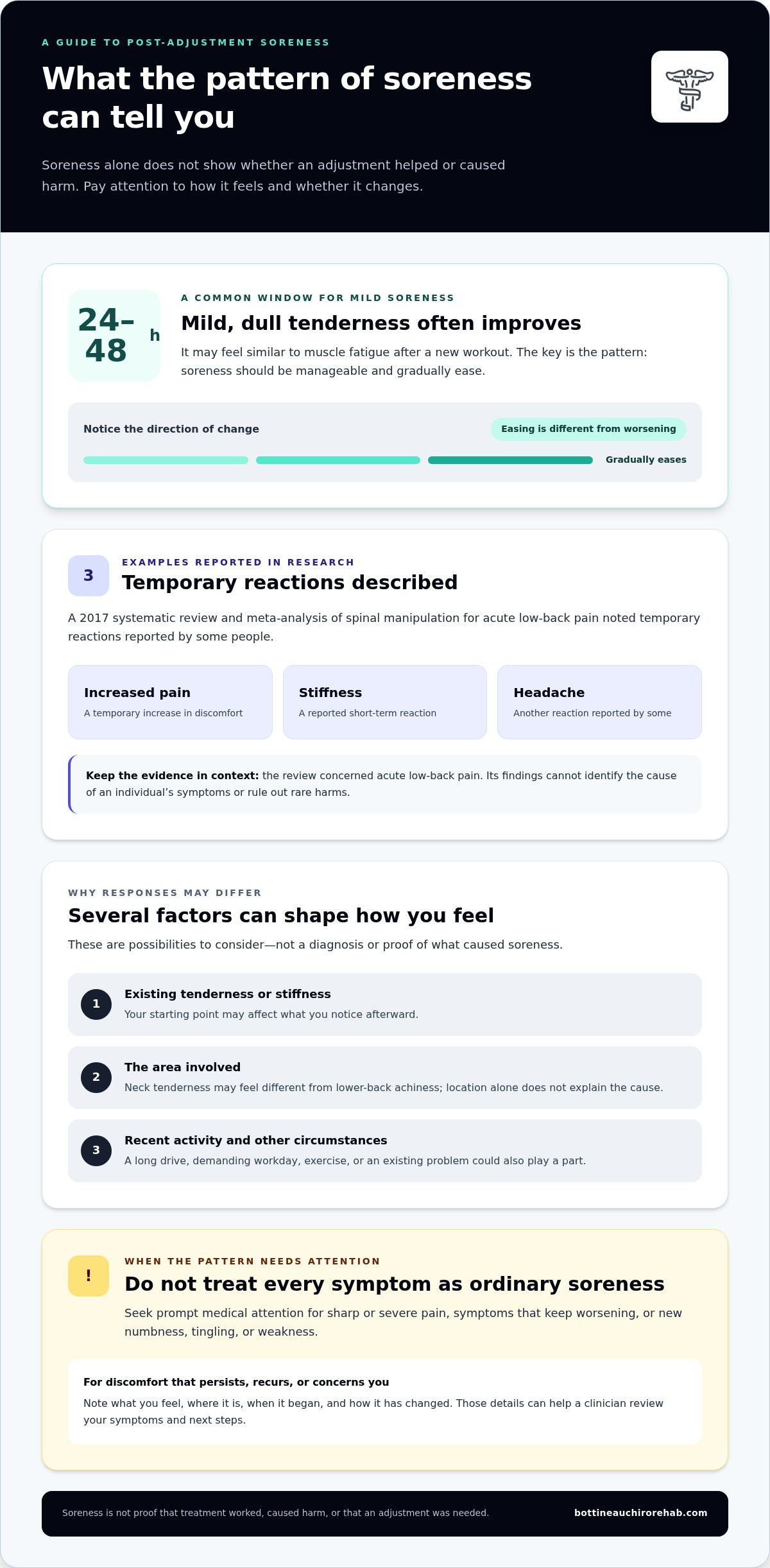
What if soreness after an adjustment is a signal to pay attention, not proof that treatment worked or caused harm? Feeling sore after chiropractic adjustment can be unsettling, especially when the ache or stiffness is unfamiliar. Mild, dull soreness can feel similar to muscle fatigue after a new workout and often improves within 24 to 48 hours.
Some discomfort may be a temporary response as your body adapts, but the pattern matters. Soreness should be manageable and gradually ease. Sharp or severe pain, symptoms that keep worsening, or new numbness, tingling, or weakness deserve prompt medical attention.
This guide explains why soreness may happen, what changes are generally expected, and how to respond to mild discomfort with comfortable movement and careful monitoring. You’ll also learn when to seek assessment rather than wait it out.
Key Takeaways
- Feeling sore after chiropractic adjustment can be uncomfortable, but soreness alone doesn’t show whether care helped or caused harm.
- Notice whether tenderness is easing or becoming more severe, and watch for symptoms that appear alongside it.
- If discomfort is mild, choose comfortable everyday movement. Stop or ease back if activity increases your symptoms.
- Persistent, recurring, or concerning symptoms are worth discussing with a clinician, who can review your history and next-step options.
- Follow-up care at Boundless Full Body Chiropractic & Rehab in Bottineau gives you an opportunity to discuss symptoms and reassess your needs.
Feeling sore after a chiropractic adjustment: what the sensation may mean
Unfamiliar tenderness or stiffness after an adjustment can feel worrying, especially if you expected to feel different right away. If you’re feeling sore after chiropractic adjustment, note what the sensation feels like, where it is, and whether it changes. Soreness by itself can’t tell you exactly what caused it.
Post-adjustment soreness is temporary tenderness, stiffness, or achiness noticed after hands-on chiropractic care. It may be mild and localized, but sharp, severe, or worsening pain is different and deserves attention. People respond differently, and soreness alone doesn’t prove that an adjustment worked or caused an injury.
How post-adjustment soreness may feel
Some people describe a tender area, reduced ease of movement, or an ache similar to muscle fatigue. Others notice little or no change. The sensation can vary with the person, the area treated, and the circumstances of the visit. For example, tenderness around the neck may feel different from achiness in the lower back, but location alone doesn’t explain the cause.
The Chiropractic overview describes soreness and stiffness among possible adverse effects of spinal manipulation. That context can help explain why these sensations are reported, but it can’t determine what’s happening in your individual case. Soreness is not evidence that joints are “realigning,” nor does it mean toxins are leaving your body.
Why one person’s response may differ from another’s
Your starting point matters. Someone who already has tenderness or stiffness may notice a different response from someone who felt well before the visit. Recent activity, the area involved, and individual health factors can also shape how the body feels afterward. These are relevant parts of the picture, not a diagnosis of a particular ache.
That’s why two people can receive similar care and describe different experiences. One might feel temporarily tender; another might notice no soreness. The same person may respond differently at different visits. The sensation alone can’t show whether it came from the adjustment, an existing symptom, daily activity, or another cause. Consider what changed, where you feel it, and whether it is easing or intensifying.
For background on how an adjustment can fit into broader care, explore this full-body chiropractic adjustment guide. It can help you understand the approach, but it won’t replace an assessment of new or concerning symptoms.
Focus on the pattern rather than treating soreness as a verdict. Mild tenderness that settles is different from pain that feels severe, unusual, or progressively worse. If you’re unsure how to interpret your symptoms, tell a clinician what you feel, when it began, and how it has changed. Those details provide a clearer starting point for deciding what to do next.
Why might muscles feel tender after an adjustment?
Hands-on care may be followed by temporary tenderness in some people. That can be unsettling, but it doesn’t point to one certain cause. A tender muscle or nearby tissue is one possibility. Existing discomfort, daily activity, or another factor may also play a part. The feeling alone can’t establish what happened in your body.
Short-term reactions such as soreness, stiffness, or increased discomfort have been reported after spinal manipulation. Research cannot identify the cause of an individual’s symptoms or show that soreness means an adjustment was needed or effective.
Possible reasons for temporary tenderness
A treated area may feel more sensitive after hands-on care, or surrounding muscles may feel temporarily tender. These are possible explanations, not a diagnosis. The sensation could also overlap with symptoms that were already present. For instance, if your back was achy before the visit, that discomfort may continue or change afterward without proving what caused it.
Think about what else was happening around the same time. A long drive, a physically demanding workday, exercise, or a flare of an existing problem could contribute to how you feel. Timing is useful to report, but it doesn’t prove cause and effect. If you’re feeling sore after chiropractic adjustment, don’t assume your muscles are “realigning,” that inflammation is the explanation, or that a specific biological process is underway.
What research can, and can’t, tell you
A 2017 systematic review and meta-analysis in JAMA examined spinal manipulation for acute low-back pain. It found that some people reported temporary reactions, including increased pain, stiffness, or headache. The included randomized trials did not report serious adverse events, but the evidence cannot rule out rare harms, and its findings don’t explain an individual patient’s symptoms. Read the review in JAMA.
Clinical research can describe reactions reported across groups, but it can’t tell you whether your soreness came from an adjustment, an existing condition, or something else. Studies may also differ in the care provided, how symptoms are collected, and which patients are included. A finding from a study of people with acute low-back pain, for example, shouldn’t automatically be applied to every treatment area, technique, or patient.
Soreness is not a measure of treatment quality or success. It doesn’t prove an adjustment was necessary, and the absence of soreness doesn’t prove that it failed. If discomfort persists, changes, or worries you, note when it began, where you feel it, and what affects it. You can discuss those symptoms during follow-up care at Boundless Full Body Chiropractic & Rehab.
Normal soreness or a warning sign? How to tell the difference
Feeling sore after chiropractic adjustment doesn’t automatically mean something is wrong. Look at the pattern: how strong the discomfort is, whether it’s easing or worsening, and whether other symptoms have appeared. A mild ache that’s improving is different from severe pain or a new loss of strength or sensation.
| What you notice | What to do |
|---|---|
| Mild, localized tenderness or stiffness that’s easing | Keep track of how it changes. Consider your overall health and any symptoms you had before the adjustment. |
| Severe, unusual, or progressively worsening pain | Seek prompt medical assessment, especially if the pain is limiting movement or is unlike your usual symptoms. |
| New weakness, numbness, or other neurological changes | Get urgent medical help. Sudden or major neurological symptoms may require emergency services. |
Signs that may fit temporary soreness
A mild, localized ache or stiffness that gradually improves may fit a short-term reaction. Research on spinal manipulation has reported temporary reactions, including soreness and stiffness, but it doesn’t establish a guaranteed recovery timeline for every person. Someone with existing back discomfort, for example, may experience a different pattern from someone without it. Monitor whether symptoms are settling, staying the same, or getting worse. Your health history and other symptoms matter, too.
Symptoms that call for prompt medical attention
Don’t wait for pain to become unbearable if it’s severe, rapidly worsening, or accompanied by new weakness or numbness. Contact an appropriate medical service promptly for assessment. New neurological symptoms need particular care because their cause can’t be determined from an article or from soreness alone.
Call emergency services for emergency symptoms. Sudden weakness or numbness, trouble speaking, confusion, vision changes, loss of balance, or a sudden severe headache can be signs of stroke; the CDC advises calling 911 for these symptoms. New difficulty controlling your bladder or bowels, inability to urinate, or numbness around the genitals or anus can signal a serious spinal problem and needs emergency assessment. See the CDC guidance on stroke symptoms and the NHS information on cauda equina syndrome.
This comparison is a guide, not a diagnosis. Don’t use it to decide that a concerning symptom is harmless or to delay urgent assessment. If symptoms are changing or worrying you, tell a clinician when they began, how they’ve progressed, and what else you’ve noticed. For an emergency, call emergency services rather than waiting for a routine appointment.
What to Do When Sore After an Adjustment
If you’re feeling sore after chiropractic adjustment, pause before deciding what to do. A practical approach is to notice the symptoms, choose comfortable movement, and reassess. The goal isn’t to push through discomfort or guess at its cause. It’s to pay attention and respond in a way that feels safe for you.
Simple steps for mild discomfort
- Pause and check in. Notice where you feel discomfort and whether it’s mild, moderate, or severe. Think about when it began and whether it feels different from symptoms you had before the visit.
- Choose comfortable movement. If it feels okay, continue gentle everyday activity, such as moving around at home or taking care of routine tasks. You don’t need to add specific exercises. Stop or ease back if an activity clearly aggravates your symptoms.
- Keep to your usual needs. Drink fluids as you normally would. Avoid unusual exertion or activities that make the discomfort worse until you feel comfortable doing them again.
- Reassess and keep notes. Track the location, intensity, start time, and changes in your symptoms. A brief note can help you explain what’s happening if you decide to seek advice.
Follow any individualized instructions from the healthcare professional who treated you. Advice may depend on your symptoms, health history, and the care provided. Don’t add medication, ice, heat, or a new treatment based only on general online guidance. If you’re considering any of these, follow your clinician’s advice or ask an appropriate healthcare professional whether it suits your circumstances.
Comfort is your guide. Gentle daily movement may be reasonable if it doesn’t increase symptoms, but there’s no need to force a stretch, test your limits, or follow a one-size-fits-all routine. If you’re unsure whether an activity is appropriate, pause and seek individualized guidance.
When to contact the treating clinician
Reach out to the clinician who provided your care if the soreness concerns you, persists, worsens, or changes in a way that feels unusual. Describe where it is, how intense it feels, when it started, and what has changed since then. Mention any other symptoms and relevant health conditions. Clear details help the clinician understand your concern and discuss appropriate next steps.
Don’t assume another adjustment is the automatic answer to soreness. A follow-up is a chance to review what you’re experiencing and reassess your needs, not a promise of a particular diagnosis or treatment. If you have sudden severe symptoms or new weakness, numbness, or other urgent warning signs, seek urgent medical assessment. For emergency symptoms, call emergency services rather than waiting for routine follow-up.
If you’re in Bottineau and want to discuss how you’re feeling after care, contact Boundless Full Body Chiropractic & Rehab.
When follow-up care can help you make sense of lingering soreness
If soreness persists, returns, worsens, or concerns you, an individualized assessment can help put the symptoms in context. You don’t have to decide on your own whether discomfort is related to an adjustment or something else. A clinician can review when it began, where you feel it, how it has changed, and what was happening before and after your visit.
What an individualized follow-up can address
A follow-up gives you space to explain your symptoms and relevant health history. The clinician can ask about severity, timing, and effects on daily activities, then discuss whether further evaluation or a different next step may be appropriate. This process may help clarify the options, but it can’t guarantee a specific diagnosis or outcome.
Care options depend on the person and the concern. Boundless Full Body Chiropractic & Rehab provides chiropractic care, including full-body and extremity adjustments, as well as physical therapy and spinal rehabilitation in Bottineau. These are care options, not automatic recommendations for soreness. An assessment helps inform whether a particular approach fits your needs. For more context on rehabilitation, see this physical therapy and spinal rehabilitation guide.
Taking the next step in Bottineau
Before a follow-up, note when the soreness began, its location and intensity, and whether it is improving, recurring, or worsening. Include any new symptoms and changes in your ability to manage normal activities. These details can help make the conversation more focused and useful.
Share persistent or concerning symptoms with an appropriate healthcare professional. If symptoms are severe or rapidly worsening, or you notice new weakness, numbness, or other urgent warning signs, seek prompt medical assessment. For emergency symptoms, call emergency services. Don’t wait for a routine appointment or assume another adjustment is the answer.
For non-emergency concerns, follow-up care can be a chance to discuss what you’re experiencing and reassess possible next steps. Boundless Full Body Chiropractic & Rehab provides chiropractic and rehabilitation care in Bottineau for people in the surrounding area, including Rugby, Rolla, Rollette, Dunseith, St. John, Sherwood, Mohall, Willow City, Lake Metigoshi, Belcourt, Kenmare, Minot, and Velva. If you’d like to explore the care options available, learn about care at Boundless.
Make your next care decision with confidence
Uncertainty can make it tempting to dismiss discomfort or decide that treatment was a mistake. You don’t have to make that call based on one sensation. Consider what you’re experiencing, what matters to you, and what questions you want answered before choosing your next step.
Feeling sore after chiropractic adjustment can be a reason to have a clearer conversation about your care, not a verdict on what happened. You can ask about your symptoms, discuss your preferences, and decide whether follow-up makes sense. The next step should reflect your situation, not pressure you into a particular treatment.
Boundless Full Body Chiropractic & Rehab provides chiropractic and rehabilitation care in Bottineau, including physical therapy, spinal rehabilitation, and sports injury rehabilitation. Explore chiropractic and rehabilitation care at Boundless, and ask about the $47 new patient special if you’re new to the practice. You deserve to feel heard as you make decisions about your health.
Frequently Asked Questions
Can I drive after a chiropractic adjustment if I feel sore?
Drive only if you feel alert, comfortable, and able to control the vehicle safely. There’s no universal restriction or clearance that applies to everyone. Don’t drive if pain limits your movement or if you feel dizzy, weak, or otherwise impaired. Routine mild tenderness is different from severe or unusual symptoms. If you’re unsure, ask a healthcare professional for individualized advice; seek prompt assessment for new neurological symptoms.
What happens if soreness starts a day or two after an adjustment?
Symptoms that start later can’t be traced to the adjustment based on timing alone. A workout, daily activity, existing symptoms, or another factor may also contribute. Note when the discomfort began, where it is, and whether it’s easing or worsening. If it concerns you or persists, discuss it with a healthcare professional. Seek urgent assessment for severe symptoms or new weakness, numbness, or other neurological changes.
Can an extremity adjustment leave an arm or leg feeling sore?
An arm or leg may feel uncomfortable afterward, but soreness alone can’t establish that an extremity adjustment caused it. Note which area was treated, when the sensation began, and whether it changes with movement or rest. Share those details with your clinician. Mild tenderness differs from severe pain or new weakness, numbness, or other concerning symptoms, which call for prompt medical assessment.
Is a headache after a chiropractic adjustment always a normal reaction?
No. A headache can have different causes, so don’t assume it’s a routine response to an adjustment. Seek medical guidance if it’s unusual, persistent, or concerning. A sudden, severe headache, especially with weakness, numbness, vision changes, confusion, or trouble speaking, needs urgent assessment. Call emergency services for emergency symptoms rather than waiting for a routine appointment or trying to determine the cause yourself.
Can children feel sore after a chiropractic adjustment?
A child’s discomfort needs to be considered in the context of their age, health, and symptoms; this article can’t determine what’s normal for an individual child. Contact the treating clinician about new or concerning soreness, and describe what the child says or how their behavior has changed. Seek prompt medical assessment for severe symptoms, unusual behavior, weakness, numbness, or other urgent warning signs.
Should I take pain medicine for soreness after an adjustment?
Check with a qualified healthcare professional or pharmacist before taking medicine for soreness. What’s suitable depends on your health, other medicines, and personal circumstances, so don’t rely on a general article for a medication choice or dose. This is especially important if you have a medical condition or take other medication. Seek assessment for severe, worsening, or unusual symptoms instead of masking them.


