

What if your first chiropractic visit is an evaluation and conversation, not an automatic adjustment? It’s understandable to feel unsure about the examination, what to explain, or whether you need to know what caused your symptoms before you arrive. If you’re searching for “what to expect first chiropractic visit,” start here: you don’t need to have all the answers before your appointment.
At Boundless Full Body Chiropractic & Rehab in Bottineau, the first step is to discuss what you’re experiencing and complete an examination. The findings help Dr. Daniel Pozarnsky, who has more than 20 years of chiropractic experience, determine whether care is a good fit and what next steps may make sense. Treatment isn’t something you have to agree to automatically.
This guide explains what information to bring, what an examination may involve, and how recommendations are shaped by your needs. You’ll also learn about the $47 NEW PATIENT SPECIAL, which includes a consultation and examination to determine fit and next steps. Arrive with your questions. Leave with a clearer understanding of your options.
Key Takeaways
- Get a simple overview of the first appointment, from sharing your concerns to discussing possible next steps.
- Learn what to expect first chiropractic visit and how your history and examination help shape recommendations.
- Prepare by noting your main concern, when it began, relevant health history, and questions. Bring any related information you already have.
- See how the assessment may consider movement and the spine or extremities based on your individual concern.
- Find Boundless at 116 E. 6th St., Bottineau, ND 58318. Call or text (701) 566-0666, or schedule online.
What to Expect at Your First Chiropractic Visit in Bottineau
Feeling nervous before a first appointment is common, especially if you’re unsure what an examination involves or whether you’ll be expected to have an adjustment. At Boundless Full Body Chiropractic & Rehab in Bottineau, the visit starts with a conversation and an evaluation. You can explain what’s bothering you, ask questions, and hear recommendations before deciding what to do next.
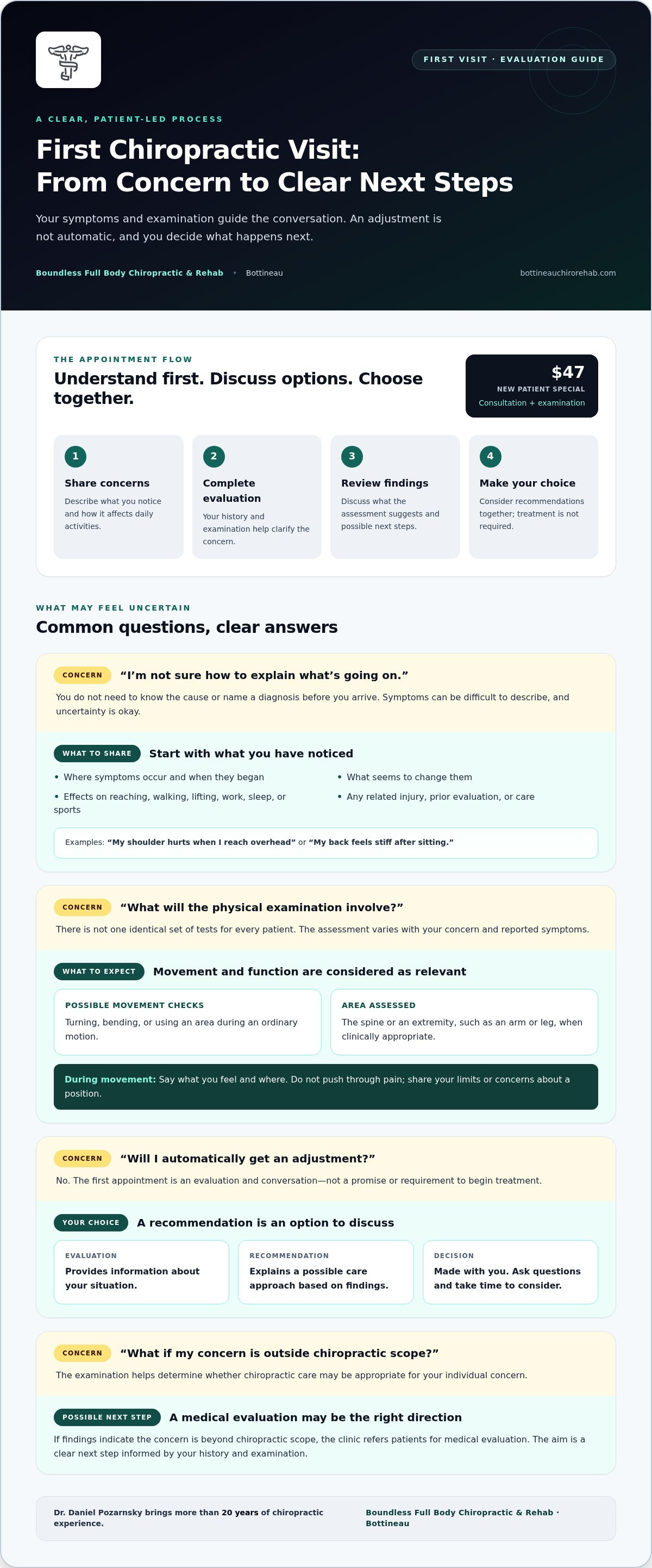
Knowing what to expect first chiropractic visit means knowing that your concerns and examination findings help guide appropriate next steps. The process is straightforward: discuss your symptoms, have a consultation and examination, review the findings, then consider recommendations together. The purpose is to understand your situation and whether chiropractic care may be appropriate, not to rush you into treatment.
Chiropractic care can involve assessing and caring for the spine and other joints. For a general overview of Chiropractic, including its history and principles, see the linked reference. At Boundless, Dr. Daniel Pozarnsky brings more than 20 years of chiropractic experience to the conversation. The $47 NEW PATIENT SPECIAL includes a consultation and examination to determine fit and next steps.
What happens from arrival through the consultation?
The first conversation centers on your main concern. Explain where you feel discomfort, when you noticed it, and how it affects daily activities such as walking, working, sleeping, or playing sports. You don’t need to know the cause before you come in. Share what you’ve observed, even if the symptoms are hard to describe.
Dr. Pozarnsky listens and may ask follow-up questions to better understand your experience before discussing recommendations. Be as specific as you can, but don’t worry about having a perfect explanation. The consultation and examination help clarify what may be contributing to the problem and what options fit your needs.
Will I receive an adjustment during the first visit?
An adjustment isn’t automatic. The examination and discussion help determine whether care is appropriate and what should happen next. Recommendations depend on your individual findings, so the first appointment isn’t a promise or requirement to begin treatment. You can ask what a recommendation involves, raise concerns, and take time to consider it before making a decision.
This distinction matters: an evaluation provides information; a recommendation explains a possible care approach; and the decision about whether to proceed is made with you. If the findings indicate that your concern is beyond chiropractic scope, the clinic refers patients for medical evaluation. The goal is a clear, informed next step, whether that means discussing conservative, non-invasive care or considering another direction based on the examination.
How the Chiropractor Evaluates Your Symptoms and Movement
An evaluation starts with what you’ve noticed, not with you naming a diagnosis. Dr. Daniel Pozarnsky considers your health history alongside examination findings to understand the concern and how it affects your movement and daily activities. You can describe symptoms in everyday language. You don’t need to identify the cause before your appointment.
Recommendations are based on your reported symptoms, relevant health history, and individual examination findings, not on self-diagnosis. This helps connect what you’re experiencing with what the examination shows, while keeping the next steps focused on your needs.
Which symptoms and health details should I describe?
Share where symptoms occur, when they began, and what seems to change them. Mention whether they affect tasks such as reaching, walking, lifting, or participating in sports. If you’ve had an injury, prior evaluation, or care related to the concern, include that context too. These details help Dr. Pozarnsky understand the issue in the context of your routine, rather than considering one symptom in isolation.
Be direct about what worries you. You might say, “My shoulder hurts when I reach overhead,” or “My back feels stiff after sitting.” If you’re uncertain about a detail, say so. Questions and concerns are useful parts of the conversation, not something you need to resolve on your own first.
What might the physical examination involve?
The examination is guided by your concern. It may include looking at relevant movement and function, such as how comfortably you turn, bend, or use an area during an ordinary motion. When clinically appropriate, the chiropractor may also evaluate the spine or an extremity, such as an arm or leg, based on your reported symptoms. The specific assessment varies. There isn’t one identical set of tests for every patient.
As you move, explain what you feel and where. A movement that brings on discomfort, feels restricted, or differs from the other side may help clarify what needs attention. Don’t push through pain to demonstrate a motion. Share your limit, and let the chiropractor know if a position or movement concerns you. This makes the assessment more informative and responsive to your experience.
The purpose isn’t to judge how well you move or expect you to perform a particular way. It’s to gather useful information and relate it to your history. The Mayo Clinic overview of chiropractic adjustment also describes how health history and physical examination contribute to understanding care. At Boundless in Bottineau, examination findings help guide appropriate recommendations. If findings exceed chiropractic scope, the clinic refers patients for medical evaluation.
Knowing what to expect first chiropractic visit includes understanding that the assessment is tailored, not a preset checklist. If you’d like to learn more about care at the Bottineau clinic, explore Boundless chiropractic and rehabilitation.
What Happens After the Examination: Findings, Options, and Your Choice
After the examination, the next step is a clear conversation about what the findings may mean for your concern. Dr. Daniel Pozarnsky discusses appropriate options in understandable language and explains how they relate to what you shared and what the assessment showed. You can ask questions before deciding whether to proceed with a recommended approach.
A recommendation is guidance based on your individual findings. A possible care approach is one option to consider, not an automatic commitment. The decision about whether to move forward is made with you. That distinction keeps the discussion focused on informed choices rather than pressure.
How are next steps chosen after the examination?
Recommendations connect your reported symptoms, health history, examination findings, and goals. For example, if discomfort is interfering with work or sports, explain which activities are affected so the discussion can address what matters in your day. Ask what a proposed approach is intended to address, why it may suit your findings, and what alternatives are appropriate. You don’t need to agree to care before you understand the recommendation.
If findings suggest that your concern exceeds chiropractic scope, Boundless refers patients for medical evaluation. That is an important part of choosing an appropriate next step. The clinic provides conservative, non-invasive chiropractic care and rehabilitation in Bottineau, and helps patients recover from injuries, avoid surgery, and get back to work, sports, and life. These are goals of care, not guaranteed outcomes.
Could rehabilitation or an adjunctive therapy be discussed?
Depending on the examination, rehabilitation may be discussed as part of a care approach. The focus is on matching options to your needs and findings, rather than assuming the same plan fits everyone. Ask how any recommended activity or therapy relates to your concern and what role it would play alongside other care.
Cold Laser / Photobiomodulation is an adjunctive therapy that may be used for selected musculoskeletal complaints when clinically appropriate. It can be used in conjunction with rehabilitation exercises or on its own, and it is not a replacement for a proper diagnosis. Non-surgical spinal decompression may be considered for selected patients and is used only when clinically appropriate. Neither therapy is automatic; suitability depends on the individual assessment.
To make the discussion useful, consider asking:
- What did the examination show that relates to my concern?
- What is the purpose of this recommended approach?
- Are there other appropriate next steps to consider?
- What should I understand before deciding whether to proceed?
Knowing what to expect first chiropractic visit also means knowing you can pause, ask for clarification, and make a considered choice. The goal is a recommendation you understand and a next step that fits the examination findings and your priorities.
How to Prepare for Your First Visit to Boundless in Bottineau
A little preparation can make it easier to explain what’s going on, but you don’t need to arrive with a diagnosis or a stack of paperwork. The goal is to share what you’ve noticed so the consultation and examination can help determine fit and next steps. Keep it simple: jot down the main concern, when it began, relevant health history, and any questions you want answered.
What should I bring or be ready to discuss?
Think about the symptoms you’re experiencing and how they affect everyday activities. You might describe discomfort that makes lifting harder, stiffness after sitting, or an injury that limits a sport. Mention relevant health history, previous evaluations or care, and any related information you already have available. There’s no need to arrange new tests or gather records just for the visit.
Use this quick checklist to organize your thoughts:
- Main concern: What would you most like to discuss?
- Symptom timeline: When did it start, and has anything changed since?
- Relevant history: Have you had a related injury, evaluation, or care?
- Daily impact: Which activities feel different or more difficult?
- Questions: What would help you feel informed about the examination or possible next steps?
You don’t need polished medical language. Describe what you feel and what you’ve observed. The $47 NEW PATIENT SPECIAL includes a consultation and examination to determine fit and next steps. For details about the offer, see what the $47 new-patient special includes.
How can I feel more comfortable before the appointment?
If you’re worried you’ll forget an important detail, write a few notes beforehand and bring them along. A short list is enough. You can also ask what an examination step involves before proceeding, or speak up if you feel uncomfortable. Understanding what’s happening can make it easier to participate and share useful feedback.
If you’re curious about how an adjustment may fit into chiropractic care, this full-body chiropractic adjustment guide offers related educational context. Reading about care is optional; you don’t need to decide on treatment before your consultation.
Use your notes to guide the conversation, not as a script you have to follow. Your questions, concerns, and priorities belong in the discussion. To take the next step, schedule your first chiropractic visit with Boundless in Bottineau.
Book Your First Chiropractic Visit at Boundless in Bottineau
You’ve learned what the evaluation can involve and how recommendations are discussed. Now you can choose a convenient way to arrange your first visit with Boundless Full Body Chiropractic & Rehab. The clinic is located at 116 E. 6th St., Bottineau, ND 58318. Call or text (701) 566-0666, or use the online booking option to request an appointment.
How do I schedule my first visit?
Choose the booking method that works best for you: call or text the clinic at (701) 566-0666, or Schedule your visit online. The clinic’s office hours are:
- Tuesday 9:00 AM to 6:00 PM
- Wednesday 9:00 AM to 4:00 PM
- Thursday 9:00 AM to 6:00 PM
- Friday 9:00 AM to 6:00 PM
- Saturday 9:00 AM to 1:00 PM
- Sunday and Monday closed
Use these hours to plan when to get in touch or schedule online. If you call or text, have a general idea of the concern you’d like to discuss. You don’t need to diagnose it or decide on treatment before booking. The first appointment is an opportunity to share what’s happening and have your condition and next steps assessed.
What does the $47 new-patient special include?
The $47 NEW PATIENT SPECIAL includes a consultation and examination to determine your condition, fit for care, and appropriate next steps. It provides a starting point for discussing your needs with Dr. Daniel Pozarnsky, who has more than 20 years of chiropractic experience. The offer covers the consultation and examination; it should not be understood as a promise of an adjustment or an ongoing treatment plan.
Knowing what to expect first chiropractic visit can make it easier to take that first step with confidence. Boundless provides conservative, non-invasive chiropractic care and rehabilitation in Bottineau. The clinic helps patients recover from injuries, avoid surgery, and get back to work, sports, and life, while recommendations depend on each person’s findings and needs. Results aren’t guaranteed, but your visit can help clarify options and an appropriate direction for care.
Choose the booking option that suits you and take the next step toward discussing your concerns in person. Boundless is here in Bottineau to help you understand your options and pursue better movement and daily function.
Take the Next Step With Confidence
Knowing what to expect first chiropractic visit can make the decision to book feel more manageable. You don’t have to arrive with a diagnosis or commit to ongoing care. Start with a conversation about what’s affecting your movement, then use the consultation to understand your options and decide what feels right for you.
At Boundless in Bottineau, Dr. Daniel Pozarnsky brings more than 20 years of chiropractic experience to whole-body care and rehabilitation. The $47 NEW PATIENT SPECIAL includes a consultation and examination to determine your condition, fit for care, and next steps. It’s a practical starting point for getting clear information about your needs.
Take that first step when you’re ready. Schedule your first visit with Boundless in Bottineau and begin a thoughtful conversation about your health and daily function.
Frequently Asked Questions
Do I need to diagnose myself before my first chiropractic visit?
No. You don’t need to identify a diagnosis before arriving in Bottineau. Describe what you feel, when it began, and what makes it easier or harder, such as bending, lifting, or resting. The chiropractor considers your account alongside examination findings to discuss suitable next steps. If those findings are beyond chiropractic scope, Boundless refers patients for medical evaluation rather than assuming chiropractic care is the right fit.
Will I get an adjustment during my first chiropractic appointment?
Not necessarily. An adjustment isn’t automatic, and your appointment doesn’t require you to begin treatment. The consultation and examination help clarify your concern and whether care may be appropriate. If an approach is recommended, ask what it involves and how it relates to your findings. For example, you can ask what a proposed adjustment is intended to address before deciding whether you’re comfortable proceeding.
What should I wear to my first chiropractic appointment?
Choose comfortable clothing that lets you move normally and makes it easy to explain which activities are affected. For instance, if reaching or bending is part of your concern, wear something that doesn’t restrict those movements. You don’t need special clothing. If you have a concern about what to wear, mention it during the consultation.
Should I bring X-rays or other imaging to my first chiropractic visit?
Bring relevant imaging or health information you already have readily available, but don’t arrange new imaging just for the appointment. You can mention when and why earlier images or evaluations were done, if you know. The chiropractor uses your history and examination to consider next steps. If findings call for evaluation beyond chiropractic scope, Boundless refers patients for medical evaluation rather than treating every concern alike.
How much does the first chiropractic visit cost at Boundless?
Boundless offers a $47 NEW PATIENT SPECIAL. It includes a consultation and examination to determine your condition, fit for care, and next steps. The stated offer covers those items; don’t assume it includes an adjustment or additional care. If a service is recommended after the evaluation, ask what that recommendation involves before making a decision. This helps you understand the proposed care clearly.
Can I come in if I do not know whether chiropractic care is right for me?
Yes. You can come in without deciding in advance whether you want treatment. The consultation and examination are meant to help assess your concern and determine fit. Be clear about what you hope to understand, whether that’s an activity-related limitation or recurring discomfort. The chiropractor discusses findings and recommendations with you, and Boundless refers patients for medical evaluation if findings exceed chiropractic scope.
What if I feel nervous about my first chiropractic examination?
It’s okay to feel nervous, and you can say so at the start of your appointment. Write down a specific concern beforehand, such as uncertainty about a movement test, so it’s easier to raise. You can ask what an examination step involves and discuss any recommendation before deciding about care. Your first visit is an opportunity to evaluate your situation, not an obligation to accept an adjustment or ongoing care.


