

An adjustment that only lasts forty-eight hours isn't a true solution; it's just a temporary pause on a recurring problem. You've likely felt that specific frustration. You leave the clinic feeling light and mobile, only to have the same old ache creep back into your neck or back by the weekend. You're stuck wondering if you should rest or move, often fearing that a standard exercise chiropractic routine might aggravate a sports injury or a sensitive disc.
It's time to break that cycle. Integrating targeted corrective movements with your clinical care changes the game. It moves you beyond temporary relief and starts building a foundation that stays aligned. Discover how combining specific corrective exercises with chiropractic adjustments accelerates healing and locks in your results for long-term mobility. We'll explore the exact movements that stabilize your spine, protect your joints, and ensure your care in Bottineau or Minot leads to lasting strength. This is how you lock in your progress and return to your daily life with total momentum.
Key Takeaways
- Learn why adjustments alone are often temporary and how an integrated exercise chiropractic plan locks in your alignment for the long term.
- Discover how to reprogram poor posture by reactivating muscles that have been inhibited by chronic pain or previous sports injuries.
- Master the balance between passive relief and active recovery to ensure your body heals with strength rather than just resting in place.
- Access a list of simple, controlled movements that stabilize the spine and extremities to prevent future injury and improve daily mobility.
- Understand how the Boundless approach combines full-body adjustments with tailored rehab to provide a decisive path toward pain-free movement.
The Synergy of Exercise and Chiropractic Care
True recovery requires more than just a table and a thrust. Clinical exercise chiropractic is the strategic integration of spinal manipulation with targeted, corrective movement. Think of your spine as the frame of a house and your muscles as the support beams. If the frame is crooked, the beams won't sit right. Conversely, if the beams are weak, the frame will eventually sag again. The Synergy of Exercise and Chiropractic Care ensures that every adjustment is supported by a stable muscular foundation.
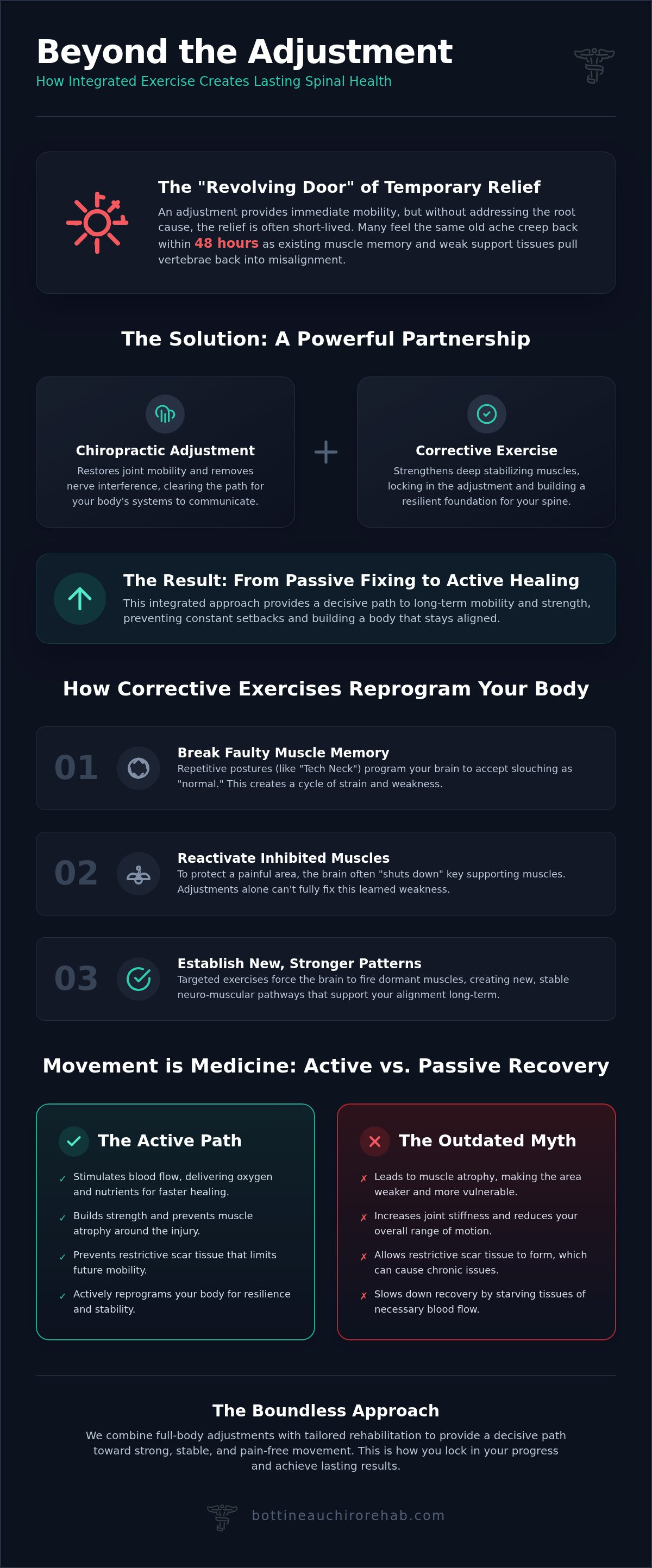
Relying on adjustments alone often leads to a revolving door experience. You feel great for forty-eight hours, but your existing muscle memory pulls the vertebrae back into misalignment. By shifting from passive fixing to active healing, you take control of your recovery. This integrated approach is essential for Bottineau families and local athletes who need to stay mobile on the field or at work without constant setbacks.
Adjustment vs. Exercise: A Partnership
The adjustment's primary job is to restore joint mobility and remove nerve interference. It clears the path for your nervous system to communicate effectively with the rest of your body. However, that newly found mobility is fragile. Specific corrective exercises lock in the adjustment by strengthening the deep stabilizing tissues surrounding the joint. Neuro-muscular synergy is the coordination between the brain and muscles to maintain stable posture and fluid motion. Without this coordination, your body remains vulnerable to the same stresses that caused the pain in the first place.
Why 'Just Resting' Might Be Slowing Your Recovery
The old advice of total bed rest for back and neck pain is a myth that often does more harm than good. Prolonged inactivity leads to muscle atrophy and increased joint stiffness. It also allows for the formation of restrictive scar tissue that limits your future range of motion. Movement is medicine. Controlled, clinical exercise chiropractic protocols stimulate blood flow, which is the delivery system for oxygen and nutrients to your healing spinal discs. While rest has its place in the first few hours of an acute injury, proactive movement is the fastest route back to a pain-free life.
How Corrective Exercises Reprogram Your Posture
Posture is more than a habit; it's a neurological program stored in your brain. Your body relies on muscle memory to navigate daily life. If you spend hours at a desk or performing repetitive labor in Bottineau, your brain eventually registers those slouched positions as "normal." This is muscle memory working against you. When chronic pain enters the picture, the brain often "shuts down" or inhibits specific muscles to protect the perceived injury. This inhibition creates a cycle of weakness and instability that adjustments alone cannot fully fix. Clinical exercise chiropractic interventions use neuro-muscular re-education to break this cycle. We force the brain to recognize and reactivate the muscles that have gone dormant.
Conditions like "Tech Neck" are the result of these failed patterns. Constant forward head posture strains the cervical spine and overworks the small muscles at the base of the skull. Corrective exercises don't just stretch tight tissues; they reprogram the firing order of your muscles. This ensures your body can handle the demands of modern life without collapsing into painful patterns. It's about moving with intent and precision.
The Brain-Body Connection
Spinal misalignments do more than cause pain; they create "noise" in your nervous system. This interference prevents your brain from receiving accurate data about your joint positions. We use specific corrective movements to send "clear signals" back to the brain. This process sharpens your proprioception, which is your body's innate sense of where it is in space. Integrated Rehab at Boundless Chiropractic focuses on clearing this communication path. By improving this feedback loop, your body becomes more resilient and less likely to slip back into old, painful habits.
Targeting the 'Deep' Stabilizers
Most people focus on "mirror muscles" like the biceps or chest. While these provide power, they don't protect your spine. Your real internal armor comes from deep stabilizers like the multifidus muscles. These tiny tissues run along your vertebrae and provide the constant, subtle support needed for a healthy back. True core strength is about endurance and timing rather than raw power. These muscles must fire a split second before you move your limbs to lock the spine in place. Our approach to physical therapy Bottineau North Dakota emphasizes these deep stabilizers. We integrate them into your daily movement patterns to provide lasting relief. If you're ready to stop the cycle of recurring pain, consider starting a customized recovery plan today.
Active vs. Passive Recovery: Choosing the Right Path
Recovery is not a single event. It's a process that requires two distinct types of care: passive and active. Passive recovery includes things like adjustments, massage, and rest. These are "done-for-you" services where the clinician does the heavy lifting to reset your system. Active recovery involves stretching, corrective exercise, and functional movement. It is a "done-by-you" commitment. Relying 100% on passive care often leads to a dependency cycle. You feel better for a few days, but because the underlying weakness remains, the pain returns. True exercise chiropractic care moves you from being a passive patient to an active participant in your own health.
This balance is especially critical for local athletes. In sports injury rehab Bottineau, we use active recovery to accelerate return-to-play times. Athletes don't just want to stop the pain; they want to regain the explosive power and stability they had before the injury. Sitting on the sidelines won't rebuild a damaged ligament or a weak core. You have to move to heal.
When to Use Passive Therapy
Passive therapy is the starting line, not the finish. It's essential during acute inflammation phases where movement is restricted or too painful to perform. This is the initial "relief" phase of a full body chiropractic adjustment. We use these passive methods to "earn" your right to move. By reducing joint interference and calming the nervous system, we create a window of opportunity. Once that sharp, stabbing pain subsides, we immediately pivot to active movement to prevent stiffness and scar tissue from taking hold.
The Long-Term Value of Active Rehabilitation
Manual labor and farming in North Dakota demand a resilient body. You can't afford to have your back go out during harvest or a busy week on the job site. Active rehabilitation builds the physical armor needed to withstand these demands. It's about more than just flexibility. It's about building the endurance and timing in your muscles so they protect your spine automatically. This approach significantly reduces the frequency of flare-ups. It empowers you to manage your own health at home. You won't just feel better; you'll be stronger and more capable of handling the physical stresses of life in Bottineau and Minot. We provide the blueprint, but active recovery gives you the foundation.
Practical Exercises for Spinal Health in Bottineau
Effective recovery in a rural community requires movements that handle real-world stress. Whether you're hauling gear or managing a shop in Minot, your body needs a specific exercise chiropractic strategy to maintain its frame. We prioritize form over intensity. Slow, controlled movements are the rule here. Fast, jerky motions often recruit the wrong muscles and lead to further strain. You must move with precision to see results.
Start with the Wall Angel to reset your shoulders. Stand with your back flat against a wall. Keep your ribs tucked down and ensure your elbows and wrists stay in contact with the surface. Slide your arms up and down slowly like a snow angel. For spinal mobility, perform the Cat-Cow on all fours. Focus on articulating each individual vertebra rather than just sagging your back. If you experience pain in your joints beyond the spine, an extremity adjusting chiropractor can help align your ankles and wrists so these movements feel fluid and natural.
The 'Big Three' for Lower Back Stability
- Bird-Dog: This movement teaches you to move your limbs while keeping your spine rock-solid. Reach one arm forward and the opposite leg back. Don't let your hips tilt or your back arch.
- Pelvic Tilts: These awaken the lower abdominals. Lie on your back and gently flatten your spine against the floor. This provides relief without putting pressure on your discs.
- Glute Bridges: Strong glutes are your low back's best defense. Squeeze your glutes to lift your hips toward the ceiling. Hold for three seconds at the top to build endurance.
Upper Body and Neck Posture Fixes
Reversing "Tech Neck" starts with Chin Tucks. Pull your head straight back as if making a double chin. This aligns your ears over your shoulders and takes the weight off your cervical spine. Follow this with Scapular Squeezes. Pull your shoulder blades down and back to open your chest and support your mid-back. For office workers, a seated thoracic rotation is vital for maintaining mid-back mobility:
- Sit tall in your chair with feet flat on the floor.
- Cross your arms over your chest.
- Rotate your ribcage to the right as far as comfortable.
- Hold for five seconds, then repeat on the left side.
Ready to build a stronger foundation? Schedule your evaluation to get a movement plan tailored to your specific physical demands.
Integrated Rehab at Boundless Chiropractic
Boundless Full Body Chiropractic & Rehab operates on a simple, effective three-pillar system: Assessment, Adjustment, and Active Rehab. We don't just look at the spot that hurts. We evaluate your entire kinetic chain to find the root cause of your dysfunction. Dr. Pozarnsky understands the unique physical demands of living in North Dakota. He tailors every exercise chiropractic plan to the specific lifestyle of Bottineau residents. Whether you're dealing with a recurring sports injury or the wear and tear of agricultural work, your recovery plan is built for your specific goals.
The real advantage of our clinic is the integration of services. You get the benefits of chiropractic care and physical therapy under one roof. This removes the friction of traveling between different providers. It also ensures that your adjustment and your rehab exercises are perfectly synchronized. This coordination is the heart of a successful exercise chiropractic program. We see how your body responds to treatment in real-time. This allows us to make immediate adjustments to your protocol. The chiropractic new patient offer provides a low-risk way to experience this comprehensive approach firsthand.
Customized Care for the Whole Family
Movement is a lifelong requirement. Our chiropractic care Bottineau family plans address the needs of every generation. We help students correct the postural strain of heavy backpacks and digital devices. We work with seniors to maintain the balance and mobility necessary for an independent life. Every plan incorporates age-appropriate exercise to ensure safety and effectiveness. The "Boundless" philosophy is clear. We avoid surgery. We avoid drugs. We focus on functional results that return you to your daily life with confidence. We treat the person, not just the symptom.
Your Next Step: The $47 Consultation
The path to lasting relief starts with a single, decisive step. Our $47 New Patient Special is designed to remove the barriers to starting your recovery. This isn't just a quick check-up. It includes a comprehensive full-body exam, a detailed consultation with Dr. Pozarnsky, and your first adjustment. We take the time to listen to your history and understand your frustrations. This data allows us to build a roadmap for your long-term mobility.
Stop waiting for the pain to disappear on its own. Pain is your body's alarm system. Ignoring it only leads to more complex issues and longer recovery times. Now is the time to take control. This offer allows you to get a professional evaluation and a clear plan of action without a massive financial commitment. Contact Boundless Full Body Chiropractic & Rehab to book your appointment in Bottineau. Start your journey toward a stronger, more resilient version of yourself today.
Take Control of Your Mobility Today
You don't have to accept recurring pain as a permanent part of your life. By combining clinical adjustments with targeted movement, you shift from temporary relief to lasting stability. This integrated approach to exercise chiropractic ensures your body has the strength to hold its alignment even under the stress of daily labor. Dr. Daniel Pozarnsky provides expert care with a comprehensive full-body and extremity focus. We proudly serve families across the Bottineau, Rugby, and Minot areas.
Stop waiting for the discomfort to fade. It's time to start building a more resilient frame. You deserve a solution that addresses the root cause and empowers you to move with confidence. Whether you are dealing with a sports injury or chronic postural strain, the right plan makes all the difference. Results that last. Mobility that returns. A life without physical limits.
Claim Your $47 New Patient Special and Start Your Rehab Journey Today. Your best days of movement are still ahead of you.
Frequently Asked Questions
Is it safe to exercise immediately after a chiropractic adjustment?
Yes, light activity is actually encouraged. Walking for 10 to 15 minutes helps your body integrate the changes from your adjustment. Avoid heavy lifting or intense gym sessions for at least 24 hours. This gives your ligaments and muscles time to stabilize in their new, correct positions. Movement is beneficial, but overexertion can trigger a protective muscle spasm.
What are the best exercises for a herniated disc?
Focus on core stability and decompression. The Bird-Dog and McKenzie press-ups are excellent for centralizing disc pressure. These movements strengthen the deep stabilizers without putting excessive load on the spine. We always tailor these to your specific disc level. Never push into sharp pain; the goal is to create space and reduce nerve irritation through controlled, gentle motion.
Can exercise replace the need for chiropractic adjustments?
No, exercise and adjustments work together as a team. Adjustments fix the structural misalignment and reset the nervous system. Exercise then builds the muscular foundation to keep that alignment in place. A complete exercise chiropractic program requires both to be successful. Without the adjustment, you may just be strengthening a crooked frame. Without the exercise, the frame won't stay straight.
How often should I perform my corrective exercises at home?
Aim for daily consistency to see real change. Performing your movements for just 5 to 10 minutes once or twice a day is more effective than one long session per week. This frequent repetition helps re-wire your brain and muscle memory. We design these plans to be simple so they fit easily into your morning or evening routine in Bottineau or Minot.
Will I be sore after doing the exercises my chiropractor recommends?
Some mild muscle soreness is common during the first week. You are likely activating small stabilizer muscles that haven't worked properly in years. This feeling is similar to the soreness after a light workout. It should disappear within a day or two. If you experience sharp, stabbing pain or increased numbness, stop the movement and call our office immediately.
Do I need special equipment to do these exercises in Bottineau?
Most corrective movements require no special tools at all. You can do the majority of your exercise chiropractic routine using a wall, a chair, or a flat floor. If your specific condition requires resistance bands or a foam roller, we'll let you know. Our goal is to make your home-care plan as accessible and straightforward as possible for every patient.
How do I know if an exercise is helping or hurting my back?
Listen to your body's signals. A helpful exercise might feel like a deep stretch or a dull muscle ache, but it should result in better mobility afterward. If a movement causes sharp pain, peripheral symptoms like tingling in your feet, or a catch in your joints, it's hurting rather than helping. Always prioritize form over the number of repetitions to stay safe.


