

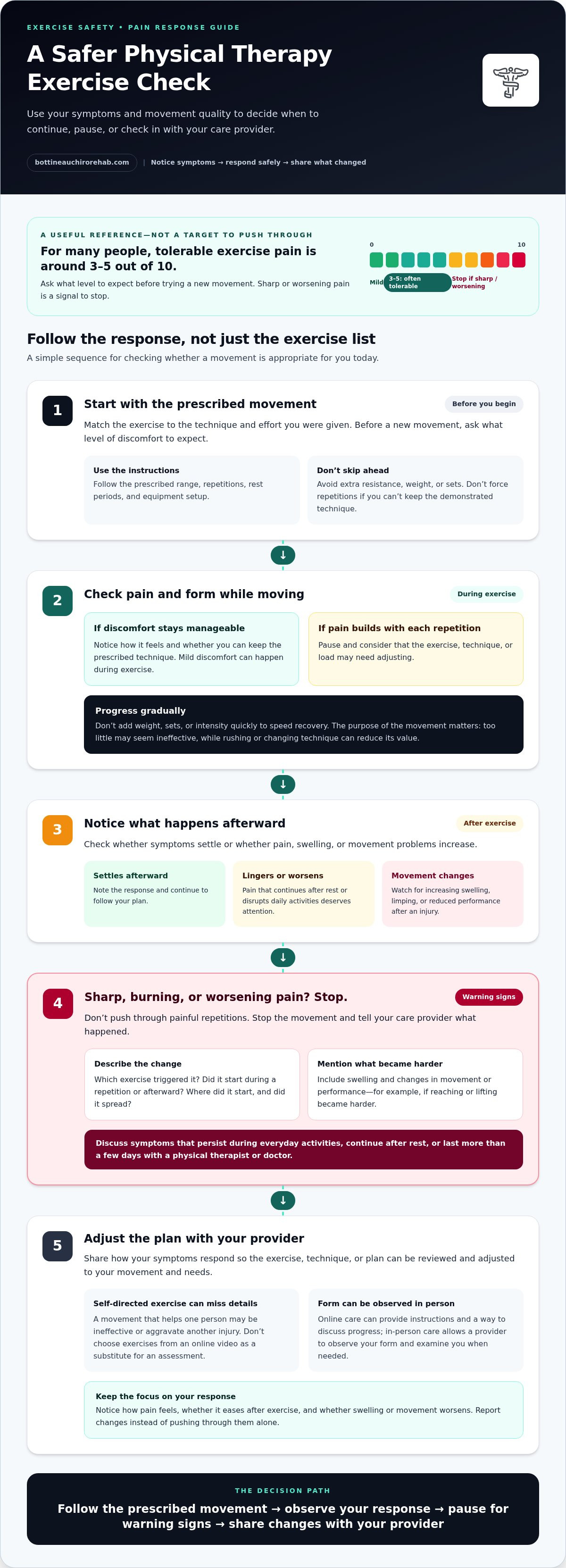
Some discomfort during physical therapy exercises can be normal, but sharp or worsening pain is a signal to stop. For many people, tolerable exercise pain is around 3 to 5 out of 10. DIY physical therapy mistakes, such as pushing too hard or using the wrong technique, can aggravate an injury instead of helping it heal.
It’s understandable to wonder whether soreness means progress or a problem. Notice how the pain feels, whether it eases after exercise, and whether swelling or movement worsens. This article explains how to interpret exercise pain, recognize warning signs, and address movement or strength issues. It also covers how rest, health, and injury severity can affect recovery, helping you make safer choices about what to do next.
Key Takeaways
- Match each exercise to the prescribed technique and effort, and adjust the routine if it leaves you feeling worse.
- Stop and report sharp pain, burning, increasing swelling, or symptoms that linger or worsen during everyday activities.
- Look beyond the painful spot: movement habits and strength in surrounding areas can influence how you recover.
- Use changes in symptoms, rest, overall health, and injury severity to guide when your recovery plan may need adjusting.
1. Is it normal to feel some pain during physical therapy exercises?
Some discomfort during an exercise can happen, but sharp or worsening pain calls for a pause. For many people, tolerable exercise pain is around 3 to 5 out of 10. Ask what level to expect before trying a new movement, then note whether symptoms settle afterward. Pain that builds with each repetition may mean the exercise, technique, or load needs adjusting.
Choosing an exercise because it looks suitable online can lead to the wrong treatment. A movement that helps one person may be ineffective or aggravate another injury. For example, spinal flexion may worsen sciatica related to a herniated disc. Don’t diagnose the cause from a video or scan alone. A 2015 systematic review examined spinal imaging from 3,110 people without back pain, according to the American Journal of Neuroradiology. Imaging findings need to be considered alongside symptoms and movement.
Online physical therapy can provide exercise instructions and a way to discuss progress, but it may not capture every detail of your movement. In-person care allows a provider to observe your form and examine you when needed. Before starting a self-directed home plan, get an assessment, preferably in person. This helps match exercises and treatment to your movement and symptoms.
Resistance bands, weights, and other equipment can cause problems if you use more resistance, weight, or sets than prescribed. Household items are not always safe substitutes for rehabilitation equipment. Follow the instructions for setup and movement, and don’t skip ahead to a harder version. If you can’t maintain the demonstrated technique, stop instead of forcing extra repetitions.
Build progress gradually. Don’t increase intensity too quickly or add weight and sets to speed recovery. Follow the prescribed range, repetitions, and rest periods. Stop if pain becomes sharp, burning, or increasingly severe. The purpose of each exercise matters: doing too little may make it seem ineffective, while rushing or changing the technique can reduce its value. Tell your therapist how your symptoms respond so the plan can be adjusted.
2. Recognizing warning signs such as sharp or lingering pain
Sharp, burning, or worsening pain is different from mild exercise discomfort. Stop the movement and tell your care provider what happened, including where the symptom started and whether it spread. Increasing swelling, limping, or reduced performance after an injury also deserves attention. Discuss pain that persists during daily activities, continues after rest, or lasts more than a few days with a physical therapist or doctor.
Give your care provider specific details, not just “it hurts.” Note which exercise triggered the pain, whether it began during a repetition or afterward, and what changed in your movement. For a shoulder injury, describe any swelling and whether reaching or lifting became harder. These details help the provider assess your response and adjust the technique or plan. After a difficult day, report worsening symptoms rather than pushing through them alone.
Choose heat and medication carefully. Applying heat right away to an acute injury can increase swelling and internal bleeding, so don’t use it automatically as a first step. Ask your clinician which comfort measures suit your symptoms and injury. Over-the-counter pain medicine may ease discomfort, but prolonged reliance can contribute to liver damage, kidney problems, or gastrointestinal issues. Don’t use medication to mask pain so you can continue a movement that worsens your symptoms.
Fear of pain can also make rehabilitation harder. Avoiding every movement may limit practice, while forcing painful repetitions can aggravate the problem. Describe what you fear, then agree on a manageable version of the exercise with your therapist. Watch for pain that travels farther down a limb, such as sciatica moving farther down the leg; this change can signal worsening symptoms. If pain or swelling keeps disrupting your routine, physical therapy support can help assess movement and guide next steps.
3. Addressing movement patterns and strength imbalances
Rehabilitation should address more than the painful joint. Weakness, limited motion, posture, and movement habits can shift stress onto nearby areas. After an ankle injury, for example, limping may strain the opposite leg. Notice whether you favor one side, shorten your steps, or avoid reaching overhead. Common DIY physical therapy mistakes include focusing only on the sore spot while overlooking these compensations. Tell your care provider about changes in how you move so exercises can address the broader pattern.
Strength work should be balanced and matched to your ability. The Centers for Disease Control and Prevention recommends that U.S. adults do muscle-strengthening activity on 2 days per week. That general target doesn’t replace an individual rehabilitation plan. A therapist may observe how you squat, lift, or climb stairs, then select movements for specific weaknesses. Ignoring an imbalance can preserve compensation even when the original injury feels better.
Daily habits also shape recovery. Break up long periods of sitting with comfortable movement, and use a posture that doesn’t repeatedly aggravate symptoms. A daily 30-minute walk can be a helpful habit for many people recovering from physical therapy. Hydration and balanced nutrition support normal body function, while consistent sleep gives your body time to recover between activities.
After surgery, follow your specific rehabilitation protocol rather than copying a general routine. Tendon or ligament reattachment procedures may require careful progression to protect the repair. Track which activities increase pain or change your movement, then share those patterns at follow-up. To avoid DIY physical therapy mistakes, consider surrounding muscles and joints as well as the injured area. A whole-body approach can support useful movement and help reduce repeated compensation during daily tasks or sports.
4. Considering multiple factors that may affect recovery
Recovery depends on more than the exercise list. Age, overall health, and injury severity affect how you respond and how quickly function returns. A muscle strain alongside another health condition may call for a different progression than a mild, recent strain. Track changes in pain, strength, and daily tasks, then share them at follow-up. This information helps show whether treatment is helping or creating new limitations.
Progress isn’t always steady. Feeling about 50% better but still unable to resume normal activity is one example of a plateau that can call for a more traditional physical therapy plan. Compare current function with specific goals, such as climbing stairs or reaching overhead, rather than judging recovery by pain alone. If progress stalls or reverses, review exercise load, diagnosis, and treatment instead of repeating the same routine. Workload, training demands, nutrition, and sleep can also affect recovery, so include relevant changes in your update.
Age-related imaging findings need context. Among people without back pain, spinal disc bulges appear in 84% of 80-year-olds. Rotator cuff changes also become more common with each decade, with or without symptoms. A scan alone doesn’t establish what is causing pain. Consider imaging alongside the patient’s history, examination, and actual movement limits before treating a finding as the diagnosis.
Share persistent back pain that doesn’t respond to treatment, along with other changes in health or symptoms. A careful history can reveal activities that increase injury risk or clues to another condition. Musculoskeletal pain can sometimes stem from serious underlying disease, including cancer, neurological disorders, or autoimmune disease. Further studies can investigate persistent back pain that fails to respond to treatment. For help reviewing your recovery concerns and next steps, discuss your physical therapy needs.
Boundless Full Body Chiropractic & Rehab: Extremity Adjusting
Boundless Full Body Chiropractic & Rehab provides extremity care for people whose joint or limb discomfort affects everyday movement. If symptoms persist, home exercises aren’t addressing the problem, or you’re unsure how to progress safely, an assessment can help identify appropriate next steps. The approach depends on the affected area, your movement, and your recovery needs.
For broader musculoskeletal concerns, Boundless Full Body Chiropractic & Rehab also provides full-body adjustments, sports injury rehabilitation, and spinal rehabilitation in Bottineau, North Dakota. These services may be relevant when pain affects more than one area or interferes with training and daily activities. Share which movements hurt, what you’ve tried, and how your symptoms change. This gives the provider useful context for assessing your concerns.
For support with movement or recovery, contact Boundless Full Body Chiropractic & Rehab or visit bottineauchirorehab.com.
Make your next recovery step a considered one
Use lessons from DIY physical therapy mistakes to make your next step more deliberate. Keep a brief record of what you tried, how your body responded, and which daily movements remain difficult. This information can help a care provider understand your priorities and shape a plan around the activities you want to return to.
Boundless Full Body Chiropractic & Rehab offers Extremity Adjusting, Full-Body Adjustments, and Sports Injury Rehab for people seeking support with movement concerns and sports-related recovery. If you’re ready to discuss your needs, contact Boundless Full Body Chiropractic & Rehab.
Steady, informed choices can help you move forward with greater confidence. Start with the next step that fits your recovery.
Frequently Asked Questions
Is it normal to feel some pain during physical therapy exercises?
Some temporary discomfort can occur, but pain that changes how you move deserves attention. Compare how you feel before exercise, during the movement, and later that day. For example, note whether stairs feel harder after a knee exercise or whether soreness settles as you move normally. Share that pattern with your care provider so they can assess whether the exercise needs to change.
Mistake 2: Why is fearing pain a problem?
Fear of pain can lead you to avoid movements that support everyday function. You might stop bending a knee or reaching with an arm, even when your care provider has selected a manageable version. Avoidance can reduce practice and make ordinary tasks feel harder. Explain what you’re worried might happen, then work with your provider on a controlled way to approach the movement.
Mistake 3: What happens when you ignore pain completely?
Ignoring pain can make it harder to notice when an exercise or activity is worsening your symptoms. Continuing to lift, run, or stretch despite a clear change may aggravate an injury and delay a useful adjustment to your plan. Don’t treat pain as something to defeat. Pause, describe what changed, and note whether the problem also appears during daily tasks or only with one movement.
Mistake 4: Why doesn’t a quick fix work?
A quick fix may ease a symptom without restoring the strength or control needed for normal activity. Feeling better at rest, for example, doesn’t show whether you’re ready to return to lifting or sports. Recovery plans should respond to changes in function, not just short-term relief. Track a practical goal, such as carrying groceries, and work toward it with appropriate guidance.
What are the most common mistakes people make doing physical therapy exercises at home?
Common errors include copying someone else’s routine, changing a prescribed movement, and exercising without a clear purpose. You might repeat a shoulder stretch but skip the movement needed for a specific daily task. Or you may rush through repetitions while distracted. Keep instructions nearby, focus on one movement at a time, and note questions to discuss at your next appointment.
How can you tell if you’re doing a physical therapy exercise with the correct form?
Correct form should follow the demonstration and instructions for your specific exercise, not merely resemble an online example. Check your starting position, movement path, and finishing position. Notice whether you’re leaning, twisting, or using another body part to complete the motion. If possible, ask your care provider to watch you perform the exercise and correct your technique before you practice independently.


