

A sprained ankle isn’t a green light to play just because you can walk. Basketball players can usually return to the court in 3 to 12 weeks, depending on injury severity; for basketball ankle sprain rehab in Dunseith, use function, not the calendar alone, to guide the decision. Before returning, you should be able to jog, sprint, jump, cut, and hop on one leg without pain or instability, with confidence and at least 90% symmetry between legs on hop tests.
It’s frustrating to sit out when you’re eager to get back on the court, but returning too soon can set recovery back. This guide to basketball ankle sprain rehab in Dunseith explains when to stop playing, how to care for and rehab a sprain, and how its severity can affect recovery. You’ll also learn the movement and strength benchmarks to work toward before returning to basketball.
Key Takeaways
- Stop playing after a sprain and judge your return by function, not eagerness to get back on court.
- Before basketball, work toward pain-free jogging, sprinting, jumping, cutting, and single-leg hopping with confidence.
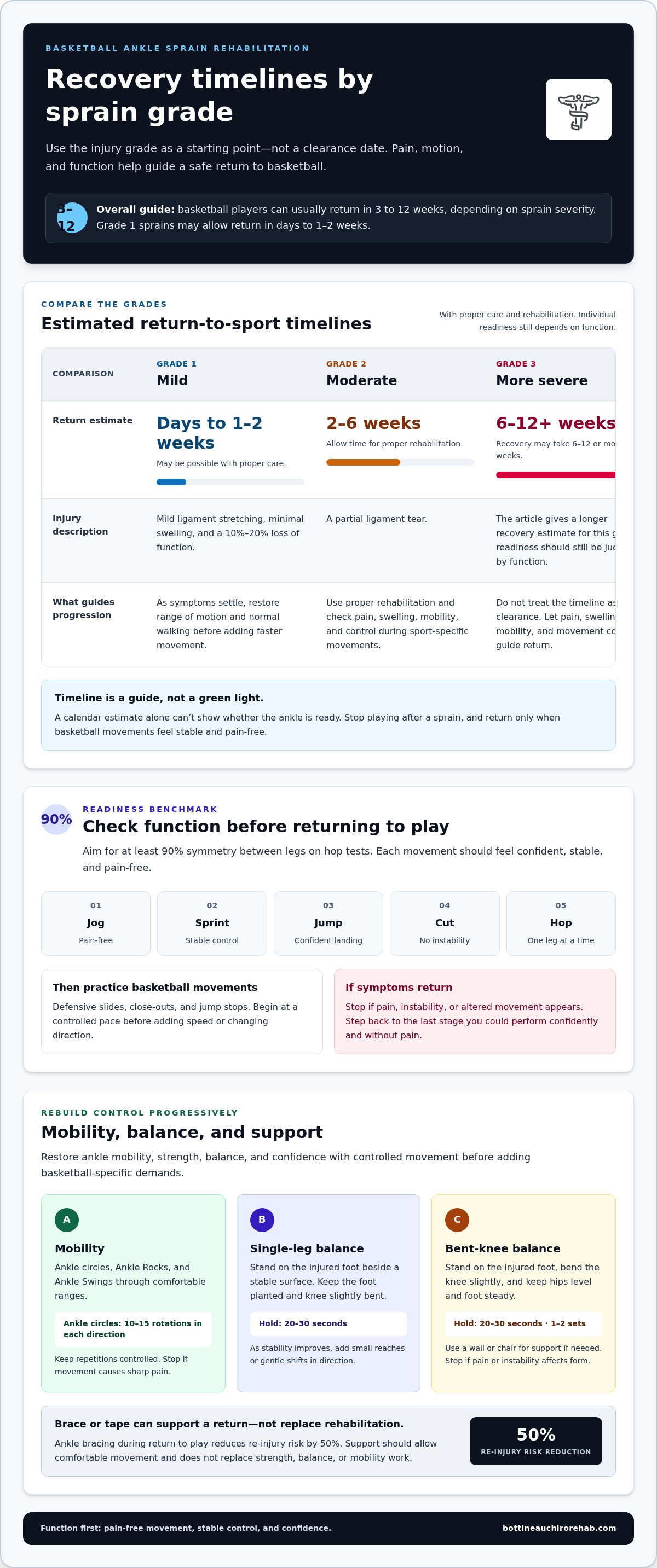
- Recovery may take 1-2 weeks for a Grade 1 sprain, 2-6 weeks for Grade 2, and 6-12 or more weeks for Grade 3.
- Rebuild ankle mobility, strength, and balance progressively; support from a brace or well-fitting shoes doesn’t replace rehabilitation.
- Pay attention to the injury’s severity and how it responds to care to guide your next steps and return to play.
Can I play basketball with a sprained ankle?
Stop playing after an ankle sprain; return only when basketball movements feel stable and pain-free. Taping or a brace can provide mechanical support and sensory feedback, and ankle bracing during return to play reduces re-injury risk by 50%.
- Use the injury grade and function to guide your timeline. Basketball players can usually return to the court in 3 to 12 weeks, depending on sprain severity. A Grade 1 sprain may allow return in days to 1-2 weeks; Grade 2 typically takes 2-6 weeks, and Grade 3 takes 6-12 or more weeks. Don’t treat these ranges as clearance. Pain, swelling, mobility, and control during sport-specific movements matter.
-
Practice Sport-Specific Return Movements
Progress from walking and jogging to sprinting, jumping, cutting, and hopping on one leg. Then practice basketball movements such as defensive slides, close-outs, and jump stops. Start at a controlled pace before adding speed or changing direction. Stop if pain, instability, or altered movement appears. Difficulty landing or pushing off suggests the ankle isn’t reliably handling that task yet.
-
Use Taping or an Ankle Brace
Use ankle taping or a brace during your return to basketball for added mechanical support and sensory feedback. Ankle bracing during return to play reduces re-injury risk by 50%. Make sure the support allows comfortable movement and doesn’t replace strength, balance, or mobility work. Treat it as one part of your return plan, not proof that the ankle is ready for full-speed play.
- Test basketball readiness before joining a game. You should be able to jog, sprint, jump, cut, and hop on the injured leg without pain or instability, while feeling confident in each movement. Hop tests can compare the injured and uninjured legs; aim for at least 90% symmetry before returning. A large gap between sides signals that explosive takeoffs and landings may still challenge the ankle.
- Build back to full play in stages. Practice each movement on its own, then combine them in sequences, such as a defensive slide into a close-out and jump stop. Check whether you can stay in control during repeated landings and direction changes, not just one successful attempt. If symptoms or instability return, step back to the last stage you could perform confidently and without pain.
Strength, balance, and mobility rehabilitation
Rebuild ankle strength, balance, mobility, and confidence with progressive exercises. Use controlled movement and steady form to restore stability before adding basketball-specific demands.
-
Build Strength and Mobility
Start with ankle circles, Ankle Rocks, and Ankle Swings to move the joint through comfortable ranges. Rotate the ankle 10-15 times in each direction. Perform Ankle Rocks and Ankle Swings in controlled, comfortable ranges, adjusting the repetitions to how your ankle feels. Keep each repetition controlled, and stop if the movement causes sharp pain.
Mobility work helps restore the range you need to bend, push off, and change direction. Check that the injured ankle moves smoothly compared with the other side. Don’t force a stiff joint or rush repetitions. Aim for deliberate movement, not speed.
-
Train Balance and Proprioception
Practice standing on the injured foot to challenge balance and proprioception, the body’s awareness of joint position. Begin beside a stable surface so you can steady yourself if needed. Hold a single-leg stance for 20-30 seconds, keeping your foot planted and your knee slightly bent. Repeat with controlled posture rather than letting your ankle roll outward.
As stability improves, add small reaches or gentle shifts in direction while maintaining your stance. These adjustments challenge ankle control without the impact of jumping. If your foot repeatedly wobbles or you need to grab support, return to a simpler position. Consistent, controlled practice helps prepare the joint for changing loads.
-
Practice the Bent Knee Balance Exercise
Stand on the injured foot, bend your knee slightly, and hold the position for 20-30 seconds. Complete 1-2 sets, keeping your hips level and your foot steady. The bent-knee position asks the ankle to maintain balance while the leg is flexed, a useful control challenge for sports movements.
Use a wall or chair for support if you lose your balance. Progress by reducing hand support, not by letting your knee collapse or ankle twist. The exercise should feel controlled. Stop if pain or instability affects your form.
- Combine the three exercises into a brief routine. Ankle Rocks, Ankle Swings, and Bent Knee Balance take five minutes or less. Start with the mobility movements, then finish with balance work while your ankle is warm. Keep your technique measured throughout each set, and adjust the movement if your form deteriorates.
- Build a repeatable plan before increasing activity. Ankle rehabilitation should restore strength, balance, mobility, range of motion, and confidence, not just reduce discomfort. If you need structured guidance progressing these exercises, Sports Injury Rehab can help tailor rehabilitation to your movement and recovery needs.
Recovery timelines by sprain grade
Use the sprain grade as a starting point, then track pain, motion, and function. A calendar estimate alone can’t tell you whether your ankle is ready for basketball.
- For a Grade 1 sprain, plan for return to sport in days to 1-2 weeks with proper care. This injury involves mild ligament stretching, minimal swelling, and a 10%-20% loss of function. As symptoms settle, restore range of motion and normal walking before adding faster movement. A mild lateral sprain still needs a gradual return, even when swelling looks limited.
- For a Grade 2 sprain, allow 2-6 weeks for return to sport with proper rehabilitation. A partial ligament tear can bring increased pain, swelling, bruising, and some instability. Build back from comfortable walking and ankle motion to strengthening and balance work. Don’t move to demanding activity just because bruising fades; the ankle also needs control when your body changes direction.
- For a Grade 3 sprain, expect 6-12 or more weeks before return to sport, with proper rehabilitation and progression. A complete ligament tear can cause significant swelling, bruising, instability, and difficulty bearing weight. Protect the ankle and restore motion and function in stages. The longer timeline reflects the greater injury and the work needed to regain dependable support for landing and pushing off.
- Account for a high ankle sprain separately. These injuries typically require 6-12 weeks of recovery, because the ligaments connecting the lower leg bones are involved. The foot is often planted while the leg twists outward. That mechanism can make normal walking and ankle motion challenging, so don’t use a typical lateral sprain timeline to judge readiness.
- Track progress through specific milestones, not just the expected week. Many players see significant improvement within 3-7 days when following an active ankle rehabilitation protocol, but improvement doesn’t equal readiness for full play. Compare the injured side’s motion, strength, balance, and confidence with the other side. Increase activity gradually, and notice whether your ankle stays stable during each new task.
- Build confidence with repeatable steps. First, regain comfortable range of motion and steady walking. Then progress through strengthening and balance exercises before testing sport movements as your control improves. Your ankle must respond to faster play as well as slow movement. If pain or instability returns at a new stage, go back to the last activity you could complete with control.
Acute ankle sprain care
Stop playing immediately after an ankle injury, protect the joint, and monitor how it responds. Seek prompt medical evaluation for severe pain, visible deformity, or inability to bear weight. For basketball ankle sprain rehab in Dunseith, early care should protect the ankle while allowing a gradual return to comfortable movement.
-
Begin Immediate RICE Care
During the first 24-48 hours, apply ice for 15-20 minutes every hour to help manage discomfort and swelling. Place a barrier between ice and skin, and stop if the skin becomes painful or numb. Avoid returning to basketball while swelling, pain, or unstable movement affects walking or landing.
Rest from play, elevate the ankle when practical, and use comfortable compression if it doesn’t increase pain or tingling. These steps may support early comfort, but they don’t show whether the ligaments are ready for basketball. Track changes in swelling and weight-bearing during the first day. Noting what worsens symptoms can help guide your next steps.
-
Apply PEACE & LOVE Acute Care
Use the PEACE portion during the first 72 hours after a sprain. Protect the ankle from painful loading, elevate it, and avoid activities that increase symptoms. Treat those first days as a protection phase, not a reason for complete inactivity beyond what pain requires.
Begin gentle ankle rehabilitation as soon as possible, including within the first 24-48 hours, using movements that stay comfortable. The first rehabilitation phase is described as days 1-7. Gradual movement can help restore function; don’t force motion or resume jumping before the ankle can tolerate basic tasks. Basketball ankle sprain rehab in Dunseith should progress according to symptoms and function, not pressure to return quickly.
-
Seek Medical Evaluation When Needed
Get prompt medical attention if pain is severe or the ankle looks deformed. Seek evaluation if you can’t bear weight on the foot, as an X-ray or MRI might be needed to check for a fracture or severe ligament damage. Don’t test the ankle with basketball movements while these warning signs are present.
If your ankle does not feel any better after 5 to 7 days, contact a health care provider, according to the National Library of Medicine. Persistent pain or swelling can interfere with walking and rehabilitation, so describe how the ankle injury happened and which movements remain difficult. For basketball ankle sprain rehab in Dunseith, this timeline is a useful prompt to seek guidance if improvement hasn’t started.
- Monitor how the ankle responds to simple daily movements. Note whether swelling increases after walking, weight-bearing becomes easier, or pain changes with gentle motion. These observations can help you describe changes during an evaluation. Don’t treat one comfortable step as proof that the ligaments can handle a basketball landing or sudden direction change.
- Restart rehabilitation exercises with control, not speed. In the days 1-7 phase, focus on movements that preserve comfortable mobility and avoid provoking sharp pain. Increase the challenge gradually as the ankle tolerates it. If swelling or instability rises after an exercise, reduce the load and return to a movement you can perform with steady control.
Basketball ankle sprain causes and severity grades
Basketball’s quick cuts, jumps, and landings repeatedly challenge ankle ligaments. Understanding how the injury happened and its severity helps clarify what recovery needs to address.
- Notice how the ankle turned during play. A lateral sprain often happens when the foot rolls inward, commonly during a landing or sudden change of direction. Lateral ankle sprains are the most frequent type in basketball, and the anterior talofibular ligament, or ATFL, is injured first in over 90% of lateral sprains. This pattern helps explain why the outside of the ankle often hurts.
- Consider the demands that led to the injury. Basketball ankle sprains account for 25-45% of injuries across all levels. A player may land on another athlete’s foot after jumping, or the ankle may roll while cutting or defending. A high ankle sprain has a different mechanism: the foot is planted while the leg twists outward. That distinction matters because the injured ligaments and recovery needs differ.
- Compare symptoms with Grade 1 features, without using symptoms alone to diagnose yourself. Grade 1 involves mild ligament stretching, minimal swelling, and a 10%-20% loss of function. Walking may remain possible, but pushing off or changing direction can still feel uncomfortable. The practical takeaway is to avoid treating a mild appearance as proof that the ankle can handle jumping, cutting, or repeated landings.
- Recognize Grade 2 signs and reduce ankle stress. A Grade 2 sprain involves a partial ligament tear and can cause increased pain, swelling, bruising, and some instability. For example, an ankle that feels unreliable during a defensive slide needs more than rest from games. Rehabilitation should restore control and strength, because basketball repeatedly challenges the joint during acceleration and landing.
- Take Grade 3 symptoms seriously. A Grade 3 sprain is a complete ligament tear that can cause significant swelling, bruising, instability, and difficulty bearing weight. Severe symptoms or trouble supporting yourself warrant medical evaluation. A previous ankle sprain is a strong predictor of future sprains, so address lingering instability instead of playing through it. For help planning recovery around ankle function, get guidance for ankle injury recovery.
Boundless Full Body Chiropractic & Rehab: Extremity Adjusting
Boundless Full Body Chiropractic & Rehab offers Extremity Adjusting and Sports Injury Rehab for people working through ankle symptoms after basketball. Consider support when pain, restricted movement, or lingering instability makes everyday activity or a gradual return to play difficult. Care can focus on your current function and the movements you need to rebuild, rather than pushing you back onto the court before you’re ready.
Sports Injury Rehab can help guide progressive work toward ankle strength, balance, mobility, and basketball-specific movement. Extremity Adjusting is another option within the practice’s care. The next step is to describe how the sprain happened and which movements remain challenging. Contact Boundless Full Body Chiropractic & Rehab to discuss support for your ankle recovery.
Make your next move with a clear plan
Getting back to basketball is not the only goal. Build a return plan that helps you trust your ankle during practice, games, and everyday movement. If discomfort or instability continues to affect your progress, professional guidance can help you choose appropriate next steps for your needs.
For basketball ankle sprain rehab in Dunseith, Boundless Full Body Chiropractic & Rehab offers Sports Injury Rehab, Extremity Adjusting, and Full-Body Adjustments. These services can support your broader recovery as you work toward comfortable, confident movement. Your next step can be a conversation about what still feels difficult and the care that may fit your situation.
Contact Boundless Full Body Chiropractic & Rehab to discuss your ankle recovery. Take it one step at a time, and keep moving toward the court with a plan that puts function first.
Frequently Asked Questions
How long does it take for an inversion ankle sprain to heal?
Basketball players recovering from an inversion sprain can usually return to the court in 3 to 12 weeks, depending on injury severity. A Grade 1 sprain may settle sooner than a Grade 3 tear, but return depends on function, not just elapsed time. For example, if your ankle still feels unstable when changing direction, that task needs attention before full-speed play.
Is jumping bad for a recovering ankle?
Jumping can overload an ankle that hasn’t regained control, especially during repeated takeoffs and landings. Don’t use jumping as an early recovery test. First build tolerance with easier movements, then progress to controlled hops and basketball-specific jumps. Notice how the ankle responds on landing. Pain, wobbling, or hesitation means the current challenge is too demanding.
Warning: What Happens If You Neglect Your Rehab?
Skipping rehabilitation can leave strength, balance, and ankle control underdeveloped, increasing the chance of ongoing instability. Chronic ankle instability affects up to 40% of athletes after an initial sprain. Players with a history of ankle injury are 4.9 times more likely to sustain another ankle injury. Follow through with progressive exercises so the ankle can better manage cutting, jumping, and landing demands.
What are the most common type of ankle injuries in basketball players?
Lateral ankle sprains are the most frequent type in basketball and commonly involve the anterior talofibular ligament, or ATFL. They often happen when a player’s foot rolls inward during a landing or cut. A high ankle sprain is different: it usually occurs when the foot stays planted as the leg twists outward. This mechanism can affect the ligaments connecting the lower leg bones.
Why does my ankle feel “loose” months after a sprain?
A loose feeling can signal lingering instability after the initial injury. The ankle may struggle to stay controlled during quick direction changes, uneven landings, or single-leg balance. Don’t dismiss repeated giving-way as normal soreness. Note which movement brings it on, whether swelling returns, and how the injured side compares with the other. Persistent instability deserves attention because a previous ankle injury predicts future sprains.
What are the symptoms and grades of a basketball ankle sprain?
Grade 1 involves mild ligament stretching, minimal swelling, and a 10%-20% loss of function. Grade 2 is a partial ligament tear, often with more pain, swelling, bruising, and some instability. Grade 3 is a complete tear and can bring substantial swelling, bruising, instability, and difficulty bearing weight. These signs help describe severity, but severe pain or deformity calls for prompt evaluation.
What is the recommended first 48-hour care for a basketball ankle sprain?
Stop playing, protect the ankle, and use ice for 15-20 minutes every hour during the first 24-48 hours. Keep ice off bare skin, and avoid returning to play while pain or swelling disrupts walking. Seek prompt medical attention for severe pain, deformity, or inability to bear weight. If your ankle doesn’t feel better after 5 to 7 days, contact a health care provider.
What ankle sprain rehabilitation exercises and progression are recommended?
Begin with comfortable ankle circles, rotating 10-15 times in each direction. Add Ankle Rocks for 1-2 sets of 15-20 repetitions per side, then Ankle Swings for 1-2 sets of 10-15. Progress to single-leg balance, holding for 20-30 seconds, before adding more challenging movement. Keep your form steady; if pain or instability changes how you move, reduce the challenge.


