

A sudden force can snap the neck forward and backward, straining muscles and other soft tissues. Whiplash often follows a rear-end collision, but sports impacts and falls can cause it too. Effective whiplash treatment in Rugby, ND, starts with understanding the injury and matching care to your symptoms, movement, and goals.
Neck pain and stiffness may not appear right away. Symptoms can develop hours or days after an injury, so feeling fine immediately afterward does not always mean your neck is unaffected.
If you’re an athlete, getting back to play takes more than waiting for soreness to fade. This article explains what whiplash is, how symptoms develop, and how chiropractic care, rehabilitation exercises, and sport-specific progression can support recovery. You’ll also learn why returning to activity should take strength, range of motion, and pain into account. Clear steps, focused on helping you move forward safely.
Key Takeaways
- Whiplash can follow a collision, fall, or sports impact. Neck pain and stiffness may develop hours or days later, so pay attention to symptoms after an injury.
- Recovery care should match your symptoms, neck movement, and daily demands. Chiropractic adjustments may be one part of a broader plan.
- Gentle, progressive exercises can help restore movement and build strength. Learn how to approach common movements without pushing through worsening pain.
- Athletes should build back toward sport-specific movements gradually. Strength, range of motion, and pain all matter when judging readiness to return.
- After a car accident, early care may include ice and a gradual return to gentle movement. Find out how treatment can progress as symptoms change.
Whiplash definition and causes
A sudden change in body motion can force the neck forward and backward, straining tissue. Understanding how whiplash happens can help you recognize risks beyond car crashes.
Whiplash Causes and Common Injuries
Whiplash is a neck injury caused by rapid back-and-forth movement. A rear-end car accident is a common cause, but falls, workplace accidents, physical abuse, and other trauma can produce similar motion. The force may affect muscles, disks, nerves, and tendons. Because these tissues support neck movement, an injury can cause pain, stiffness, or difficulty turning your head.
Sports-Related Whiplash Risks
In sports, whiplash can follow a collision, awkward fall, or sudden stop that sharply changes body motion. Contact sports create opportunities for player-to-player impact, but an unexpected landing can also jolt the neck. A 19-year-old college soccer player, for example, developed whiplash after a mid-air collision. Recognizing the cause matters because an athlete may need evaluation before returning to full activity.
Not every neck injury involves direct contact. A sudden impact can move the torso while the head continues in another direction, placing force on neck tissue. Similar forces can occur during a car crash or fall. The direction and intensity of movement, along with the tissues affected, help explain why symptoms and movement limitations vary from person to person.
Can you get whiplash treatment in Rugby, ND without a referral? You can seek an evaluation for neck symptoms after an injury, though insurance coverage and referral requirements may depend on your plan. For whiplash treatment in Rugby, ND, describe how the injury happened and when your symptoms began.
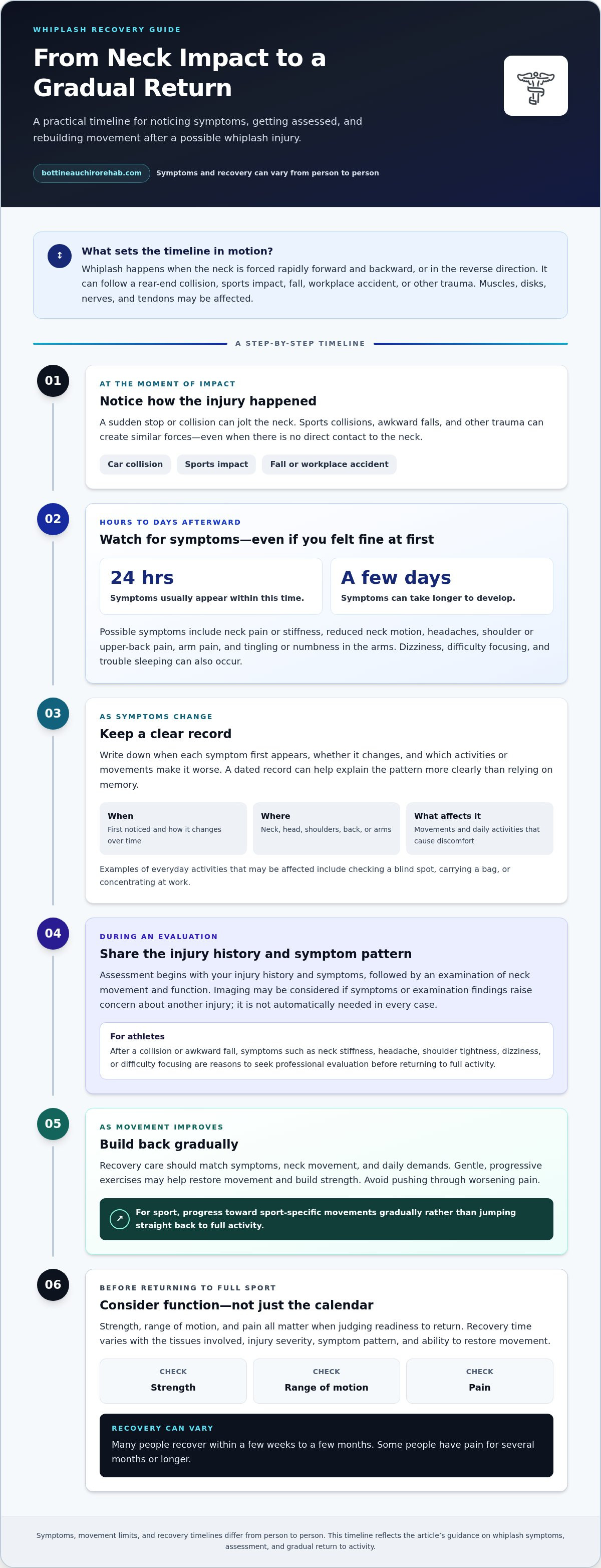
How is whiplash diagnosed, and what tests may be needed? Assessment begins with your injury history and symptoms, followed by an examination of neck movement and function. Imaging may be considered if symptoms or examination findings raise concern about another injury. It is not automatically needed in every case.
How long does whiplash recovery usually take, and what affects it? Many people recover within a few weeks to a few months. The tissues involved, injury severity, symptom pattern, and ability to restore movement can affect the course. Some people have pain for several months or longer, so recovery time varies with the injury and its effects.
A sudden change in body motion, such as stopping during a car accident or a similar event, can result in whiplash. Causes also include sports injuries, falls, work-related accidents, and physical trauma. Whiplash occurs when the neck is forced forward and then backward, or in the reverse direction.
Whiplash symptoms
Symptoms may begin after the initial impact, not only at the scene of a collision. Noticing changes over the following days helps you describe the injury clearly and seek an appropriate evaluation.
Common Whiplash Symptoms
Whiplash symptoms include neck pain and stiffness, reduced neck motion, headaches, and pain in the shoulders, upper back, or arms. Some people also experience tingling or numbness in their arms. These symptoms can affect everyday tasks, such as checking a blind spot, carrying a bag, or concentrating at work. Note which movements cause discomfort and where symptoms travel.
Delayed Symptom Development
Symptoms usually appear within 24 hours, but they can take a few days to develop after an accident. The initial rush and distraction of a collision may also make subtle discomfort harder to notice. Track the first time each symptom appears, whether it changes, and which activities make it worse. A dated record gives a clearer picture than relying on memory later.
For example, neck stiffness may become noticeable the morning after a crash, followed by a headache or shoulder tightness. Other possible symptoms include dizziness, difficulty focusing, trouble sleeping, or migraines. Symptoms vary: one person may have reduced neck motion, while another notices arm tingling. Changes over time matter, especially if pain spreads or daily movement becomes harder.
Athletes should watch for symptoms after a collision or awkward fall, even if they initially feel ready to continue. Neck stiffness, a headache at the base of the skull, shoulder tightness, dizziness, or difficulty focusing can affect sport movements and concentration. Playing through discomfort does not prove the injury is minor. Seek professional evaluation before returning to full activity if symptoms follow an impact.
After a car accident in North Dakota, record the date, time, collision details, and symptoms as they develop. Keep copies of medical evaluations, treatment records, and related expenses, and share accurate information with the insurer handling your claim. These steps create a useful record but do not establish eligibility or guarantee compensation.
Persistent pain can last several months or longer for some people. If symptoms interfere with training, work, or routine movement, sports injury rehabilitation can help assess function and support a planned return to activity. A gradual return matters for athletes. Readiness is assessed through strength, motion, and pain, not simply the time since the collision.
When seeking effective whiplash treatment Rugby ND patients should note that symptoms often appear hours or days after an accident. They may include neck tension, discomfort, headaches, migraines, insomnia, or difficulty concentrating.
Chiropractic adjustments
Chiropractic care for whiplash may include neck and spinal adjustments, depending on injury severity. The goal is to address restricted motion and support mobility as part of a broader recovery plan, rather than treating every neck injury the same way.
An evaluation connects your injury history with current movement and symptoms. Difficulty turning your head, pain during a particular motion, or symptoms extending into an arm can help identify areas needing attention. The tissues affected and the severity of the injury also matter. Assessment is an important step before choosing an adjustment or other therapy.
What are the risks of chiropractic neck manipulation for whiplash? One concern is using a technique without accounting for injury severity or the tissues affected. Because whiplash can involve muscles, disks, nerves, and tendons, adjustments should be selected after an assessment and adapted to your symptoms and movement.
Chiropractic treatment may be combined with manual therapy and progressive strength training. Manual therapy works with soft tissues and movement, while strengthening builds capacity for everyday tasks. In one sports-related example, a college soccer player received four weeks of adjustments, manual therapy, and progressive strength training. This illustrates a combined approach, not a fixed plan for every neck injury.
Therapy should connect to practical goals. Turning to check traffic, carrying a backpack, or resuming a sport each requires different movement and control. A care plan can track whether neck motion improves and tasks become easier. Progress with those activities shows how treatment relates to daily function.
Medication may be part of whiplash care alongside physical therapy or chiropractic treatment. Options can include nonsteroidal anti-inflammatory medicines such as ibuprofen, muscle-relaxing medicines, and topical gels or injections into the neck to ease pain. Medication addresses discomfort, while movement and rehabilitation work on restoring function. Tell the treating professional what medicines you already use so the overall approach accounts for them.
For athletes, adjustments alone do not show whether the neck is ready for play. Strength, motion, and pain levels help guide return-to-play decisions. Sports injury rehabilitation can connect treatment with progressive training and sport-specific demands. A soccer player, for example, needs to turn the head, track play, and tolerate contact-related movement before returning to full activity.
Care should adapt as function changes. If neck motion remains limited, daily movements still provoke pain, or sport demands reveal weakness, the next therapy focus can address those barriers. Appropriate chiropractic care, physical therapy, and progressive exercise can keep attention on mobility, strength, and the activities you need to regain.
Rehabilitation exercises and postural training
After a sudden neck injury, guided movement can help restore mobility and build strength. Exercise plans may progress from gentle neck movement to everyday and sport-specific tasks.
Exercise and Neuromuscular Rehabilitation
Neuromuscular rehabilitation uses controlled exercise to improve how muscles support movement. After whiplash, that can mean practising neck control before adding more demanding tasks. Corrective exercises may reduce discomfort, strengthen neck and back muscles, and lower the risk of further injury. Progress should reflect movement quality and function, not simply a desire to resume activity quickly.
At-Home Neck and Shoulder Exercises
Common at-home movements include chin tucks, shoulder blade squeezes, and gentle neck rotations and side bends. These exercises practise controlled neck and shoulder movement without equipment. Use the technique and range of motion taught during care rather than forcing a stretch. If turning your head is difficult, gentle rotations can practise that movement as part of recovery.
Corrective Exercises and Postural Training
Corrective exercises combine strength and movement practice with attention to posture during daily tasks. For example, notice whether your head drifts forward while reading or using a phone, then practise a comfortable, supported position. Postural training also applies to desk work, driving, and lifting. Changing position and moving regularly can help limit stiffness associated with prolonged inactivity.
Does physical therapy help whiplash, and when should it start? Physical therapy can evaluate and treat muscles affected by whiplash as soon as possible after the injury. A therapist can match exercises to your symptoms, neck motion, and the activities you need to regain.
Exercise works best as a progression, not as a single stretch repeated without purpose. A plan can begin with comfortable movement, then build toward strength and functional control. For instance, practise turning your head before adding a task that requires repeated head turns. Prolonged inactivity can contribute to stiffness, while measured movement supports a gradual return to function.
Athletes can progress from basic neck control to drills that reflect their sport. A soccer player may practise tracking play with controlled head turns before adding faster movement. Gradually reintroducing sport-specific drills can help rebuild confidence in movement. Return-to-play readiness considers strength, motion, and pain, rather than relying only on the time since injury.
Persistent or chronic discomfort can make ordinary movement harder, so track how exercises affect your function. Note whether you can turn farther, sit more comfortably, or complete a familiar task more easily. These examples help show whether the current exercise level is useful or needs adjustment. Focus on controlled movement and steady recovery, not pushing through pain.
What treatments are recommended for whiplash after a car accident?
After a car accident, whiplash care can combine symptom relief, professional assessment, and gradual movement. The right approach depends on the injury, your symptoms, and how neck motion changes during recovery.
Arrange an assessment when neck discomfort appears after a crash. Physical therapy can evaluate and treat muscles affected by whiplash as soon as possible after the injury. Describe how the accident happened, when symptoms began, and which movements increase discomfort. This information helps guide care and identify how the injury affects everyday movement.
For early self-care, Johns Hopkins Medicine describes ice during the first 24 hours and gentle, active movement after 24 hours as possible whiplash treatments. Apply ice for 20-30 minutes at intervals throughout the day. Resting the neck immediately after injury can allow soft tissues to heal, but prolonged inactivity can contribute to stiffness.
As initial inflammation subsides, heat may help relax tight muscles and improve circulation. Heat is often considered within 48-72 hours after the initial inflammation has subsided. Use the changing response of your neck as a guide: for example, note whether warmth eases muscle tightness or increases discomfort.
Movement should be gentle and active, not forced. After the first 24 hours, comfortable neck movement can help maintain mobility. A physical therapist can match movement and exercise to your symptoms and function. If turning your head remains difficult, that limitation can guide treatment and later exercise progression.
Other treatment options may include physical therapy, osteopathic manipulation, and medicines. Medicines can include nonsteroidal anti-inflammatory drugs such as ibuprofen, muscle-relaxing medicines, and topical gels or injections into the neck to ease pain. Each option has a different role. Tell the professional evaluating you about your symptoms and medicines so the care plan accounts for your situation.
Chiropractic care may also be considered after an accident or when discomfort appears. Treatment can include neck and spinal adjustments, depending on injury severity. A professional assessment helps determine whether this approach fits the injury and how it should work alongside movement or other therapy. Track changes in pain, stiffness, and motion between visits.
Recovery is easier to monitor when you note practical changes, such as turning your head to check traffic or sitting comfortably. If pain persists or movement remains limited, a focused whiplash recovery assessment can help identify appropriate next steps.
Boundless Full Body Chiropractic & Rehab: Extremity Adjusting
Boundless Full Body Chiropractic & Rehab provides extremity adjusting and full-body adjustments as part of its chiropractic care in Bottineau, North Dakota. After a whiplash injury, an evaluation can help identify movement limits and whether an adjustment is appropriate. For athletes working toward a return to sport, sports injury rehabilitation supports recovery through function-focused care.
Consider reaching out when neck discomfort or restricted movement affects daily tasks, training, or your return to activity. Bring a clear account of how the injury happened and which movements remain difficult. This gives the care team useful context for discussing next steps.
Contact Boundless Full Body Chiropractic & Rehab or visit bottineauchirorehab.com to learn more.
Choose a Clear Next Step Toward Recovery
Make your next goal specific. Choose a daily movement or sport task you want to regain, such as turning comfortably while driving or returning to a familiar drill. Sharing that goal can help shape a recovery plan around the movements that matter in your life. For whiplash treatment in Rugby, ND, focus on care that addresses your current function and supports your next steps without rushing your return.
Boundless Full Body Chiropractic & Rehab provides extremity adjusting, full-body adjustments, and sports injury rehabilitation in Bottineau, North Dakota. These services can be part of a care plan focused on movement and recovery. If ongoing neck discomfort or restricted motion affects your routine, contact the practice to discuss your needs and next steps.
Contact Boundless Full Body Chiropractic & Rehab to take the next step. Steady, goal-focused progress can help you move forward with confidence.
Frequently Asked Questions
What is whiplash?
Whiplash is a neck injury caused by rapid back-and-forth movement of the head and neck. It can happen in a vehicle crash, sports collision, or fall. The force may affect soft tissues and other neck structures, so symptoms can involve more than soreness in one spot. For example, discomfort may interfere with turning your head, sleeping comfortably, or concentrating at work.
When should I call my healthcare provider?
Contact a healthcare provider if neck discomfort, stiffness, headache, or limited movement develops after an accident. An assessment is also useful if symptoms persist, spread into an arm, or interfere with routine activities such as driving or working. Keep a brief record of when symptoms began and which movements affect them. This gives the provider practical context to evaluate your neck and decide what care may help.
Why Treat the Condition?
Treatment can address pain and movement problems that interfere with work, sleep, driving, or sport. It can also help you understand which activities to modify while your neck recovers. Some people experience persistent pain for several months or longer, so ongoing symptoms deserve attention rather than being ignored. A useful goal is to restore comfortable function for specific daily tasks, then build toward more demanding activities.
When should someone with whiplash seek emergency medical care?
Seek emergency medical care after an accident if symptoms are severe, rapidly worsening, or include new weakness, numbness, or difficulty moving normally. These changes need prompt assessment because they may signal an injury requiring urgent medical attention. Do not drive yourself if symptoms make driving unsafe. For mild but persistent symptoms, contact a healthcare provider for an evaluation and guidance on appropriate next steps.
What pain relief medicines and home care are recommended for whiplash?
Home care may include ice during the first 24 hours, followed by gentle active movement after 24 hours, according to Johns Hopkins Medicine. Pain-relief options can include nonsteroidal anti-inflammatory medicines such as ibuprofen, muscle-relaxing medicines, or topical gels. Rest the neck initially, then avoid prolonged inactivity. Medication choice depends on your health and other medicines, so discuss suitable options with a healthcare professional.
Which clinics, physical therapists, or chiropractors treat whiplash in Rugby, North Dakota?
Boundless Full Body Chiropractic & Rehab in Bottineau provides chiropractic care, physical therapy, and Sports Injury Rehab for people addressing musculoskeletal injuries. The practice is located at 116 E. 6th St., Bottineau, ND 58318. For someone in Rugby seeking whiplash-related care, these services can support evaluation and rehabilitation focused on movement and function. Contact the practice to discuss your symptoms and care needs.


