

Outer-hip pain isn’t always a problem inside the joint. Hip bursitis is irritation of a small, fluid-filled sac that cushions the hip, often after repeated pressure or movement. Physical therapy treatment for hip bursitis can help manage symptoms by modifying aggravating activities and gradually building hip and core strength.
Pain while walking, lying on your side, or getting through a workday can be frustrating. A physical therapy plan for hip bursitis can focus on easing irritation and helping you move more confidently, rather than pushing through pain.
Learn how physical therapy may support recovery, how to try an external rotator stretch, and how to build back toward daily tasks, work, and sports. You’ll also find practical guidance on modifying activity and progressing exercises at a steady pace.
Key Takeaways
- Recognize common hip bursitis pain patterns and the movements or positions that may aggravate them.
- Learn how to perform a clamshell with controlled movement and avoid letting your hips roll backward.
- Follow clear positioning and hold-time instructions for a gentle external rotator stretch.
- Use gradual activity changes to work toward daily tasks, work, and sports without rushing your return.
How Can a Physical Therapist Help?
Physical therapy for hip bursitis can address pain while helping restore movement and strength. Recovery often takes weeks with treatment, according to Mayo Clinic, but progress depends on symptoms and activity demands.
-
Begin Hip Exercises Gradually
Begin with gentle movement and follow a healthcare professional’s guidance on when to start. A physical therapist may begin with passive hip movements, then progress to active exercises and stretches. Move slowly and check that each motion doesn’t increase pain. A gradual start helps identify which movements your hip tolerates before you add effort. This step-by-step approach keeps the exercise plan matched to your current ability.
-
Perform the Clamshell Exercise
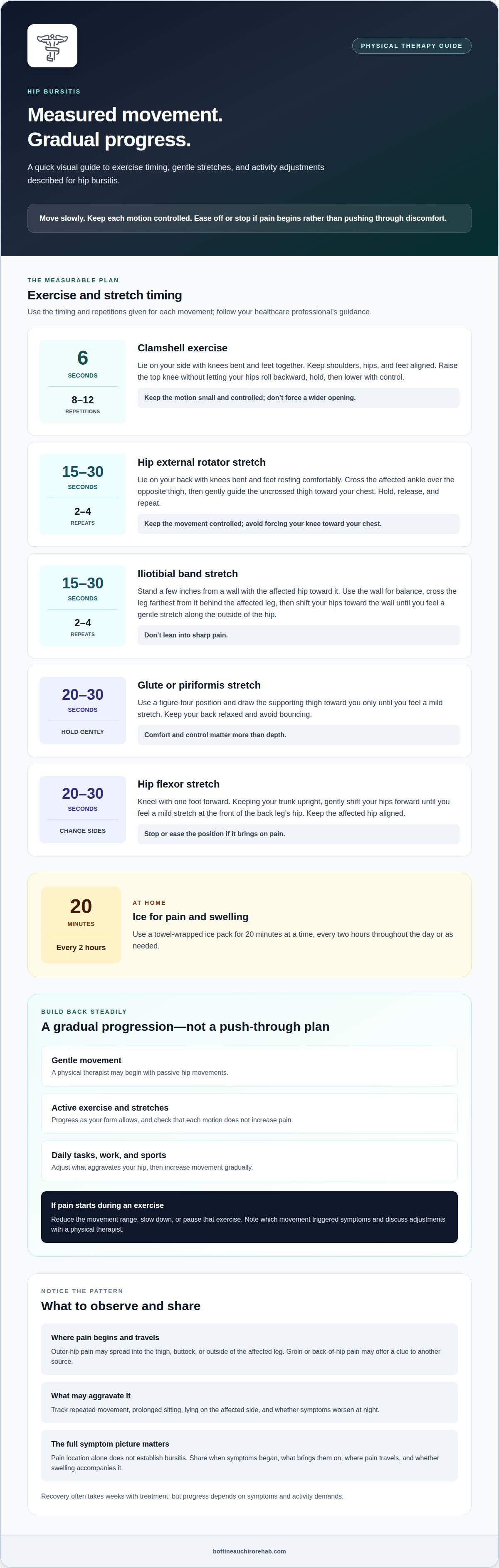
Lie on your side with your knees bent and feet together. Keep your shoulders, hips, and feet aligned, then raise your top knee without letting your hips roll backward. Hold for about 6 seconds, then lower with control. Repeat 8 to 12 times. This physical therapy exercise for hip bursitis targets muscles that support steadier movement. Keep the motion small and controlled rather than forcing a wider opening.
-
Build Hip and Glute Strength
Follow a therapist-directed plan to strengthen your hip, glutes, and core. These muscles may also be weak or injured, and strengthening can help restore strength and agility during recovery. Progress from controlled movements to active exercises as your form allows. For example, during a prescribed side-lying lift, keep your leg straight and avoid letting your hip roll backward.
-
Adjust Exercises When Pain Starts
Ease off if an exercise causes pain. Reduce the movement range, slow down, or pause that exercise instead of pushing through discomfort. Note which movement triggered symptoms, such as a clamshell or a lift that makes walking more uncomfortable. A physical therapist can adjust your plan and guide your progression. Prioritize controlled movement over extra repetitions.
Hip bursitis symptoms and causes
Hip bursitis is irritation and inflammation of a cushioning sac near the hip, often following repeated pressure or movement. Symptoms commonly include outer-hip pain that may spread into the thigh, buttock, or outside of the affected leg.
-
Locate the Hip Pain
Notice where the pain begins and where it travels. Greater trochanteric bursitis, the most common form of hip bursitis, usually affects the outer hip and may extend into the thigh, buttock, or outside of the leg. Pain around the groin or back of the hip may offer a clue to the source of hip pain. Pain location offers a clue, but a healthcare professional considers the full symptom pattern to distinguish bursitis from other hip problems.
-
Understand Possible Causes
Track repeated movements and positions before symptoms appear. Hip bursitis usually develops through repeated irritation rather than one sudden injury. Prolonged sitting without moving around is another possible cause. Greater trochanteric bursitis is commonly seen in females between 40 and 60 years old. It is also most common in people with osteoarthritis, though younger people without arthritis can develop it. These patterns describe risk, not a diagnosis for every patient.
- Note which activities aggravate your hip. Outer-hip or groin pain may worsen at night, and repeated pressure or movement can keep an irritated bursa sore. Record whether symptoms follow prolonged sitting, a repeated activity, or lying on the affected side. This sequence can help a healthcare professional understand when discomfort starts, what changes it, and whether swelling accompanies the pain.
- Describe your symptoms clearly to a healthcare professional. Explain whether pain is at the outer hip, groin, or back of the hip, and whether it spreads down your leg. Bursitis can resemble other hip conditions, so pain location alone does not establish the cause. Share when symptoms began and which movements bring them on. These details help clarify the pattern and guide the next step.
Hip external rotator stretch
Use gentle stretches to add controlled movement around the affected hip. Move slowly, and stop or ease off if pain begins.
- Try the hip external rotator stretch. Lie on your back with your knees bent and feet resting comfortably. Cross the ankle of the affected leg over the opposite thigh, then guide the uncrossed thigh gently toward your chest. Keep the movement controlled. Hold the stretch for 15 to 30 seconds, then release. Repeat 2 to 4 times, and avoid forcing the knee toward your chest.
- Stretch the iliotibial band carefully. Stand a few inches from a wall, with the affected hip toward it. Place a hand on the wall for balance, then cross the leg farthest from the wall behind the affected leg. Shift your hips toward the wall until you feel a gentle stretch along the outside of the hip. Hold for 15 to 30 seconds and repeat 2 to 4 times. Don’t lean into sharp pain.
- Add a gentle glute stretch. For a piriformis or glute stretch, use a figure-four position and draw the supporting thigh toward you only until you feel a mild stretch. Keep your back relaxed and avoid bouncing. Hold for 20 to 30 seconds. This can complement other hip and leg stretches, including those used for trochanteric bursitis, but comfort and control matter more than depth.
- Include a hip flexor stretch if it feels comfortable. Kneel with one foot forward, then gently shift your hips forward while keeping your trunk upright. You should feel a mild stretch at the front of the back leg’s hip. Hold for 20 to 30 seconds, then change sides. Keep the affected hip aligned, and stop or ease the position if it brings on pain. A healthcare professional can help select stretches that suit your symptoms.
Returning to daily, work, and sports activities
Return to activity by adjusting what aggravates your hip, then increasing movement gradually. For pain and swelling at home, use a towel-wrapped ice pack for 20 minutes at a time, every two hours throughout the day or as needed. Mayo Clinic recommends ice during the first 48 hours after symptoms start.
-
Rest and Modify Activity
Reduce activities that trigger hip pain, but choose gentler movement rather than stopping all activity. Walking, swimming, or biking may be more comfortable alternatives while symptoms settle. For example, shorten a walk if discomfort builds, then resume at a comfortable pace. A walking cane or another assistive device may reduce pressure on the affected area. Use one if it makes daily movement easier.
-
Avoid Aggravating Movements
Pause high-impact activities such as running and jumping while they provoke pain. Repeatedly pushing through painful movement can keep the area irritated. Change positions during work or other prolonged tasks, and avoid lying directly on the painful side if that worsens symptoms. Trochanteric bursitis affects the outer hip, so modify movements or pressure that increase pain there. Arthritis can also contribute to hip symptoms, making appropriate activity adjustments important.
- Build back toward work and daily tasks in manageable stages. Start with necessary movements, such as standing from a chair or walking across a room, then increase the task as your hip tolerates it. At work, break up long periods of sitting with gentle movement. Notice how your hip feels during and after each activity, and scale back if pain returns.
- Prepare for sports with a warm-up before practice or heavy physical activity. Increase activity gradually rather than jumping straight to your previous intensity. For example, add duration or effort in small steps, not both at once. Give your muscles time to adapt, and watch for hip pain during drills, running, or jumping. Get support planning your return to activity if hip symptoms are limiting daily movement or sport.
Boundless Full Body Chiropractic & Rehab: Physical Therapy
Boundless Full Body Chiropractic & Rehab provides physical therapy in Bottineau for people whose hip pain limits walking, work, or exercise. A physical therapist can adapt movements and build a plan around your symptoms and everyday goals. If hip problems affect sports, Sports Injury Rehab can support your return to activity. Extremity Adjusting and Full-Body Adjustments are also part of the practice’s care.
Consider support if pain keeps returning, exercises are difficult to perform comfortably, or daily tasks remain challenging. Bring details about which movements aggravate your hip and what you want to resume. Contact Boundless Full Body Chiropractic & Rehab in Bottineau to discuss physical therapy for your hip and your next steps.
Make Your Next Move With Confidence
Connect your recovery plan with the activities that matter to you. That might mean getting through a workday more comfortably, returning to a favorite sport, or handling everyday errands with less disruption. Keep your goals specific so your care team can shape progress around your routine.
Physical therapy for hip bursitis can focus on the movements and activities you want to manage. Bring a clear account of what feels difficult and what you hope to resume. That conversation can help turn general recovery goals into a practical direction for care.
Boundless Full Body Chiropractic & Rehab can help you take that next step. Contact Boundless Full Body Chiropractic & Rehab to discuss your hip concerns and goals. Start with the activity you most want to get back to, and move forward with a clearer plan.
Frequently Asked Questions
What is hip bursitis?
Hip bursitis is inflammation of a bursa, a small fluid-filled sac that cushions tissues near the hip. The sac helps reduce friction as nearby structures move. Bursitis describes irritation around the joint, not necessarily damage inside the hip joint itself. Because other hip problems can cause similar discomfort, pain alone cannot confirm the condition.
Can This Injury or Condition Be Prevented?
You can reduce repeated irritation by changing positions and varying tasks that repeatedly load your hip. If you sit for long periods, take movement breaks instead of staying still all day. Before sports or strenuous activity, warm up and increase your workload gradually. Keep track of movements that trigger discomfort, then modify them rather than repeating them at the same intensity.
How Is It Diagnosed?
Hip bursitis is assessed by considering symptoms and whether another cause better explains the pain. X-rays and MRI scans are typically not needed to diagnose it. X-ray images can help rule out other causes, while ultrasound or MRI may help with diagnosis. Blood tests or analysis of fluid from an inflamed bursa may help identify what is causing symptoms.
Treating Hip Bursitis with Physiotherapy: What Works Best?
A useful physical therapy plan matches treatment to your symptoms and movement limits. It may begin with activity changes or passive hip movement, then progress to active exercise and stretching. Strengthening the hip and core can address weakness during recovery. For people in Bottineau, an in-person physical therapy assessment can help tailor exercises to daily tasks, such as standing from a chair or walking at work.
What are the effective physiotherapy interventions for managing hip bursitis?
Physical therapists may use methods such as activity modification, ice, heat, ultrasound, electrical stimulation, taping, exercise, or massage to address pain and swelling. Not every method suits every person or stage of recovery. A therapist may begin with passive movement, then adjust the approach as active movement becomes more comfortable. The plan can focus on restoring useful movement, not just easing symptoms at rest.
What physical therapy exercises help hip bursitis?
Side-lying hip abduction is one option for strengthening the hip. Lie on your side and raise the affected leg about 30 centimetres (12 inches), keeping the kneecap pointed forward and your hip from dropping back. Hold for about 6 seconds, then lower with control. Repeat 8 to 12 times. Start slowly, follow professional guidance, and ease off if pain begins.


