

If you’re searching “numbness and tingling in arm chiropractor,” you may be trying to figure out whether the sensation is coming from your neck, shoulder, or arm, and whether it needs urgent attention. Tingling can have several causes, so the right next step depends on an appropriate evaluation, not just the location of the sensation.
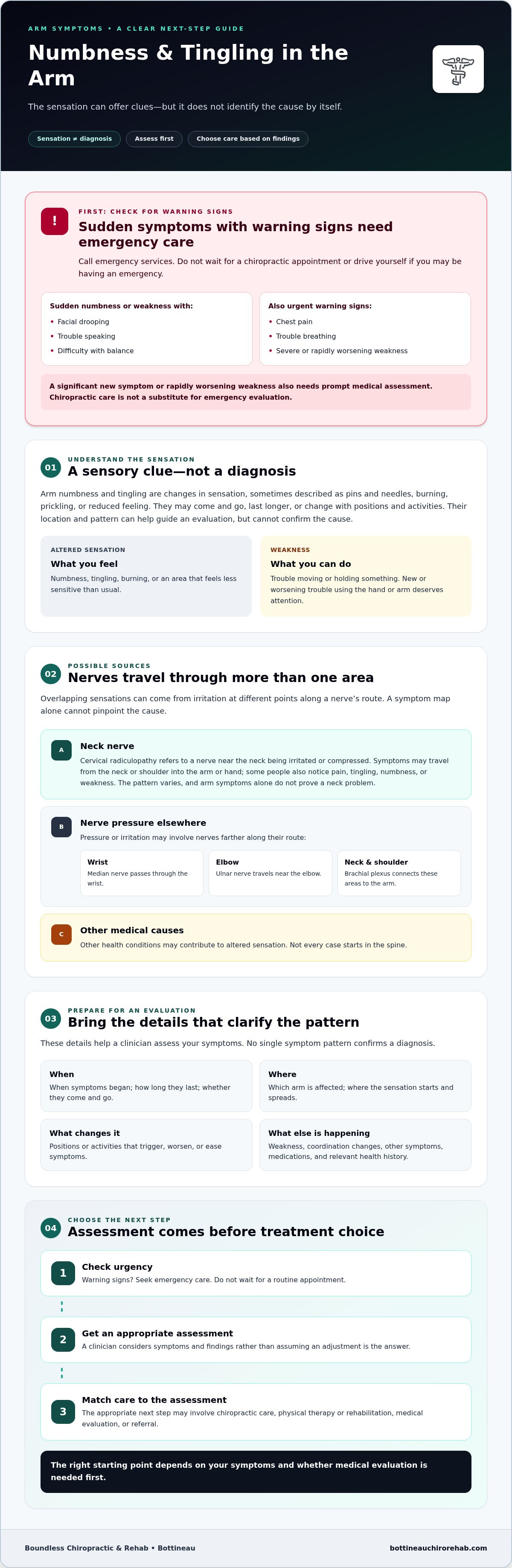
This guide explains warning signs, what information can help during an evaluation, and how chiropractic care, physical therapy, and medical evaluation differ. Sudden numbness or weakness with chest pain, trouble breathing, facial drooping, or difficulty speaking needs emergency care. Don’t wait for a chiropractic appointment if these symptoms occur.
For symptoms without those warning signs, start with an assessment rather than assuming an adjustment is the answer. A clinician can consider what may be causing the symptoms and help you decide whether chiropractic care, rehabilitation, medical evaluation, or referral is appropriate.
Key Takeaways
- Arm numbness and tingling describe changes in sensation, but they don’t identify the cause by themselves.
- Neck nerve irritation is one possibility. Pressure on a nerve elsewhere and other medical causes may also need consideration.
- The right starting point, whether a chiropractor, physical therapist, or medical clinician, depends on the symptoms and whether medical evaluation is needed first.
- Before an evaluation, note when symptoms began, where you feel them, what affects them, and any weakness, medications, or relevant health history.
- Searching for a “numbness and tingling in arm chiropractor” can help you explore care options, but treatment should follow an appropriate assessment and may include rehabilitation or referral.
Arm Numbness and Tingling: What the Sensation Can, and Cannot, Tell You
Arm numbness and tingling are changes in sensation. You might feel pins and needles, burning, prickling, or reduced feeling in part of your arm or hand. These sensations are often called paresthesia. They may come and go or last longer. The sensation can be uncomfortable or unsettling, but it doesn’t reveal its cause by itself.
Arm tingling is a sensory clue, not a diagnosis. Its location and pattern can help guide an evaluation, but they can’t identify the cause on their own. Nerve irritation in the neck is one possibility. Pressure on a nerve elsewhere or another medical issue may also be involved. Don’t assume that tingling in a particular area points to one specific condition.
What does tingling in one arm usually feel like?
Pay attention to what you feel and how it changes. Sensory symptoms can include pins and needles, burning, or an area that feels dull or less sensitive than usual. They may be intermittent or become more noticeable with certain positions or activities. These are useful details to share with a clinician, but they don’t confirm a cause.
Keep track of which arm is affected, where the sensation starts and spreads, when it began, how long it lasts, and what seems to trigger or ease it. Also distinguish altered sensation from weakness or poor coordination. Numbness changes what you feel; weakness affects your ability to move or hold something. New or worsening trouble using your hand or arm deserves attention.
Which arm symptoms need urgent attention?
Act immediately if symptoms start suddenly with facial drooping, trouble speaking, difficulty with balance, chest pain, or severe weakness. Call emergency services. Don’t drive yourself if you may be having an emergency, and don’t wait to see if the symptoms pass.
Rapidly worsening weakness or another significant new symptom also needs prompt medical assessment. A chiropractic appointment is not a substitute for emergency evaluation. If symptoms are sudden, severe, or accompanied by other concerning changes, seek medical care first.
For people searching “numbness and tingling in arm chiropractor,” the first question isn’t which adjustment to try. It’s whether the symptoms need urgent medical attention and what evaluation can help clarify the cause. Once urgent concerns are addressed, a clinician can help guide the next step based on your symptoms and findings.
Possible Causes of Arm Tingling: From Neck Nerves to Local Pressure
The location of tingling can offer useful clues, but it doesn’t pinpoint the cause. Nerves travel from the neck through the shoulder and arm to the hand, so irritation at different points can create overlapping sensations. The causes of numbness and tingling include nerve pressure, among other possibilities. A clinician considers the full picture rather than relying on a symptom map alone.
When might a neck nerve be involved?
Cervical radiculopathy means a nerve near the neck is irritated or compressed. Symptoms may travel from the neck or shoulder into the arm or hand, and some people also notice pain, tingling, numbness, or weakness. The pattern varies. Arm symptoms alone don’t prove a neck problem, spinal misalignment, or a disc condition. An evaluation is needed to determine whether the neck may be involved.
How can pressure on a nerve elsewhere affect the arm?
Nerves can also be affected farther along their route. The median nerve passes through the wrist, the ulnar nerve travels near the elbow, and the brachial plexus is a network of nerves connecting the neck and shoulder to the arm. Pressure or irritation in these areas may be relevant. Other health conditions can also contribute to altered sensation, so don’t assume every case starts in the spine.
To help assess the possibilities, a clinician may ask where symptoms occur, when they began, whether they come and go, and what positions or activities change them. They’ll also want to know about weakness, other symptoms, and relevant health history. These details can guide an assessment, but no single symptom pattern confirms a diagnosis. Online charts can’t replace an individual evaluation.
If you’re looking for a numbness and tingling in arm chiropractor, focus on identifying the likely source before choosing care. Boundless Full Body Chiropractic & Rehab in Bottineau offers chiropractic care, physical therapy, extremity adjustments, and spinal rehabilitation. You can discuss arm tingling and care options after an appropriate assessment. If the cause appears to need medical attention, follow the clinician’s recommendations rather than treating the symptom as a routine nerve or alignment issue.
Chiropractor, Physical Therapist, or Medical Clinician: Comparing Your Options
The right starting point depends on what may be causing the symptoms and whether they need medical investigation. Arm tingling can have several possible causes, as outlined in MedlinePlus’ overview of the causes of numbness and tingling. A provider should assess what’s appropriate instead of assuming every case calls for the same treatment.
| Care option | Main focus | When it may fit |
|---|---|---|
| Medical clinician | Assessing symptoms, considering medical causes, and deciding whether further investigation or treatment is needed | Urgent, unexplained, worsening, or medically complex symptoms |
| Physical therapist | Movement, strength, function, and rehabilitation goals | When an evaluation indicates rehabilitation may be appropriate |
| Chiropractor | Assessing musculoskeletal symptoms and considering whether chiropractic care is suitable | When symptoms and assessment suggest this care may be appropriate |
These options can sometimes complement one another, but they aren’t interchangeable. Referral or coordinated care may be appropriate if an assessment raises concerns outside a provider’s scope or suggests another type of evaluation should come first.
When is a chiropractor worth discussing?
Start with a conversation and assessment, not an automatic adjustment. A chiropractor should consider your symptoms and health history, then determine whether chiropractic care is suitable or whether medical evaluation should come first. If care involving an arm or another extremity is being discussed, Boundless offers extremity adjustments. Learn more about extremity adjusting as one option, not a presumed solution for every cause of tingling.
When may medical evaluation or physical therapy be the better next step?
Seek medical evaluation first for emergency warning signs, rapidly worsening symptoms, or unexplained neurological changes. A medical clinician can assess whether the symptoms call for further investigation or treatment beyond routine elective care. Don’t delay that assessment to try chiropractic care.
Physical therapy may be considered when an assessment points toward movement or functional goals. It can focus on strength, mobility, and everyday activity, with an approach guided by individual findings. It isn’t a substitute for medical evaluation when that’s needed. See this physical therapy overview for more context on rehabilitation care.
If you’re searching “numbness and tingling in arm chiropractor,” treat that as a question to discuss, not a diagnosis or treatment plan. In Bottineau, Boundless Full Body Chiropractic & Rehab offers chiropractic care and physical therapy to discuss after appropriate assessment. Explore local care options, and follow medical recommendations if referral or further evaluation is indicated.
What to Expect From an Evaluation for Arm Numbness in Bottineau
A clear next step starts with safety, then useful information. If symptoms start suddenly with facial drooping, speech or balance problems, chest pain, or severe weakness, contact emergency services. For symptoms that aren’t an emergency, use this sequence:
- Check urgency. Don’t delay medical attention for rapidly worsening weakness or significant new symptoms.
- Record the pattern. Note when symptoms began, where you feel them, how they change, and what seems to trigger them.
- Arrange an appropriate evaluation. Choose a medical clinician, physical therapist, or chiropractor based on your symptoms and any prior recommendations.
- Follow the findings. An examination and health history help guide whether care, further assessment, or referral is appropriate.
For Bottineau-area residents, a local appointment may be an opportunity to discuss symptoms and suitable care options. The right plan depends on the evaluation, not just where the tingling occurs or which type of provider you initially hoped to see.
How should you prepare for a first appointment?
Bring a brief symptom timeline. Include which arm and areas are affected, when the sensation started, whether it’s constant or intermittent, and which activities or positions seem to change it. Note any weakness or coordination changes. List medications and relevant health history, and bring prior testing or records if available. You don’t need to identify the cause yourself. Accurate details are more useful than a guess.
Evaluation procedures vary by provider and situation, so ask what to expect when arranging care. If you’re searching for a “numbness and tingling in arm chiropractor,” remember that an appointment should begin with a discussion of your symptoms and whether care is suitable, not an assumption that an adjustment is the answer.
What questions can help you compare care plans?
Ask questions until the proposed next step is clear. For example:
- What findings support this approach, and what other options should I consider?
- How will we review progress, and what changes should prompt reassessment?
- Should another provider be involved, or do my symptoms need further medical evaluation first?
- What should I expect at each visit, and what practical arrangements should I confirm before starting?
Boundless Full Body Chiropractic & Rehab in Bottineau offers chiropractic care, physical therapy, extremity adjustments, and spinal rehabilitation. These are options to discuss after appropriate assessment, not guaranteed treatments for arm numbness. To discuss your symptoms and care options, contact the Bottineau practice. Confirm current appointment details directly.
Discussing Arm Tingling With Boundless Chiropractic & Rehab
Choosing a care provider doesn’t mean you’ve already chosen a treatment. For readers in Bottineau and nearby communities, Boundless Chiropractic & Rehab is a local place to discuss arm tingling and ask whether an evaluation is appropriate. The practice offers chiropractic care, physical therapy, extremity adjustments, and spinal rehabilitation. Which option, if any, may suit your situation depends on your symptoms and assessment.
How can local care support an informed next step?
An appointment can be an opportunity to explain what you’re experiencing, share relevant health history, and discuss possible next steps. You can ask whether your symptoms appear suitable for care at the practice or whether another type of medical evaluation should come first. The goal is an informed decision, not an automatic adjustment or a promise of relief.
If you’re searching for a “numbness and tingling in arm chiropractor,” keep the cause-first approach in mind. Chiropractic care and rehabilitation are options to consider after appropriate assessment. If your symptoms or evaluation findings suggest another provider should be involved, follow that recommendation. Chiropractic care doesn’t replace emergency treatment or medical evaluation when those are needed.
What should you do next if symptoms persist?
Pay attention to changes. If tingling continues, spreads, returns, or begins to interfere with daily activities, arrange reassessment with a suitable healthcare provider. Share what has changed, when it happens, and whether you’ve noticed weakness or other new symptoms. Clear details can help guide the next decision.
Sudden symptoms with facial drooping, difficulty speaking or balancing, chest pain, or severe weakness require emergency services. Don’t wait for a routine appointment in these situations.
For non-emergency symptoms, you can ask Boundless Chiropractic & Rehab whether discussing your concerns is an appropriate next step. Be ready to describe when the sensations began, where you feel them, and any changes in strength or function. Contact Boundless Chiropractic & Rehab to discuss your next step.
Choose Your Next Step With Confidence
Arm tingling is a symptom, not a diagnosis. Its pattern can help guide an evaluation, but it can’t tell you by itself whether the cause is in your neck, shoulder, arm, or elsewhere. The safest care choice depends on your symptoms and assessment. Sudden symptoms with facial drooping, trouble speaking or balancing, chest pain, or severe weakness require emergency attention, not a routine appointment.
If you’re searching for a “numbness and tingling in arm chiropractor,” focus first on finding the right next step for your situation. Boundless Full Body Chiropractic & Rehab serves Bottineau and nearby communities, with chiropractic care, physical therapy, spinal rehabilitation, and full-body and extremity adjustments available to discuss after appropriate assessment. Care may also involve referral when indicated.
Bring your symptom history and questions. For a conversation about whether an evaluation may be appropriate, contact Boundless Full Body Chiropractic & Rehab to discuss your next step.
Frequently Asked Questions
Is a chiropractor appropriate for numbness and tingling in the arm?
It depends on the cause and your symptoms. If you searched “numbness and tingling in arm chiropractor,” remember that arm symptoms don’t automatically mean there’s a spinal problem. A chiropractor can discuss your concerns and assess whether chiropractic care may be suitable. Seek urgent medical attention for sudden symptoms, worsening weakness, facial changes, speech trouble, or chest pain. If the cause is unclear or needs further evaluation, ask whether referral is appropriate.
Can a pinched nerve in the neck cause tingling in the arm?
Yes, irritation or pressure on a nerve near the neck can sometimes cause symptoms that travel into the shoulder or arm. But tingling can have other causes, and its location alone can’t confirm a diagnosis. A clinician considers your symptom history, examination, and other health concerns. Arrange medical assessment if symptoms persist or worsen. Sudden neurological changes, such as facial drooping or trouble speaking, need urgent attention.
How do I know if arm tingling is an emergency?
Get emergency help for sudden arm numbness with facial drooping, trouble speaking, severe weakness, loss of coordination, chest pain, or difficulty breathing. These symptoms can signal a serious health problem and shouldn’t wait for a routine chiropractic appointment. If tingling is new, worsening, or concerning but you don’t have emergency signs, contact a medical professional promptly for guidance on an appropriate evaluation.
What happens during an evaluation for arm numbness?
A clinician may ask when symptoms began, which areas are affected, what changes them, and whether you have weakness or other health concerns. They may examine you and decide whether further medical assessment or referral is appropriate. The process varies by provider and situation. Bring a symptom timeline, relevant health history, information about medications, and any available prior test results. Prepare questions about possible next steps, too.
Can physical therapy help with arm tingling?
Physical therapy may be an option if an assessment indicates rehabilitation is appropriate. It can focus on movement, function, and an individualized plan, but the right approach depends on the cause of your symptoms. Don’t assume tingling is simply a muscle or joint issue. Seek medical evaluation for sudden, worsening, unexplained, or otherwise concerning symptoms before starting an exercise program, especially if you’ve noticed new weakness.
Should I see a chiropractor or a doctor for arm numbness?
Choose based on your symptoms and what evaluation they may need. Sudden numbness with stroke-like signs, chest pain, or severe weakness calls for emergency care. Persistent, worsening, or unexplained symptoms warrant medical evaluation to determine whether further investigation is needed. Chiropractic care may be considered when appropriate after assessment. A chiropractor should discuss your symptoms and whether referral is needed, rather than assume an adjustment is the right first step.
What information should I bring to an appointment about arm tingling?
Write down when the sensation started, which arm and areas are affected, whether it comes and goes, and what seems to trigger it. Include any weakness, pain, recent injury, relevant health conditions, medications, and previous evaluations. These details help a clinician understand the pattern and consider suitable next steps. Boundless Full Body Chiropractic & Rehab serves Bottineau and nearby communities, including Rugby, Rolla, Rollette, Dunseith, St. John, Sherwood, Mohall, Willow City, Lake Metigoshi, Belcourt, Kenmare, Minot, and Velva.


