

A back pop can feel relieving, but forceful or frequent self-cracking may strain muscles and other tissues. Repeated manipulation may also contribute to joint looseness. The risks of cracking your own back matter most when pain, injury, numbness, or tingling is already present, so don’t force a pop.
That brief release can be tempting when your back feels tight. But the sound alone doesn’t mean a joint needed adjusting, and temporary relief doesn’t address what’s causing persistent discomfort.
This article explains why backs pop, how self-cracking differs from a chiropractic adjustment, and what strain or instability may result from repeated or forceful twisting. You’ll also learn when to stop self-manipulating and consider an evaluation instead.
Key Takeaways
- A popping sound can come from pressure changes in a joint, but it doesn’t prove that the joint needed to be adjusted.
- Avoid forceful self-manipulation if your back is painful, swollen, injured, or accompanied by numbness, tingling, or weakness.
- Repeatedly forcing the same area may strain surrounding tissues and contribute to joint looseness, even if it feels relieving at first.
- Learn what signs can point to disc, bone, or nerve injury and when it’s time to stop self-managing and seek an evaluation.
Is self-cracking the same as a chiropractic adjustment?
Both can move a joint, but self-cracking and a chiropractic adjustment are different processes. That distinction matters if you have back pain, swelling, or an injury.
Self-Cracking and Professional Adjustments
Self-cracking uses your own twisting or leverage, while a chiropractor assesses the spine before applying controlled force to specific joints. That assessment helps guide where and how an adjustment is delivered. It isn’t simply a stronger version of a self-generated pop. A chiropractor may use hands or a tool and tailor care to the examination findings. Forceful twisting can irritate tissues around a spinal joint, causing muscles to guard and tighten rather than relax.
Back and Neck Self-Manipulation
Back self-manipulation often involves twisting your torso or pulling against a chair, while neck self-manipulation moves the head and neck directly. Forceful cracking can strain muscles, including those in the neck, and repeatedly trying to produce a pop may increase irritation. If you feel a persistent urge to crack your neck, stop manipulating it and seek an evaluation rather than repeating the movement.
Avoid self-cracking when your back is painful, swollen, or injured. Numbness, tingling, or loss of strength in an arm or leg after cracking calls for medical attention. A pop or grinding sensation that starts after an injury, especially with pain, is another reason to get evaluated rather than twist again.
Arrange a medical evaluation for long-lasting, recurring, or severe back symptoms, or when frequent urges to crack come with pain, numbness, or tingling. Repeatedly trying to release tightness may leave an underlying muscle or posture issue unaddressed. A healthcare professional can assess your spine and guide treatment, exercises, or stretches based on the findings.
Can cracking your back cause damage?
A pop alone doesn’t prove damage, but repeatedly forcing a movement can strain tissues or affect joint stability. The sound and any relief that follows don’t show whether the underlying stiffness has resolved. The risks of cracking your own back depend in part on how forcefully and often you manipulate the joints.
Gas Release and Temporary Relief
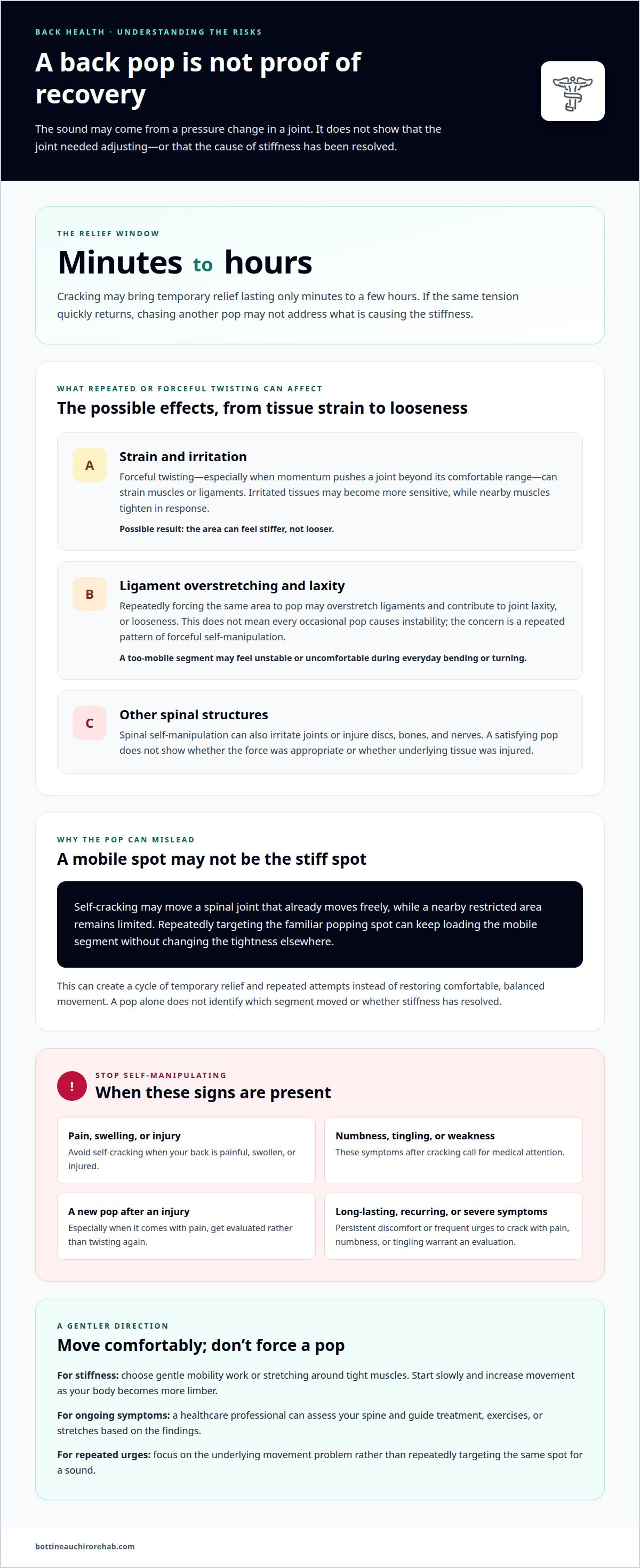
A back pop can occur as pressure changes within a joint. This sound is a physical joint event, not proof that a restricted joint has moved into the correct position. Cracking may bring temporary relief, lasting only minutes to a few hours. If the same tension quickly returns, chasing another pop may not address what’s causing the stiffness.
Strain, Inflammation, and Joint Dysfunction
Forceful twisting can strain muscles or ligaments, especially when momentum pushes a joint beyond its comfortable range. Irritated tissues around the joint can become more sensitive, and nearby muscles may tighten in response. That guarding can leave the area feeling stiffer, not looser. Trying to release one spot may also put unwanted stress on neighboring muscles and joints.
Repeatedly stretching the same area through self-cracking may overstretch ligaments and contribute to joint laxity, or looseness. A joint that becomes too mobile can feel unstable while a separate restricted area remains stiff. Repeatedly targeting the mobile joint may create a cycle of temporary relief without restoring comfortable movement. New pain or reduced flexibility after cracking suggests the movement may have aggravated the area. These risks of cracking your own back make repeated force a poor way to manage recurring stiffness.
For back stiffness, choose gentle mobility work or stretching around the tight muscles rather than forcing a pop. Start slowly and increase movement as your body becomes more limber; regular activity, heat or cold packs, and improved workstation posture can also help. If stiffness follows a sports injury, Sports Injury Rehab can help address movement and function.
Joint hypermobility and instability
Joint hypermobility means a joint moves more freely than its surrounding support can comfortably control. In the spine, repeatedly forcing the same segment to pop may stretch its ligaments and contribute to laxity, or looseness. This doesn’t mean every occasional pop causes instability. The concern is a repeated pattern of forceful self-manipulation, especially when the same spot keeps feeling as though it needs another release.
A pop also doesn’t show that you moved the stiff segment. Self-cracking may affect a spinal joint that already moves freely, while a nearby restricted area remains limited. For example, twisting again toward a familiar popping side can keep loading the mobile segment without changing tightness elsewhere. This mismatch can encourage more attempts instead of restoring balanced movement across the back.
Ligaments help support joints, so overstretching them can reduce the restraint they provide. If a segment becomes too loose, it may feel unstable or uncomfortable during everyday movements such as bending or turning. That feeling doesn’t identify the cause by itself, but recurring instability after forceful cracking is a reason to stop provoking the movement and seek an assessment. Avoid twisting more to test whether the area still pops.
Chiropractic adjustments differ from repeated self-cracking because the practitioner assesses the spine before choosing how to address restricted or mobile areas. The goal isn’t to keep forcing the same joint until it makes a sound. Gentle movement and exercises selected for the examination findings can address stiffness without repeatedly loading an already mobile segment. If the urge to crack keeps returning, focus on the underlying movement problem, not just the pop.
Can you get a slipped disc while cracking your back?
Forceful or incorrect self-adjustment can stress spinal structures beyond their intended movement. A satisfying pop doesn’t show whether the force was appropriate or whether underlying tissue was injured.
Injury to Spinal Bones, Discs, and Nerves
Spinal self-manipulation can strain muscles and ligaments, irritate joints, or injure discs, bones, and nerves. The risk rises when you use excessive force or twist sharply to make a joint pop. Nerve irritation may cause pain, numbness, or tingling. Stop if symptoms begin or worsen, rather than trying another twist to correct the feeling.
Slipped Discs and Existing Injuries
A slipped disc is uncommon from back cracking, but improper technique can put undue stress on spinal discs and may aggravate an existing disc problem. A prior injury matters because the area may already be vulnerable to additional force. Don’t crack your back when you have pain or an existing injury. Persistent or worsening symptoms call for an evaluation, not repeated self-manipulation.
Forceful movements can also injure blood vessels in the neck or back. Neck manipulation deserves particular caution: people at high risk of stroke should avoid cracking their back. Don’t use a sudden head turn or strong pressure to create a pop. If your back pops or grinds on its own after an injury, especially with pain or discomfort, get medical attention instead of testing the movement again. New numbness, tingling, or loss of strength in an arm or leg also warrants prompt evaluation.
Posture and muscle tightness can contribute to the urge to crack, but a pop doesn’t resolve those underlying factors. Choose gentle movement instead of forceful twisting, and seek an assessment for recurring symptoms. Get help evaluating back symptoms when discomfort or movement changes persist.
Boundless Full Body Chiropractic & Rehab
Boundless Full Body Chiropractic & Rehab in Bottineau offers a professional next step when you’re repeatedly cracking your back to manage stiffness or discomfort. Full-Body Adjustments and spinal rehabilitation address spinal movement concerns, while Sports Injury Rehab supports recovery when symptoms began after physical activity or an injury. The appropriate care depends on your symptoms and what’s driving them, not simply whether your back pops.
If pain keeps returning, movement feels limited, or you notice numbness or tingling, stop forcing a pop and seek an appropriate medical evaluation. For ongoing back concerns that may benefit from chiropractic or rehabilitation care, contact Boundless Full Body Chiropractic & Rehab in Bottineau to discuss your next step.
Choose a More Purposeful Next Step
Understanding the risks of cracking your own back can help you replace a repeated habit with a more deliberate response to discomfort. Notice which movements bring on stiffness and how it affects daily activities. That context can make a professional evaluation more useful than chasing another pop.
Boundless Full Body Chiropractic & Rehab in Bottineau offers Extremity Adjusting, Full-Body Adjustments, and Sports Injury Rehab. These services support different movement and recovery needs. The appropriate next step depends on your symptoms and what you want to get back to doing. If discomfort keeps interrupting your routine, start a conversation about care that fits your needs.
Contact Boundless Full Body Chiropractic & Rehab to discuss your concerns and take a clear step toward moving with more confidence.
Frequently Asked Questions
What Happens When You Crack Your Back?
A back crack usually comes from a pressure change inside a joint, which can release dissolved gas and create a pop. The sound doesn’t reveal whether a joint was restricted or whether the movement addressed your discomfort. For example, a pop during an ordinary stretch may happen without injury. Pay attention to what follows: new pain or unusual sensations are more useful signals than the sound alone.
Can you get arthritis from cracking your back?
No, cracking your back doesn’t cause arthritis. A pop by itself isn’t evidence that arthritis has developed or that a joint is being damaged. However, if an area already feels stiff or swollen, forceful twisting may aggravate those symptoms. Notice whether discomfort continues during everyday tasks, such as getting dressed or turning to reach something. Persistent symptoms deserve attention to their cause, rather than repeated attempts to make the joint pop.
Does cracking your back stunt growth?
No, cracking your back doesn’t stunt growth. Growth occurs at the epiphyseal plates in long bones, not because the joints in your back pop. A back crack therefore doesn’t determine how tall someone becomes. If a young person’s back feels tight, avoid forceful twisting to produce a sound. Gentle movement is a better response, and ongoing pain or changes in strength or sensation should be discussed with a healthcare professional.
Is it bad to crack your back while pregnant?
Cracking your back during pregnancy is generally considered fine when done cautiously, but avoid forceful twisting or any movement that causes pain. A growing abdomen can change your balance and make familiar positions feel different, so don’t push through discomfort to get a pop. For pregnancy-related back discomfort, ask a healthcare professional about movement that suits your situation. Stop if a maneuver causes pain, unusual symptoms, or a feeling of strain.
Is it bad to pop your back?
An occasional pop during a comfortable stretch isn’t generally considered harmful to a healthy spine. The concern is repeatedly forcing a crack, especially by twisting hard or using leverage. Don’t treat the sound as a target or keep trying when a movement feels painful. If you find yourself popping your back to manage recurring discomfort, notice the pattern and seek guidance about what may be causing it.
Is it normal for your back to pop on its own?
A back may pop during ordinary movement, and joint sounds can occur in healthy joints without signaling a problem. For instance, you might hear a pop while standing up or changing position. A new sound after an injury is different, especially if it comes with pain or discomfort. In that situation, avoid testing the movement repeatedly and arrange an evaluation to understand what’s causing the change.


