

Rehabilitation is about more than getting a joint moving again. Chiropractic care can focus on spinal and joint motion, while physical therapy may be a better fit when recovery calls for a structured plan to rebuild strength, movement, and function. Knowing when to choose physical therapy over chiropractic starts with what you need to do next, not just where you feel pain.
Both approaches can address musculoskeletal problems, but their focus differs. Adjustments may help improve joint mobility, while rehabilitation exercises can help restore strength and movement over time. Neither approach is automatically right for every situation.
This guide explains how rehabilitation goals, spinal adjustments, radiating nerve symptoms, and postsurgical recovery can shape your decision. You’ll learn when physical therapy may offer the structure you need, when chiropractic care may fit your needs, and how the approaches can work together when coordinated.
Key Takeaways
- Choose care based on your recovery goal: improving joint motion and rebuilding strength call for different treatment approaches.
- Radiating pain or nerve symptoms deserve attention to both symptom relief and the movement and strength that support recovery.
- After surgery, rehabilitation should follow a gradual plan guided by your surgeon’s protocol.
- Learn how physical therapy and chiropractic care can fit different needs, and when coordinated care may be useful.
Is Chiropractic Considered Rehabilitation?
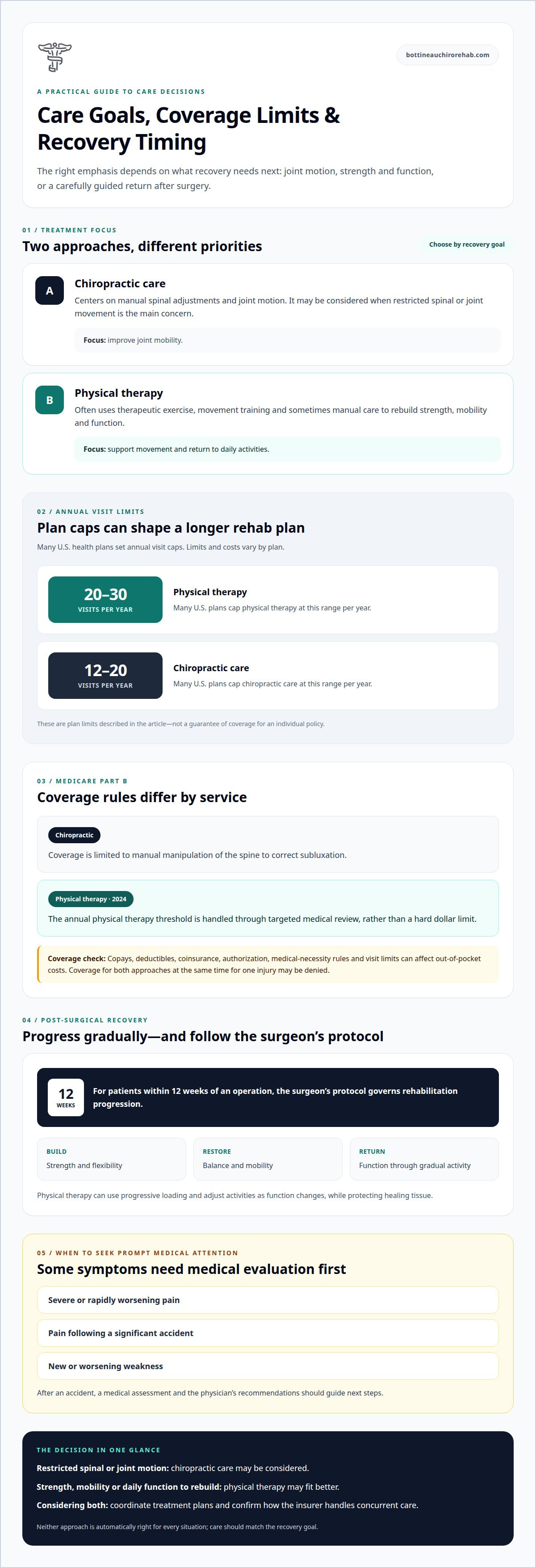
Chiropractic care can be part of musculoskeletal rehabilitation, but its emphasis differs from physical therapy. Chiropractic treatment commonly uses manual spinal adjustments to address joint motion. Physical therapy often uses therapeutic exercise to rebuild strength, movement, and function. For example, an adjustment may address restricted spinal motion, while an exercise plan builds strength for tasks such as lifting or walking.
Insurance rules also shape the choice. As of 2024, Medicare Part B covers chiropractic services only for manual manipulation of the spine to correct subluxation. Medicare Part B handles its annual physical therapy threshold through targeted medical review, rather than a hard dollar limit. Commercial plans, Medicare, Medicaid, and workers’ compensation may cover physical therapy, but the plan’s terms affect the benefit and the patient’s out-of-pocket share.
Visit limits can change the cost of a longer rehabilitation plan. Many U.S. health plans cap physical therapy at 20 to 30 visits per year and chiropractic care at 12 to 20 visits per year. Copays, deductibles, coinsurance, authorization rules, and whether care is considered medically necessary can affect what a patient pays. Coverage for physical therapy and chiropractic care at the same time for one injury may also be denied by an insurer.
| Option | Main focus | Coverage considerations |
|---|---|---|
| Chiropractic care | Manual spinal adjustments and joint motion | Medicare Part B coverage is limited to spinal manipulation for subluxation; plans may set visit caps. |
| Physical therapy | Therapeutic exercise, strength, and functional movement | Coverage and visit limits vary; Medicare uses targeted medical review for its annual threshold. |
In most U.S. states, patients can access physical therapy without a doctor’s referral, though insurance may have its own requirements. Before starting, review your plan’s referral, authorization, visit-limit, and cost-sharing rules. If you’re considering both approaches for one injury, coordinate the treatment plans and confirm how your insurer handles concurrent care.
Choose based on your rehabilitation goal: prioritize physical therapy when rebuilding strength and function is central, and consider chiropractic care when spinal or joint motion is the focus.
Nerve symptoms and radiating pain
Pain that travels from the back into a buttock or leg can involve nerve irritation. A herniated or bulging disc, spinal stenosis, and age-related spinal changes can contribute to radiating symptoms. Neck-related nerve irritation may also send symptoms into an arm. The location and pattern matter, but pain alone doesn’t identify the cause.
Chiropractic adjustments use controlled manual pressure on joints. They may improve spinal mobility and reduce nerve irritation. Physical therapy takes a different route: exercises and movement training can strengthen the muscles and joints that support the affected area. For example, someone with sciatica and reduced leg strength may need a plan addressing both comfortable movement and strength, not only spinal motion.
Seek urgent medical evaluation rather than starting with physical therapy or chiropractic care if pain is severe, rapidly worsening, or follows a significant accident. New or worsening weakness also calls for prompt medical attention. After an accident, a medical assessment and the physician’s treatment recommendations should guide next steps.
For ongoing symptoms, a professional evaluation can consider pain location, strength, mobility, and how symptoms change during movement. Physical therapy may help address chronic lower-back pain, nerve compression, spinal stenosis, or back strains and sprains. Treatment can include therapeutic exercise and manual therapy to address movement limits and build support around the affected area.
Choose based on the pattern and the recovery goal. If restricted spinal or joint motion is central, chiropractic care may be considered. If weakness, reduced mobility, or difficulty returning to daily activities is prominent, rehabilitation focused on strength and movement may fit better. A combination may be coordinated, but both providers should align their treatment plans. For an overview of movement-focused care for radiating symptoms, consider how mobility and strength relate to your goals.
When physical therapy may suit post-surgical recovery
After surgery, recovery often involves more than restoring comfortable joint movement. Patients may need to rebuild strength, balance, flexibility, and function through gradual activity. Physical therapy can provide therapeutic exercise, mobility training, and movement practice matched to those goals. After a major injury, for example, a patient may progress from basic movement toward tasks required at work or during sports.
The timing and pace matter. For patients within 12 weeks of an operation, the surgeon’s protocol governs rehabilitation progression. Physical therapy uses progressive loading to increase demands as recovery advances. This stepwise approach can help address weakness and movement restrictions while protecting healing tissue. It also gives the therapist a way to adjust activities as function changes.
Choose physical therapy for back or neck pain when recovery calls for structured work on strength, mobility, or daily movement, including after surgery or a serious injury. The distinction is practical: chiropractic care centers on adjustments, while physical therapy can combine manual care with exercise and movement training. The right emphasis depends on whether restricted joint motion or rebuilding function is the main goal.
Evidence supports both approaches for common musculoskeletal problems, rather than one universal winner. The American Physical Therapy Association’s 2023 updated clinical practice guidelines recommend physical therapy as first-line care for several conditions, including low-back pain, neck pain, and postsurgical rehabilitation. The American College of Physicians lists both spinal manipulation and exercise-based rehabilitation among first-line, non-drug options for low-back pain. A New England Journal of Medicine trial found only modest differences among chiropractic manipulation, physical therapy, and an education booklet for low-back pain.
Physical therapy and chiropractic care can be used together when their goals are coordinated. Manual care may address joint motion, while rehabilitation exercises build strength and support function. Keep both providers informed so treatment plans align and recovery isn’t disrupted by conflicting directions.
What conditions are better treated with physical therapy than chiropractic care?
Physical therapy may be a good fit when symptoms involve weakness, limited movement, or difficulty with daily tasks. Knee osteoarthritis, for example, can make stairs challenging, while shoulder impingement can limit reaching overhead. Therapeutic exercise can build strength and improve movement patterns. Chiropractic adjustments may address restricted joint motion, but adjustments alone don’t replace strengthening exercises.
Chronic low-back pain is another situation where exercise-based rehabilitation can be useful. A 2022 systematic review in the Journal of Orthopaedic & Sports Physical Therapy found better long-term outcomes from exercise-based physical therapy than spinal manipulation alone. This evidence can help clarify when to choose physical therapy over chiropractic: consider whether your recovery goals include lasting improvements in movement and function.
After a significant sports injury or accident, physical therapy may help when mobility is affected. A therapist can assess movement limits and build a progressive plan around the activities you need to resume. Returning to running, for instance, may require restoring balance, strength, and control, not simply easing discomfort around one joint. These goals can help clarify when to choose physical therapy over chiropractic care.
Neurological symptoms, movement dysfunction, or a condition that hasn’t resolved with chiropractic care can also point toward rehabilitation. The American Physical Therapy Association’s 2023 updated clinical practice guidelines recommend physical therapy as first-line treatment for several musculoskeletal conditions, including low-back pain, neck pain, shoulder impingement, knee osteoarthritis, and postsurgical rehabilitation. The main question is whether recovery depends more on restoring strength and function or improving restricted joint motion.
For an assessment focused on movement and function, explore physical therapy options.
Boundless Full Body Chiropractic & Rehab: Physical Therapy
Boundless Full Body Chiropractic & Rehab in Bottineau, North Dakota, offers physical therapy for people working to restore movement, strength, and everyday function. If an injury has made walking, lifting, or returning to sports difficult, rehabilitation may be a useful next step. Sports Injury Rehab also supports recovery when an injury is limiting activity.
When restricted joint motion is part of the picture, care may also include Full-Body Adjustments or Extremity Adjusting, when clinically appropriate. The focus depends on your needs: rebuilding strength and movement calls for rehabilitation, while adjustments address joint motion. A professional evaluation can help clarify which approach fits your recovery goals.
For support with movement, strength, or sports injury recovery in Bottineau, contact Boundless Full Body Chiropractic & Rehab.
Choose a Next Step That Supports Your Goals
Start with the change you want to make in daily life. Are you aiming for easier movement, a return to an activity, or more confidence using an injured area? Those goals can help clarify when to choose physical therapy over chiropractic care and what you want your care plan to address.
In Bottineau, Boundless Full Body Chiropractic & Rehab offers Physical Therapy, Sports Injury Rehab, Extremity Adjusting, and Full-Body Adjustments. These services connect rehabilitation with joint-focused care, so your next step can reflect the movement challenges you’re facing.
Bring your questions and describe which activities have become difficult. A focused conversation can help identify a practical direction for recovery and the support that makes sense for your needs.
Contact Boundless Full Body Chiropractic & Rehab to discuss your next step. Keep moving toward the activities that matter to you.
Frequently Asked Questions
What Conditions Respond Best to Chiropractic?
Chiropractic care may suit musculoskeletal problems involving back or neck pain, joint stiffness, or restricted movement. Some people also consider it for sciatica or radiating discomfort. The useful distinction is the main limitation: if joint motion is restricted, adjustment may be considered; if weakness or difficulty performing daily activities dominates, rehabilitation may better match that need. A focused assessment helps guide the choice.
When Is Chiropractic the Better Starting Point?
For acute low-back pain that began within two weeks, chiropractic care may be a starting point when red flags aren’t present. The focus is controlled spinal adjustments to improve joint mobility. If symptoms include weakness or trouble returning to normal activities, rehabilitation may also be needed. A sudden injury from an accident calls for medical assessment and following the physician’s recommendations before choosing treatment.
Which one should I see for my new injury?
Let the injury and its effect on function guide your next step. For a new sports injury that limits walking, lifting, or practice, an evaluation can identify movement restrictions and whether structured rehabilitation fits. If the injury followed a collision or caused major changes in function, get a medical assessment first. Then follow the physician’s recommendations for care and return to activity.
How do physical therapy and chiropractic care compare in cost and insurance coverage in the US?
There’s no single out-of-pocket cost that applies across the United States. Your deductible, copay, coinsurance, visit limits, and authorization rules affect what you pay. Medicare Part B covers chiropractic services only for manual spinal manipulation to correct subluxation; it manages the annual physical therapy threshold through targeted medical review, not a hard dollar limit. Plans may also restrict coverage for both treatments on one injury.
How can patients choose a qualified physical therapist or chiropractor?
Look for a physical therapist with a Doctor of Physical Therapy degree or a chiropractor with a Doctor of Chiropractic degree and training in spinal anatomy, manual therapy, and musculoskeletal assessment. For sports-related care, a chiropractor may hold CCSP credentials; a physical therapist should evaluate your movement and symptoms before creating a personalized plan.


