

You're twelve hours into the shift, the bin is almost full, and that sharp pull in your lower back just flared up again. You know the feeling. It's the stiffness that makes climbing out of the cab feel like a chore and the nagging fear that one wrong move could sideline you right when the crop is ready. In North Dakota, harvest doesn't wait for your spine to feel better. You've likely pushed through the pain before, hoping a night's sleep would fix it. But when your livelihood depends on your physical ability to stay in that seat, just toughing it out isn't a sustainable strategy.
This guide focuses on the tactical reality of preventing back injuries during harvest season so you can stay in the field and out of the operating room. We're prioritizing immediate, practical ergonomics and recovery strategies that fit into your 14-hour days. We will cover how to optimize your cab setup, quick movements for the grain truck line, and the recovery routines that keep North Dakota farmers moving until the last acre is in the bin. It's time to stop reacting to pain and start protecting your most valuable piece of equipment: your body.
Key Takeaways
- Shift your mindset from "powering through" pain to proactive maintenance to prevent catastrophic downtime during the busiest weeks of the year.
- Identify the mechanics of the "Harvest Hunch" and learn how to stabilize your pelvis to protect your lower back during 15-hour shifts.
- Implement tactical cab ergonomics and 30-minute micro-breaks as essential tools for preventing back injuries during harvest season.
- Adopt a simple 5-minute morning warm-up and post-shift decompression routine to reverse the cumulative trauma of machinery vibration.
- Discover why a targeted full-body adjustment offers a faster, non-surgical path to recovery than bed rest or ignoring a growing injury.
Why Harvest Season is High-Risk for Your Spine
The "power through" mindset is a staple of North Dakota farming culture. You ignore the nagging ache in your lumbar spine because the weather is holding and the combine needs to move. However, ignoring minor stiffness is the fastest way to trigger major harvest downtime. A single "blown" disc can sideline you for weeks, turning a profitable season into a financial disaster. Preventing back injuries during harvest season starts with acknowledging that your spine isn't an unbreakable tool. It requires maintenance just like your machinery.
Cumulative trauma is the silent enemy in the field. It isn't always a single heavy lift that causes a rupture. Instead, it's the result of weeks spent in a high-vibration environment coupled with awkward seating. This erosion of spinal health is a core concern within the broader field of Agricultural safety and health. In 2026, with the increased pressure of shifting market prices and tight labor windows, you can't afford to lose five days to bed rest. Proactive care is a tactical investment, not a luxury. Physical preparation is the only way to meet modern production demands without sacrificing your long-term mobility.
The Impact of Whole-Body Vibration (WBV)
Long-term tractor and combine operation exposes your body to constant low-frequency vibration. This forces your spinal discs to act as shock absorbers for hours on end. Over time, this leads to micro-trauma in the lumbar region. The discs lose their ability to hydrate and rebound, causing them to thin and become brittle. Early warning signs include tingling in the legs or a deep, dull ache that doesn't resolve after you stand up. Don't wait for the numbness to set in before seeking an adjustment. Identifying vibration-induced nerve irritation early can prevent permanent damage.
Repetitive Motion and Lifting Hazards
The yard is full of "cold" lifting hazards. Moving grain augers or tossing seed bags when your muscles are stiff from sitting is a recipe for acute injury. Twisting under load is the primary cause of herniated discs in the yard. When you rotate your torso while carrying weight, you put immense shearing force on your spinal ligaments. Extremity fatigue further complicates this. When your legs and arms are tired, your spine takes the brunt of the load. Preventing back injuries during harvest season requires you to focus on your form, even when the sun is going down and you're rushing to finish the last bin.
The Mechanics of Agricultural Back Pain
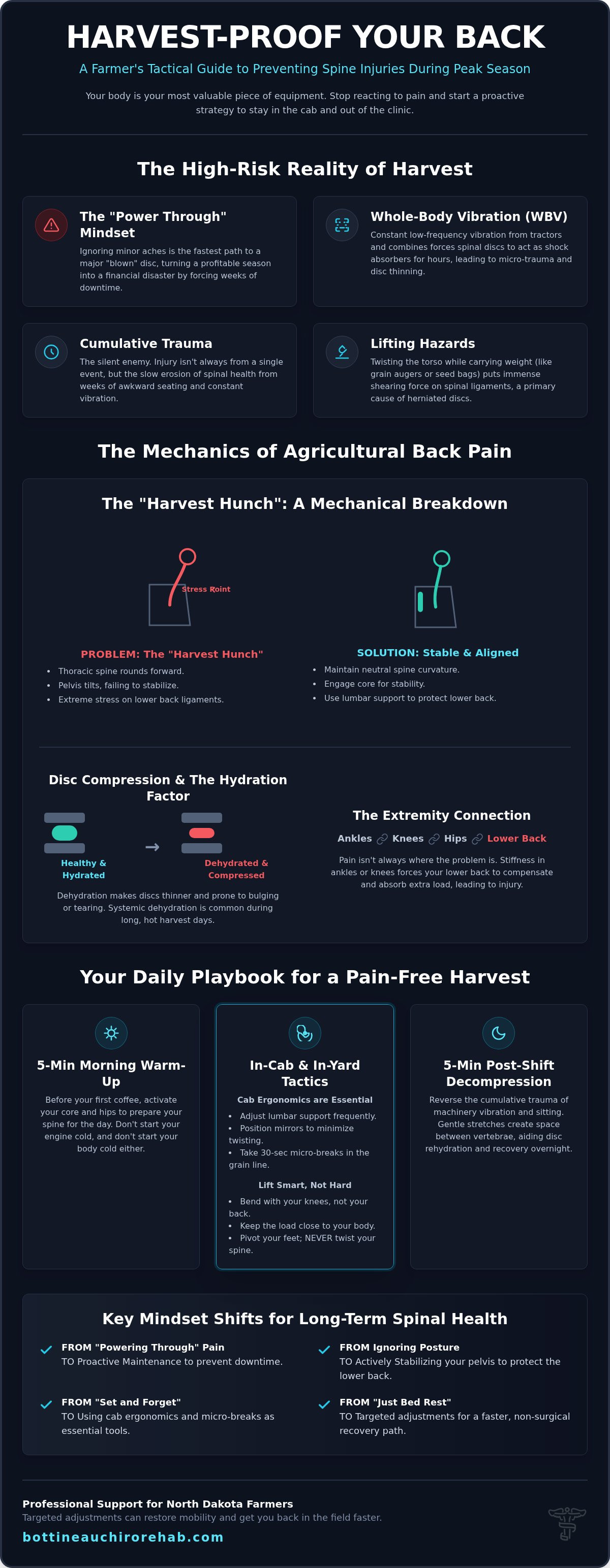
The "Harvest Hunch" is more than just a tired posture. After ten hours in a combine seat, your thoracic spine naturally rounds forward. This position places extreme stress on the ligaments and muscles of the lower back. When you finally stand up, your pelvis and hips are often locked in a tilted position. They fail to stabilize your spine during heavy labor. This mechanical breakdown is why many farmers experience sciatica. That sharp, radiating leg pain usually doesn't start in the leg; it begins with nerve impingement in the lumbar spine. If you ignore these signals, you risk a season-ending injury.
Maintaining full-body alignment ensures your entire kinetic chain functions under the high-stress conditions of the field. When your spine is aligned, your weight is distributed evenly across your joints. This is a fundamental part of Farming with Chronic Back Pain prevention and management. Without this balance, your body compensates in ways that lead to rapid wear and tear. Preventing back injuries during harvest season requires a focus on how these different parts of your body work together as a single system.
Understanding Disc Compression
Your spinal discs act as fluid-filled shock absorbers. They cushion the vertebrae against the constant jarring of heavy machinery. However, these discs rely on the "Hydration Factor" to stay resilient. During a long harvest day, heat and high caffeine intake often lead to systemic dehydration. Dehydrated discs are thinner and more prone to bulging or tearing under pressure. Spinal decompression is the mechanical process of creating space between vertebrae to relieve nerve pressure and restore disc health.
The Extremity Connection
Pain isn't always located where the problem starts. Stiffness in your ankles or knees forces your lower back to work harder every time you climb a ladder or lift a heavy bag. If your joints aren't moving through their full range of motion, your spine pays the price. Working with an extremity adjusting chiropractor can help restore mobility to your limbs, which directly supports preventing back injuries during harvest season. Even "shoulder pain" felt while steering is frequently a referred issue from a misaligned neck. Total body wellness requires looking beyond the spine to ensure every joint is moving correctly. If you feel a "catch" in your hip or knee, it's a sign that your foundation is shifting.
Cab Ergonomics and Heavy Lifting Strategy
Your tractor seat is your primary office during harvest. Most operators treat it as a fixed object, but failing to optimize your workspace is a leading cause of chronic pain. Preventing back injuries during harvest season requires a proactive approach to cab ergonomics. Adjust your lumbar support to maintain the natural curve of your lower spine. Your seat height should allow your hips to sit slightly higher than your knees. This position reduces the pressure on your pelvic floor and lower discs. If your machinery is older, don't settle for a worn-out cushion. Add an external lumbar roll to provide the necessary support.
The 30-minute micro-break is a tactical necessity. You don't have to leave the cab to find relief. Perform seated pelvic tilts or gentle neck retractions every half hour. These small movements prevent your muscles from locking into a static, strained position. For more detailed strategies on equipment safety, consult the USU Extension Guide to Back Health in Agriculture. It highlights how consistent, small adjustments can prevent long-term disability. Your exit from the equipment also matters. Jumping off the last step of a combine sends a massive shockwave through your spine. Impact can instantly misalign a vertebra already stressed by vibration. Always use three points of contact. Face the machine and step down carefully. It takes three extra seconds but saves you weeks of recovery.
Setting Up Your Workspace for Success
Achieving a neutral posture is the goal for every operator. Use this checklist to stay aligned:
- Keep your feet flat on the floor or footrests.
- Position your hips slightly higher than your knees.
- Relax your shoulders and keep your head centered over your spine.
Avoid leaning to one side to reach controls. This asymmetrical loading is a fast track to a herniated disc. Place a small piece of brightly colored tape on your monitor or dashboard as a visual cue. Every time you look at it, reset your posture. Check your mirrors. If you have to strain to see them, your seat or your body is out of alignment.
Tactical Lifting for the Yard
When you move to the yard, the "Power Zone" is your safety net. Keep heavy loads between your mid-thigh and mid-chest. This keeps the weight close to your center of gravity. Use a wide stance to create a stable base before you move a single seed bag or tool. The "Pivot" rule is non-negotiable: never lift and twist. Move your feet to turn your whole body. If a load is too heavy, put your pride aside. Team lifting or using a loader is far cheaper than a week of bed rest. Preventing back injuries during harvest season is about making smart choices when you're exhausted. Your spine doesn't care about your schedule. It only responds to the load you place on it.
Daily Recovery Routine for the Field
Harvest days are grueling. You don't have time for a 45-minute gym session, but you need a recovery strategy that fits into the few hours you aren't in the cab. Preventing back injuries during harvest season relies on these small, consistent recovery windows. Start your day with a 5-minute joint mobility routine before you climb into the equipment. Focus on circling your ankles, hips, and neck. This signals your body to produce synovial fluid, which lubricates your joints before the first load. When the sun finally goes down, use post-shift decompression. Lying flat on the floor with your legs elevated on a chair for ten minutes can reverse hours of spinal compression and cab-induced slouching.
Fueling your recovery is just as vital as fueling your equipment. Your spinal discs are mostly water. If you're dehydrated, they lose their cushioning ability and become prone to injury. Drink water throughout the day, not just coffee. When you finally hit the bed, prioritize your sleep posture to maximize a short rest window. If you're a side sleeper, put a pillow between your knees to keep your pelvis neutral. Back sleepers should place a pillow under their knees. This small change reduces tension on the lumbar spine, making a 6-hour sleep window much more effective for tissue repair.
The 'Harvest Three' Stretch Routine
Focus on these three targeted movements to combat the physical toll of farming:
- Psoas Stretch: Step into a lunge and tuck your tailbone. This releases the deep hip flexors that tighten from prolonged sitting in the tractor.
- Thoracic Extensions: Lean back over the top of a chair or use a foam roller. This opens your chest and counteracts the "harvest hunch" caused by steering for 12 hours.
- Hamstring Release: Tight hamstrings pull on your pelvis, which directly strains your lower back. Keep them loose to maintain your foundation.
Inflammation Management
Managing soreness is about choosing the right tool for the job. Use ice for acute, sharp pain to reduce swelling after a long day. Use heat for dull, chronic stiffness to increase blood flow and relax tight muscles. Natural anti-inflammatory strategies, such as maintaining a diet rich in omega-3s, can also support your recovery during these high-stress weeks. Many of the same sports injury rehab Bottineau techniques used by high-performance athletes apply directly to farmers. You are an agricultural athlete, and your body deserves professional attention. If the stiffness won't quit, don't wait for a total breakdown. Schedule a visit at Boundless Full Body Chiropractic & Rehab to reset your alignment before your next shift.
Professional Support at Boundless Chiropractic
A mid-harvest adjustment is a tactical decision for your farm's productivity. You wouldn't skip a critical oil change on a combine during a busy week; your spine deserves the same level of maintenance. Preventing back injuries during harvest season often requires professional intervention to correct misalignments before they become debilitating. At Boundless Full Body Chiropractic & Rehab, we focus on speed and efficiency. We know you don't have hours to sit in a waiting room while the weather is clear. Our goal is to get Bottineau farmers back to the field fast with improved mobility and reduced pain levels.
Our approach centers on the full body chiropractic adjustment. We don't just look at a single sore spot. We evaluate your entire kinetic chain, from your neck to your ankles. This comprehensive view ensures that your body can withstand the repetitive vibration and long hours of cab operation. By restoring proper alignment, we help your nervous system function at its peak. This is essential for both physical resilience and the mental focus required for high-stakes field work.
A Personalized Plan for Rural North Dakota
Dr. Daniel Pozarnsky understands the specific physical toll of North Dakota farming. He tailors care to address the "Harvest Hunch" and the extremity stiffness common in agricultural workers. By combining targeted adjustments with physical therapy Bottineau North Dakota, we help you build long-term resilience against future injuries. We proudly serve the agricultural community across a wide radius, including Bottineau, Rugby, and Minot. Our clinic acts as a partner in your season's success, providing the non-surgical support you need to stay active.
Take Action Before the Pain Stops You
Don't wait for a "thrown out" back to force your hand. A quick adjustment is significantly faster and more effective than a week of mandatory bed rest from a blown disc. Investing in your health now prevents the catastrophic downtime that breaks a season's profitability. Preventing back injuries during harvest season is about being proactive rather than reactive. Claim the chiropractic new patient offer today to secure your $47 special. It's a mission-critical investment in your season. Prioritize your alignment now so you can finish the harvest strong and stay out of the operating room.
Finish the 2026 Harvest Without the Pain
Harvest is a physical marathon that tests both your machinery and your body. By optimizing your cab ergonomics and committing to a daily recovery routine, you take the first steps toward preventing back injuries during harvest season. Remember that stiffness is a warning light, not a badge of honor. Ignoring these signals can lead to costly downtime that your farm simply can't afford. Professional maintenance for your spine is just as critical as the maintenance you perform on your tractors.
Boundless Full Body Chiropractic & Rehab is here to support the Bottineau agricultural community with expert, non-surgical spinal rehab. We focus on getting you back to work quickly and safely. Don't let a misaligned spine sideline your season. Ready to finish harvest strong? Claim your $47 New Patient Special at Boundless Chiropractic today! Our decisive care is the tool you need to stay in the field until the last acre is done. You've got a crop to bring in; let's make sure your body is ready for the task.
Frequently Asked Questions
Is it safe to get adjusted during the middle of harvest season?
Yes, it's safe and often necessary to maintain your physical performance in the field. A targeted adjustment reduces joint pressure and improves nerve function immediately. This helps in preventing back injuries during harvest season by ensuring your spine can handle the repetitive stress of machinery operation. Waiting until the season ends often allows minor misalignments to develop into more severe, chronic issues that require longer recovery times.
How can I tell if my back pain is a minor strain or a serious disc issue?
Minor strains typically involve localized muscle soreness that improves with light movement. Serious disc issues often present as sharp, stabbing pain or sensations that travel into your glutes or legs. If you experience weakness, persistent numbness, or pain that worsens when coughing or sneezing, you need a professional evaluation. Dr. Pozarnsky uses clinical exams to differentiate between muscular fatigue and structural damage to ensure you get the correct non-surgical care.
What is the fastest way to relieve lower back stiffness after a 12-hour shift?
Use the post-shift decompression technique by lying on a flat surface with your legs elevated at a 90-degree angle. This position neutralizes the pull on your psoas muscles and allows your spinal discs to rehydrate after hours of compression. Combine this with a cold pack for 15 minutes if you feel acute inflammation. This simple routine is a critical part of preventing back injuries during harvest season for farmers in the Bottineau area.
Can a chiropractor help with the numbness I feel in my legs while driving the tractor?
Yes, numbness in the legs is frequently caused by nerve compression in the lower spine or pelvis. When your vertebrae are misaligned, they can pinch the sciatic nerve, sending tingling or "pins and needles" sensations down your extremities. A full-body adjustment restores proper spacing and alignment. This removes the pressure on the nerve and restores normal sensation, keeping you focused and safe while operating heavy equipment around Rugby and Minot.
Do I really need a full-body adjustment if only my lower back hurts?
Yes, because your body operates as a single kinetic chain. Stiffness in your ankles or a misalignment in your neck forces your lower back to compensate for the lack of mobility elsewhere. If we only treat the spot that hurts, the underlying cause remains. A full-body approach ensures every joint from your neck to your feet is moving correctly. This comprehensive strategy provides more stable, long-term relief during high-demand work weeks in North Dakota.
How long does a typical chiropractic session take for a busy farmer?
Most follow-up adjustment sessions take approximately 15 to 20 minutes. We respect the tight schedules of North Dakota agricultural workers and prioritize efficient, high-impact care. Your initial visit involves a more thorough examination to establish your baseline, but subsequent visits are designed to get you back to the yard or the field quickly. Efficiency is a hallmark of our Bottineau practice, ensuring your health doesn't cause unnecessary downtime during harvest.
What should I bring to my first visit at Boundless Chiropractic?
Bring any recent imaging, such as X-rays or MRI reports, if you have them available. Wear comfortable, loose-fitting clothing that allows for a full range of motion during your physical assessment. You should also have your identification and any relevant insurance information ready. Our team in Bottineau makes the intake process straightforward so we can focus on your recovery and help you return to your daily life without delay or complex paperwork.
Does the $47 special include an exam and an adjustment?
The $47 new patient special is a comprehensive introductory offer designed to identify the root cause of your discomfort. It includes a detailed initial consultation and a physical examination to assess your spinal health and mobility. Based on those findings, Dr. Pozarnsky will determine the most effective path forward for your recovery. This low-friction entry point makes it easy for farmers from Dunseith to Mohall to access professional care before an injury worsens.


