

Resting an injury is often the worst thing you can do for your long-term health. While old advice suggests staying still, current 2026 clinical standards favor proactive, functional movement to truly restore mobility after injury. You want your independence back. You're likely frustrated by joint stiffness that keeps you off the North Dakota trails or makes manual work in Bottineau a struggle. It's common to fear that one wrong move will cause a setback.
We recognize your frustration and validate your pain. This article provides a comprehensive, non-surgical roadmap to help you reclaim your full range of motion. You'll discover how the synergy of full-body chiropractic adjustments and targeted rehabilitation creates a foundation for lasting vitality. We'll preview a recovery timeline that prioritizes joint alignment before muscle strengthening. This structure-first approach prevents the compensatory patterns that lead to chronic issues. Move with confidence. It's time to return to the active life you deserve.
Key Takeaways
- Understand the "Guard Response" and how your brain uses stiffness to protect tissue even after the initial healing phase.
- See why structural alignment is the critical first step to restore mobility after injury before you begin strengthening exercises.
- Replace static rest with active recovery techniques that promote blood flow and prevent permanent joint restrictions.
- Follow a clear 5-step checklist to transition from a professional assessment to independent, pain-free movement.
- Learn how integrated chiropractic care and physical therapy help Bottineau residents return to active lifestyles and manual work.
What is Functional Mobility and Why Does Injury Take It Away?
Functional mobility is your ticket to an independent life. It's the ability to move through your day, reach for groceries, or climb into a tractor without thinking twice. To understand What is Functional Mobility, you must look beyond simple stretching. While flexibility refers to the passive length of a muscle, mobility is about active, controlled movement within a joint. You need both to restore mobility after injury. Functional mobility is the intersection of joint health, muscle strength, and neurological control.
When an injury occurs, your brain takes over immediately. It initiates what clinicians call the "Guard Response." This is a survival mechanism where the nervous system creates intense muscle tension and stiffness to protect the perceived "weak spot." It acts like an internal cast. While helpful in the first 48 hours, this neurological lockdown often persists long after the tissue has physically healed. If you don't address this brain-body feedback loop, you'll remain stiff and prone to re-injury.
The Hidden Costs of Limited Movement
Ignoring stiffness isn't just uncomfortable; it's a threat to your long-term health. Muscle atrophy begins within days of immobilization. When you stop using a limb, your body stops investing resources in those muscles, leading to a rapid decline in strength. Your body is also a master of compensation. A slight limp from a lingering ankle sprain quickly translates into hip misalignment or chronic lower back pain. In rural North Dakota, these physical limitations carry heavy social weight. Losing your independence in a community that relies on manual work and outdoor activity can lead to significant frustration and isolation. You deserve to move without fear.
Common Injuries That Restrict Mobility in Bottineau
Residents in our region face specific physical demands that lead to unique injury patterns. We frequently see sports-related strains from local high school athletes who try to "play through" injuries without proper rehabilitation. Winter months bring a surge of slips and falls on the ice, often resulting in extremity joint restrictions that won't resolve on their own. Additionally, the repetitive stress of agricultural work and manual labor puts immense pressure on the spine and shoulders. These structural issues require a decisive, professional plan to restore mobility after injury and get you back to the field or the shop.
The Chiropractic Connection: Why Alignment is Step One
You can't build a stable house on a crooked foundation. Your body works the same way. To effectively restore mobility after injury, you must address structural roadblocks first. These roadblocks, known as subluxations, are misalignments that physically prevent your joints from moving through their full range. When a joint is stuck, the muscles surrounding it either overwork to compensate or shut down entirely. This creates a cycle of chronic tension. Focusing only on the muscles while ignoring the joint is a recipe for recurring injury. The joint is the pivot point. If the pivot point is off, every movement is compromised.
This is why a full body chiropractic adjustment is the essential first step in your recovery plan. We look at the entire kinetic chain. Your body is an interconnected system, not a collection of isolated parts. An old ankle injury can easily cause a "roadblock" in your hip or lower back. Adjustments serve to "reset" the nervous system. By correcting these misalignments, we signal the brain to release the protective muscle tension we discussed earlier. This clears the path for smoother, pain-free movement and sets the stage for long-term rehabilitation.
Extremity Adjusting: Beyond the Spine
Trauma doesn't just impact your back. Your ankles, knees, and wrists are often the first points of impact during a fall or a sports collision. Working with an extremity adjusting chiropractor ensures that these specific joints are properly aligned. Proper foot and ankle alignment is especially critical. They provide the stable base for your entire body. When they are misaligned, it forces your knees and hips into dysfunctional patterns. We restore the mechanical integrity of these joints so you can walk, run, and work with confidence. Precise adjustments make the difference between a lingering limp and a full recovery.
Neurological Re-education
Adjustments do more than move bone; they improve proprioception. This is your body's innate awareness of its position in space. After an injury, this "internal GPS" often becomes calibrated to pain and restriction. We use targeted spinal rehab to break the "pain-spasm-pain" cycle. This prepares your body for the active phase of physical therapy Bottineau North Dakota. By choosing Active Recovery vs. Static Rest, you maintain the structural gains made during your adjustment. This synergy is how you restore mobility after injury for good. If you're feeling stuck, our $47 new patient special is a decisive way to begin your journey toward total alignment.
Active Recovery vs. Static Rest: Why 'Waiting it Out' Fails
The old advice to "just rest it" is often the biggest obstacle to your recovery. While initial inflammation requires a short period of calm, complete immobilization is a trap. To restore mobility after injury, you must transition to active recovery as soon as safely possible. Waiting for the pain to vanish entirely before moving often leads to permanent stiffness. Active recovery involves gentle, controlled movements that stimulate the healing process without overstressing damaged tissues. It's the difference between healing and simply "getting by."
Prolonged rest carries significant physical risks. When a joint stays still for too long, the joint capsule begins to tighten and shrink. Scar tissue, or adhesions, can form within the muscle fibers, creating a restrictive web that limits your future range of motion. We use a professional assessment to determine exactly when your body is ready to move from passive care to active rehabilitation. This "window of opportunity" is critical. Missing it can double your recovery time and leave you frustrated with slow progress.
- Passive Care: Adjustments and therapies that happen to you to reduce pain.
- Active Care: Movements and exercises performed by you to rebuild function.
- The Goal: A seamless transition that respects your pain levels while pushing for progress.
The Science of Tissue Healing
Movement is a biological necessity for repair. It acts as a natural pump, flushing out stagnant inflammation and delivering nutrient-rich blood to damaged ligaments. During controlled loading, your body increases collagen synthesis, which is the primary protein needed to rebuild strong, resilient tissue. Without this mechanical stress, new fibers grow in a disorganized, weak pattern. Motion is lotion for the joints. By introducing movement early, we ensure your recovery is built on a foundation of strength rather than fragile scar tissue.
Dangers of Compensatory Movement Patterns
Your body is an expert at "cheating" to avoid pain. If your ankle hurts, you'll shift your weight, change your gait, and twist your pelvis. These compensatory patterns quickly become hardwired into your nervous system. You might stop feeling the ankle pain, but you'll soon develop "mystery" back or hip issues. We see this frequently in Bottineau, where residents try to power through agricultural work or manual labor with a lingering limp. Our sports injury rehab Bottineau program focuses on identifying and correcting these "cheats" before they become permanent habits. We don't just want you moving; we want you moving correctly to restore mobility after injury for the long term.
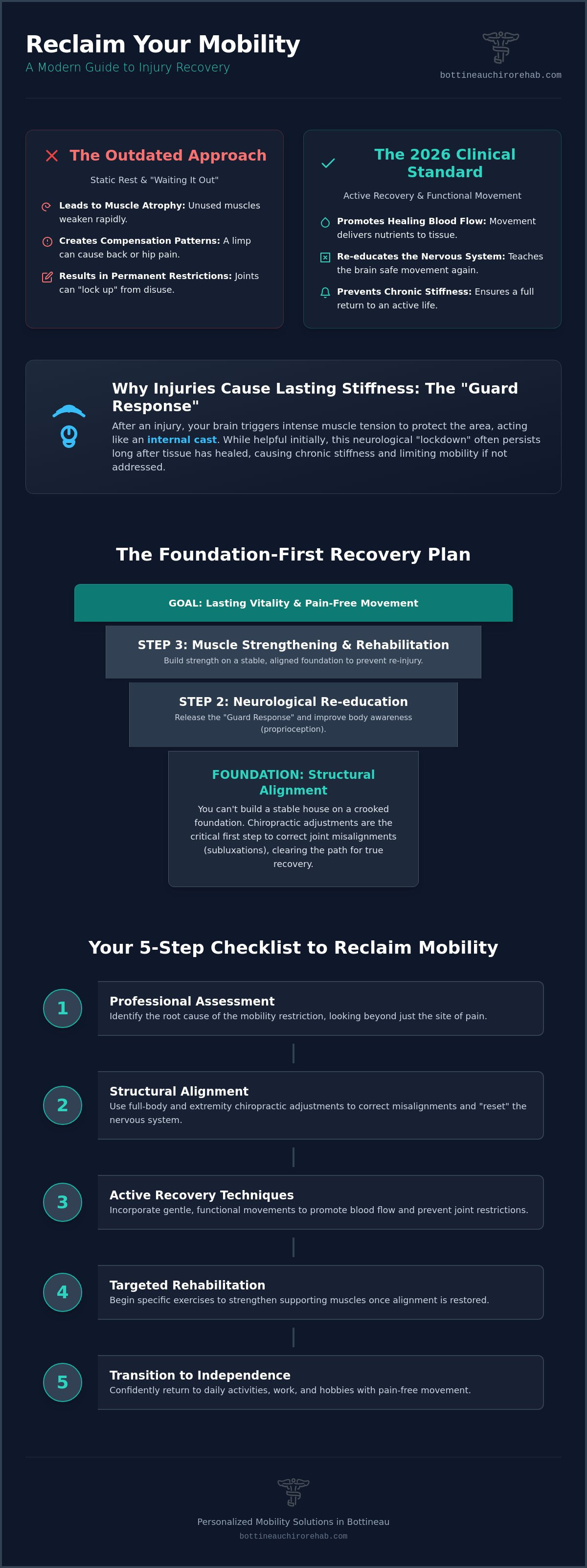
Your 5-Step Checklist to Restore Mobility After Injury
Recovery isn't a guessing game. It requires a logical, sequential plan to ensure your body heals correctly without developing compensatory habits. If you want to restore mobility after injury, you must follow a path that prioritizes structural integrity before adding heavy loads. This five-step checklist provides the roadmap you need to transition from acute pain to an active, independent lifestyle.
- Step 1: Professional Assessment. Identify the root cause. We don't just look at where it hurts; we look at the entire kinetic chain to find the structural source of your restriction.
- Step 2: Structural Alignment. Clear joint restrictions. Through full-body adjustments, we remove the mechanical "roadblocks" that prevent your limbs from moving through their natural range.
- Step 3: Soft Tissue Work. Address scar tissue and muscle guarding. We break up the adhesions that formed during your body's "Guard Response" to ensure your muscles can slide and contract freely.
- Step 4: Functional Strengthening. Build stability. Once your joints are aligned, we use targeted exercises to strengthen the supporting muscles, ensuring your new range of motion is permanent.
- Step 5: Maintenance and Prevention. Sustain your gains. We help you develop long-term habits and ergonomics to protect your mobility and prevent future setbacks.
Ready to start your checklist? Take the first step today by scheduling our $47 New Patient Special to get your professional assessment.
Measuring Your Progress
How do you know if your recovery is working? We use functional markers to track your success. Can you reach into a high cupboard without a sharp twinge? Can you bend to tie your shoes or squat to pick up a tool in the shop? We also monitor objective data, such as your degrees of movement in a specific joint. Consistency is the engine of progress. Your home exercise plan isn't a suggestion; it's a vital tool to lock in the improvements made during your clinical visits. Small, daily wins lead to massive long-term results.
When to Push and When to Pause
You must learn to distinguish between "good" soreness and "bad" injury pain. Good soreness feels like a dull ache in the muscles, typically appearing 12 to 24 hours after rehab. Bad pain is sharp, stabbing, or causes you to hold your breath. Follow the 24-hour rule. If your pain levels are higher than usual for more than a full day after a session, you've pushed too hard. Scale back the intensity. Always consult your Bottineau provider before increasing the difficulty of your movements. We are here to guide you safely as you work to restore mobility after injury.
Personalized Mobility Solutions in Bottineau: The Boundless Approach
Boundless Full Body Chiropractic & Rehab isn't just a clinic. It's a partner in your recovery. We combine the precision of full-body adjustments with the long-term benefits of physical therapy. This dual approach is specifically designed to restore mobility after injury by addressing both the structural misalignment and the muscle weakness that follows. We don't believe in temporary fixes. Our team focuses on non-surgical, drug-free solutions that get you back to your life faster. By integrating spinal rehab with active movement, we ensure your recovery is both comprehensive and sustainable.
We see the person, not just the injury. Whether you are dealing with a lingering sports strain or a repetitive stress injury from work, our goal remains the same. We want to see you moving without pain. We validate your physical frustration and offer a decisive path toward improvement. You've learned about the Guard Response and the importance of structural alignment in previous sections. Now, it's time to put that knowledge into action with a provider who values your time and your well-being equally.
A Community-Focused Recovery Experience
We serve the hardworking residents from Rugby to Minot and everywhere in between. If you're a farmer in Bottineau or a weekend hiker at Lake Metigoshi, you face unique physical demands. North Dakota winters are tough on the body. We understand the slips on the ice and the repetitive strain of agricultural labor. Our care plans are flexible. We work around your busy schedule to ensure you receive the family care and extremity adjusting you need to stay active. We are proud to be a local, family-oriented practice that understands the grit and determination of our community.
Take the First Step Toward Pain-Free Living
Reclaiming your independence starts with a single decision. We invite you to claim our chiropractic new patient offer for just $47. This introductory special includes a comprehensive exam and a detailed consultation. During your initial functional mobility assessment, we'll map out your current range of motion and identify the structural "roadblocks" holding you back. You'll leave with a clear understanding of your recovery timeline and a decisive path forward. Don't let stiffness become your new normal. It is time to restore mobility after injury and return to the sports, work, and family activities you love. We are ready when you are.
Reclaim Your Active Lifestyle and Move Without Fear
You don't have to accept stiffness as your permanent reality. True recovery requires a decisive shift from passive waiting to proactive movement. By prioritizing structural alignment through full-body adjustments, you remove the mechanical barriers that stop your body from healing correctly. This foundation allows you to transition safely into active rehabilitation. It's the most effective way to restore mobility after injury and prevent the compensatory patterns that lead to future pain.
At Boundless Full Body Chiropractic & Rehab, we specialize in a non-surgical approach to sports and work-related injuries. Our expertise in extremity adjustments ensures that every joint in your kinetic chain is functioning at its peak. We want to see you back on the North Dakota trails or returning to work in Bottineau with full confidence. Stop guessing about your health and start following a proven roadmap.
Claim Your $47 New Patient Special and Restore Your Mobility Today. This introductory offer for Bottineau residents includes a comprehensive exam and consultation to identify your specific needs. Your journey back to independent, pain-free movement begins now. We're ready to help you thrive again.
Frequently Asked Questions
How long does it typically take to restore mobility after an injury?
Recovery timelines vary based on the severity of your tissue damage and your consistency with rehab. Most patients begin to see measurable functional improvements within 2 to 4 weeks of starting a structured plan. A comprehensive program often spans several months to ensure that structural alignments are stable and compensatory patterns are fully corrected. We provide a specific timeline after your initial assessment.
Can chiropractic care help if my injury happened years ago?
Yes, it's often possible to address restrictions even years after the initial trauma occurred. Chronic misalignments and accumulated scar tissue can be corrected through targeted adjustments and soft tissue work. It's never too late to restore mobility after injury. We focus on clearing long-standing structural roadblocks and retraining your nervous system to move without the old "Guard Response."
Is it safe to get adjusted while I am still in the acute pain phase?
Adjustments are safe and highly effective during the acute phase of an injury. We use specialized, low-force techniques to reduce inflammation and calm the nervous system's protective tension. Early intervention prevents your body from hardwiring dysfunctional "cheating" movements. By restoring alignment immediately, we create the optimal environment for your tissues to heal correctly from the start.
What is the difference between physical therapy and the rehab offered at Boundless?
We provide a unique integration of structural chiropractic adjustments and functional physical therapy. Traditional therapy often focuses on strengthening muscles around a joint that may still be misaligned. Our "structure-first" approach ensures the joint is properly seated and moving before we begin intensive strengthening. This synergy leads to faster results and a lower risk of recurring issues.
Do I need a doctor's referral to start mobility rehab in Bottineau?
No, you do not need a referral from a medical doctor to begin care at our clinic. Chiropractors are primary care providers for musculoskeletal health in North Dakota. You can schedule your initial consultation directly with us. This direct access allows you to bypass long wait times and start your recovery process when it matters most.
Will I have to do exercises at home to see results?
Yes, your home exercise plan is a critical component of your success. While our clinical adjustments clear structural restrictions, your daily movements reinforce that new alignment. Think of it as a partnership. We provide the professional corrections, and you provide the consistency needed to lock in those gains. We keep your home routine simple and highly focused on your specific goals.
Does the $47 new patient special include a mobility assessment?
Yes, the $47 special covers your comprehensive initial exam and consultation. This includes a full functional mobility assessment where we identify joint restrictions and measure your current range of motion. It is designed to give you a clear, professional understanding of your condition without a significant financial hurdle. You'll leave your first visit with a decisive plan for improvement.
What should I wear to my first rehabilitation appointment?
Wear comfortable, loose-fitting clothing that allows you to move freely. Athletic wear or flexible casual clothes are the best choices. We will be performing various movement screens and assessments, so avoid restrictive items like stiff denim or heavy work boots. This ensures we can accurately evaluate your joints and muscles during your functional assessment.


