
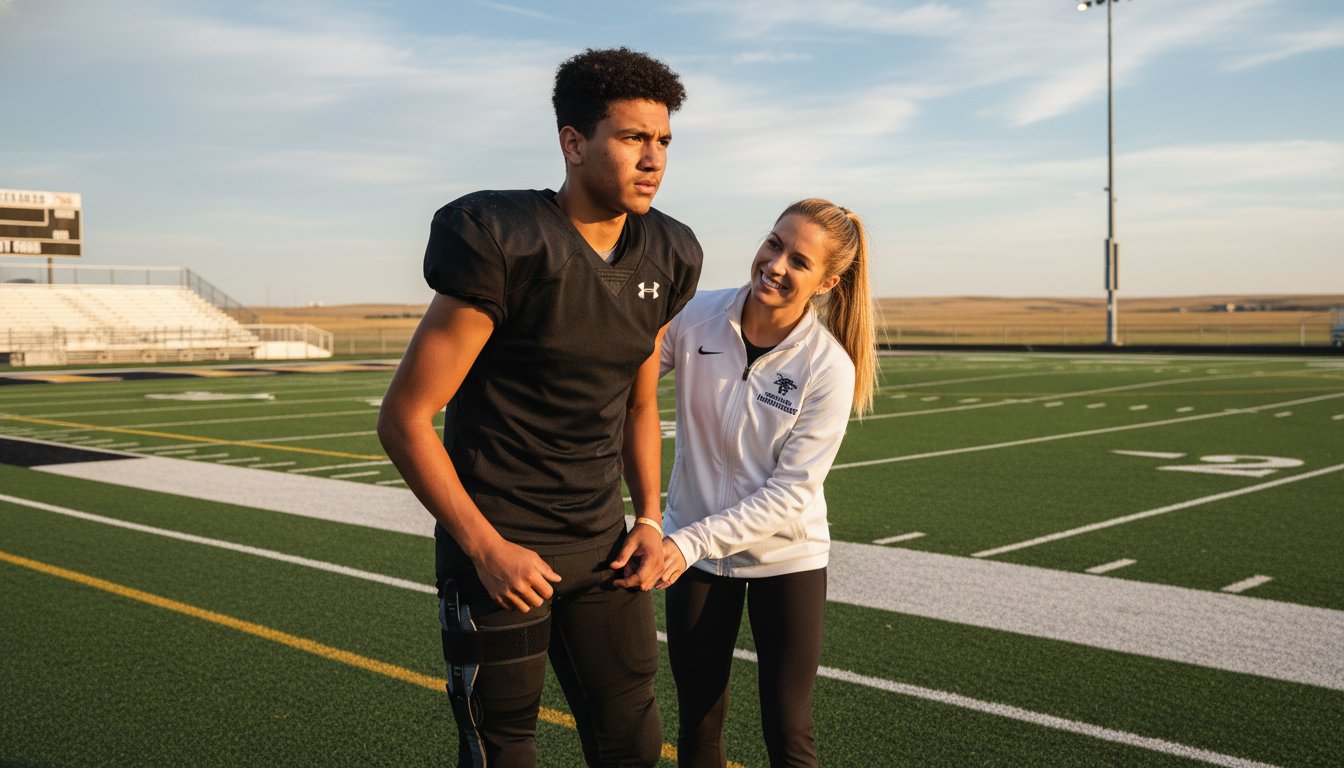
Resting an injury isn't a recovery plan; it's a waiting game that often leads to another trip to the sidelines. You want to be back on the field in Bottineau or Rolla, not stuck on the couch watching your season slip away. It's normal to feel anxious about whether your body is truly ready or if you're one wrong move away from a repeat injury. Safely managing your return to sport after injury North Dakota requires more than just waiting for the pain to fade. It demands a structured approach that respects both your physical limits and the strict requirements of state law.
You deserve a recovery path that restores your performance without relying on surgery. This guide provides the roadmap you need to master your comeback. We'll break down the legal requirements for school sports compliance under the North Dakota Century Code and outline a clear, phased timeline for active rehabilitation. From full-body adjustments to targeted sports injury rehab, you'll learn how to rebuild strength and meet every athletic safety milestone with confidence. Let's get you back in the game safely and decisively.
Key Takeaways
- Navigate North Dakota Century Code 15.1-18.2 requirements to ensure your recovery meets mandatory school safety and concussion protocols.
- Master a structured four-phase roadmap to manage a safe return to sport after injury North Dakota without the risk of premature re-injury.
- Move beyond the "rest and wait" approach by using active rehabilitation to fix hidden compensatory patterns before they cause new pain.
- Prepare for the physical demands of seasonal transitions with sport-specific strategies designed for North Dakota athletes.
- Access professional sports injury rehab and full-body adjustments in Bottineau to restore your mobility and competitive edge.
Understanding North Dakota’s Return-to-Play Requirements and Injury Risks
Returning to the field after a setback isn't a single moment in time. It's a clinical process that requires precision, patience, and professional oversight. For local athletes, a successful return to sport after injury North Dakota means more than just being pain-free. It involves a multi-stage clearance process where mobility, strength, and sport-specific mechanics are tested under pressure. You don't just "get back out there." You earn your way back through measurable physical milestones that ensure your body can handle the rigors of competition.
North Dakota's athletic culture adds layers of complexity to this recovery. Our athletes are often multi-sport competitors who transition directly from the physical impact of football into the high-intensity endurance of wrestling or basketball. The harsh climate also plays a role. Cold temperatures can increase joint stiffness and affect warm-up efficiency, making proper rehabilitation even more critical. Whether it's an ACL tear on the turf or a rotator cuff issue from a summer of baseball, the goal is always the same: full restoration of function without the risk of a repeat injury.
North Dakota Century Code 15.1-18.2: What Parents Must Know
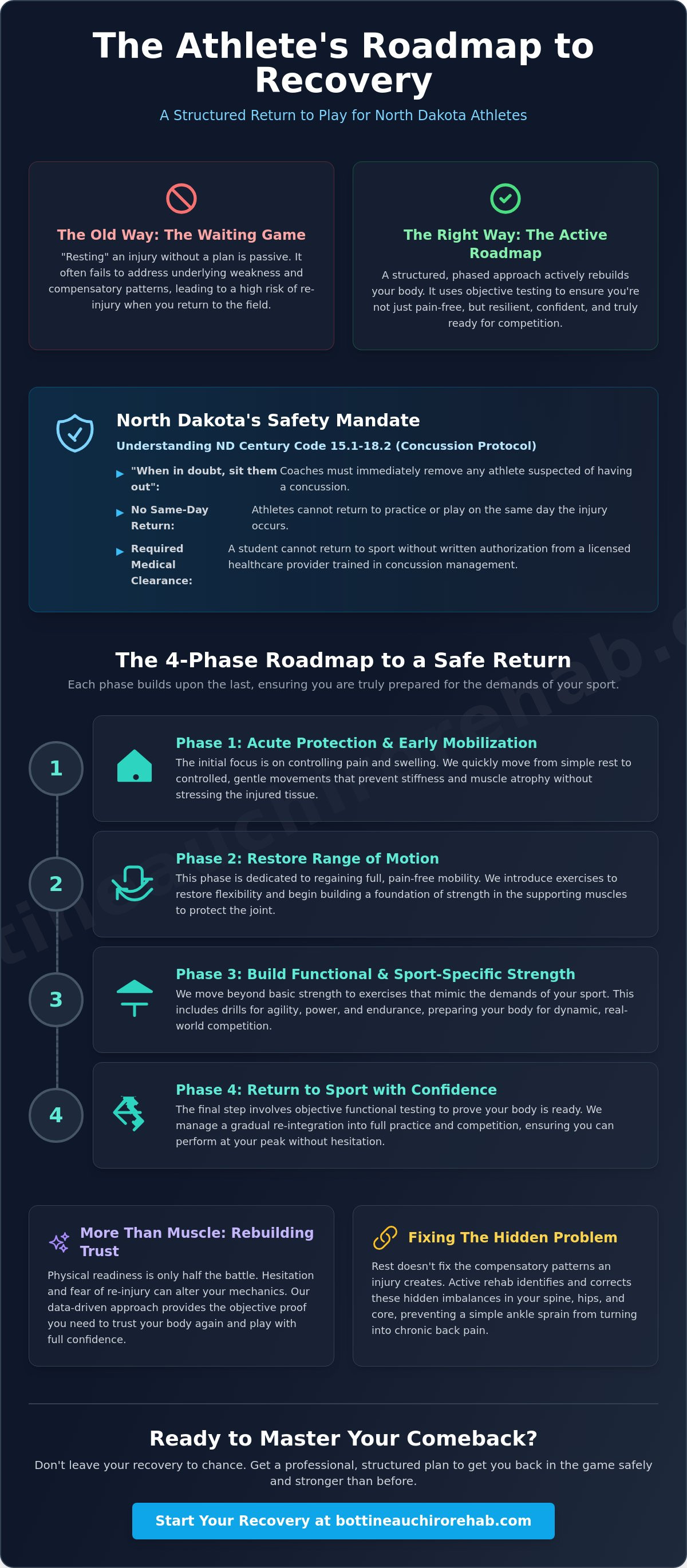
State law is very clear regarding student-athlete safety, particularly concerning head injuries. As of the 2024 updates to the North Dakota Century Code, schools must follow a strict "when in doubt, sit them out" philosophy. If a coach or official suspects a concussion, the athlete must be removed from play immediately. They cannot return to the game or practice on the same day the injury occurred. This isn't a suggestion; it's a legal requirement designed to protect young brains from secondary impact syndrome.
Before any student can return to their sport, they must provide written authorization from a licensed healthcare provider trained in concussion management. This clearance is the final step in a step-wise protocol that monitors how the athlete responds to increasing levels of physical exertion. Understanding these legal boundaries helps parents and athletes navigate the healthcare system more efficiently. It ensures that every return to sport after injury North Dakota is documented, legal, and, most importantly, safe.
Common Sports Injuries in the Bottineau and Minot Regions
In our local communities, the types of injuries we see often reflect our seasonal activities. High-impact sports like football and wrestling frequently result in acute trauma, such as ligament tears or severe sprains. Meanwhile, track and field or basketball athletes often struggle with overuse injuries like shin splints or tendinitis. Gaining a deeper perspective on Understanding Sports Injuries helps clarify why a sprained ankle in October can lead to hip issues by February if the underlying biomechanics aren't addressed.
We also see a high volume of "weekend warrior" injuries from recreation at Lake Metigoshi. Sudden bursts of activity on the water or the trails can lead to back strains and extremity injuries for those who aren't conditioned for year-round sport. Regardless of how the injury happened, the recovery focus remains on active rehabilitation. We look at the whole body to ensure that a knee injury hasn't created compensatory patterns in the spine or hips. This comprehensive approach is what keeps Bottineau athletes performing at their peak.
The 4-Phase Roadmap: How to Safely Return to Play
Pain-free movement doesn't mean you're ready for the field. It's a common mistake that leads straight back to the treatment table. You need a structured roadmap to ensure a successful return to sport after injury North Dakota. This process uses objective functional testing to prove your body is resilient before you take a hit or make a cut. We move beyond "feeling better" and focus on performing better. Your recovery is a ladder. You must climb every rung to reach peak performance safely.
Physical readiness is only half the battle. You must also trust your body again. Psychological readiness is a vital component of this roadmap. If you're hesitant to plant your foot or shy away from contact, your mechanics will suffer. Functional testing gives you the data to overcome that fear. It provides the confidence that comes from knowing your joints and muscles can handle the load. This phased approach removes the guesswork from your comeback.
Phase 1 & 2: Acute Protection and Restoring Range of Motion
The first steps focus on protection and preparation. We move quickly from the traditional RICE method to early, controlled mobilization. Full-body adjustments and extremity adjusting are essential here. These interventions reduce local inflammation and restore basic joint play. The goal is simple but critical. We want to reduce swelling and achieve symmetrical movement. If your injured limb doesn't move exactly like your healthy one, you aren't ready to add weight. We prioritize quality of motion over everything else in these early stages.
Phase 3 & 4: Functional Strength and Sport-Specific Integration
Once your range of motion is restored, we add dynamic loads. We transition from static exercises to multi-planar movements that mimic the chaos of a real game. Functional strength is the ability to maintain alignment under sport-specific loads. This is where we bridge the gap between the clinic and the court. There is a vital distinction between being cleared for practice and being cleared for full competition. Practice allows for controlled contact and drills. Following a formal NFHS Return-to-Play Planning framework ensures you don't skip these necessary graduation steps.
Full competitive clearance is the final milestone. It requires you to demonstrate power, agility, and endurance without compensatory patterns. If you're ready to start this structured journey, our sports injury rehab team can help you build a personalized plan. We focus on results that last beyond the final whistle. Don't leave your recovery to chance. Follow the roadmap and return stronger than before.
Why Traditional Rest Isn't Enough: The Case for Active Rehab
"Just rest it" is some of the most common, yet damaging, medical advice an athlete can receive. While initial protection is necessary, prolonged inactivity is a recipe for muscle atrophy and joint stiffness. Your body is designed for movement. When you stop, your recovery stalls. A successful return to sport after injury North Dakota depends on active rehabilitation that challenges your tissues to adapt and strengthen. We don't wait for healing to happen; we drive it forward with purposeful intervention.
Rest often hides the true problem. You might feel better while sitting on the couch, but the moment you sprint or jump, the weakness reappears. Active rehab identifies these gaps early. We use sports injury rehab to stress the body in controlled ways, ensuring your ligaments and tendons are actually ready for the demands of the game. This proactive approach cuts down on recovery time and builds a more resilient athlete. It moves you from a state of fragile protection to one of durable performance.
Beyond the Spine: Extremity Adjusting for Athletes
Athletic performance starts from the ground up. For North Dakota runners and jumpers, ankle and foot alignment is non-negotiable. If your ankle joint is restricted, your knee and hip have to work twice as hard to compensate. We use extremity adjusting to restore proper mechanics to every joint in the kinetic chain. This isn't just about the back; it's about making sure your power transfers efficiently from the ground through your entire body. When your feet and ankles are aligned, your entire gait becomes more efficient.
Upper body athletes aren't exempt. Shoulder adjustments are a critical tool for preventing "pitcher’s elbow" and chronic rotator cuff strain. When the shoulder blade doesn't move correctly, the elbow takes the brunt of the force during a throw. By aligning the extremity, we protect the smaller joints and improve your overall athletic efficiency. Full-body adjustments ensure that no single joint is carrying an unfair load, allowing you to maximize your power output safely.
Correcting Compensatory Patterns Before Re-Injury
Your body is an expert at "hacking" movement to avoid pain. If your right ankle hurts, you'll naturally shift your weight to the left. These compensatory patterns quickly become hardwired into your nervous system. You might stop feeling the ankle pain, but you're now setting yourself up for a hip or lower back injury. This is why the second injury is often more severe than the first. The mechanics are broken, even if the primary pain is gone. You're essentially playing on a misaligned frame.
At Boundless Chiropractic, we use full-body assessments to find these hidden risks. We look at how you move, not just where it hurts. Spinal rehab plays a vital role here by maintaining core stability while your limbs recover. A strong, aligned spine provides the stable base your arms and legs need to generate power. Don't let a "minor" injury turn into a career-ending chain reaction. Address the compensations now so you can return to sport after injury North Dakota with total confidence in your physical foundation.
Sport-Specific Preparation for North Dakota Athletes
In North Dakota, the athletic calendar never stops. You transition from the physical grind of football directly into the explosive movements of basketball or wrestling. This rapid shift puts immense stress on your body. If you hasn't fully recovered from the previous season, you're entering the next one with a deficit. A successful return to sport after injury North Dakota requires a plan tailored to these specific demands. You need to prepare your body for the new forces it will face on the mat, the court, or the track.
Adopting a "pre-hab" mindset is the best way to stay on the field all year. This means fixing small imbalances before they become season-ending injuries. You can start this at home with simple drills for balance and proprioception. Try single-leg stands for 30 seconds at a time or controlled "bird-dog" movements to stabilize your core. These small habits build the neurological foundation your body needs to react quickly during a game. Consistency at home makes our work in the clinic even more effective.
Football and Wrestling: Impact Management and Stability
High-contact sports like football and wrestling demand elite neck stability and spinal alignment. Every hit and every take-down creates micro-trauma that accumulates over a long season. If your spine is misaligned, your nervous system can't coordinate the muscle contractions needed to protect your joints. For wrestlers in the Rolla and Rugby areas, we focus heavily on core-strengthening routines that stabilize the lower back. Full-body adjustments ensure your frame can absorb impact without buckling, keeping you competitive from the first match to the state finals.
Basketball, Track, and Volleyball: Explosive Power and Joint Health
Court sports and track events see a high rate of ACL and ankle injuries because of the constant jumping and cutting. Most of these injuries happen when the hips aren't firing correctly. When your hip mechanics are off, your knees and ankles take the brunt of the force. Proper alignment improves your vertical jump and sprint speed by allowing your muscles to fire in the correct sequence. Use this checklist for "return-to-jump" readiness:
- Symmetrical Landing: You can land softly on both feet without your knees caving in.
- Single-Leg Balance: You can hold a steady stance for 30 seconds on the injured side without swaying.
- Reactive Power: You can perform a box jump without compensatory shifts in your hips or spine.
If you're struggling to check these boxes, it's time for professional intervention. Our sports injury rehab programs are designed to get you back to peak performance quickly. Don't let a lingering ache turn into a torn ligament. Claim our $47 New Patient Special today to get a full assessment and start your specific preparation for the upcoming season.
Start Your Recovery Journey at Boundless Chiropractic in Bottineau
Don't leave your athletic career to chance. Your return to sport after injury North Dakota requires a partner who understands the specific physical demands of our local sports. At Boundless Full Body Chiropractic & Rehab, we provide the clinical expertise and proactive care needed to get you back in the game. Dr. Daniel Pozarnsky leads our team with a focus on immediate results and long-term performance. We serve athletes from Bottineau, Minot, and all across our rural communities. You don't have to travel to a major city to find elite sports injury rehab. Professional care is right here in your backyard. We bridge the gap between injury and peak performance with decisive, expert guidance.
Our clinic is designed for efficiency and results. We value your time as much as your health. Whether you're coming from Rugby or Rolla, our Bottineau location offers the specialized care you need to stay local while getting better. We understand the frustration of being sidelined. That's why our communication is direct and our solutions are immediate. We focus on restoring your vitality and movement as quickly as possible. You deserve a recovery process that feels like progress every single day.
Our Non-Surgical Approach to Sports Rehabilitation
We believe in treating the athlete, not just the injury. Our philosophy centers on a "whole-person" approach. We combine full-body adjustments with physical therapy and spinal rehab to address every link in your kinetic chain. If you're recovering from a knee injury, we look at your hips and spine to ensure your foundation is stable. This integrated method helps you avoid the risks and downtime associated with invasive procedures. Experience the difference of extremity adjusting and targeted rehab. We help you rebuild your strength and confidence without relying on surgery. We restore function so you can play without hesitation.
Take Action: Your Path Back to the Field Starts Here
Your comeback begins with a single step. We've made it simple and affordable to start your recovery today. Our $47 New Patient Special includes a comprehensive exam and consultation to identify your specific needs. We'll evaluate your mobility, check your alignment, and build a personalized roadmap for your return to the field. You can book your appointment online or visit our clinic in Bottineau. Don't wait for your symptoms to get worse. Take control of your recovery and reclaim your competitive edge. Our team is ready to guide you through every phase of your roadmap.
Claim your $47 New Patient Special today!
Take the First Step Toward Your Comeback
A successful return to the field requires more than just waiting for the clock to run out on your recovery. It demands a proactive strategy that balances legal compliance with precise, functional movement. You've learned how a structured roadmap and active rehabilitation can prevent the compensatory patterns that lead to re-injury. Now, it's time to put that knowledge into action. Navigating your return to sport after injury North Dakota is safer and more efficient when you have an expert guide by your side.
Dr. Daniel Pozarnsky specializes in non-surgical sports injury rehabilitation designed to get Bottineau athletes back to peak performance. We focus on the whole body. We ensure every joint and muscle is ready for the intensity of your next season. Don't let a past injury dictate your future performance. Take advantage of our specialized care and local expertise to rebuild your strength with confidence. Your team is waiting for you to lead them again. Schedule your $47 New Patient Special and get back in the game! We're ready to help you win your recovery.
Frequently Asked Questions
How long does it typically take to return to sports after a concussion in North Dakota?
Returning to play after a concussion in North Dakota takes as long as the mandatory step-wise protocol requires for your specific symptoms. By law, an athlete cannot return to competition on the same day the injury occurred. You must progress through increasing levels of physical exertion without symptoms returning. Once you complete these stages, you need written authorization from a licensed healthcare provider trained in concussion management to ensure your brain is fully protected.
Can a chiropractor sign my school's return-to-play clearance form?
Yes, a licensed chiropractor can sign your return-to-play clearance form if they have specific training in the evaluation and management of concussions. North Dakota law requires the healthcare provider to be knowledgeable in this area to authorize a student's return to athletic activities. At Boundless Chiropractic, we understand these legal requirements and provide the necessary clinical assessments. We help you navigate the paperwork so you stay compliant with school district policies and state law.
What is the difference between physical therapy and chiropractic for sports injuries?
Chiropractic focuses on joint alignment and nervous system function, while physical therapy emphasizes muscle strengthening and movement patterns. Chiropractic adjustments ensure your frame is aligned so that the exercises in physical therapy are effective. At Boundless Chiropractic, we combine these approaches. We use full-body adjustments to fix the foundation and sports injury rehab to build the strength needed for a safe return to sport after injury North Dakota.
How do I know if my sports injury requires surgery or if rehab is enough?
Determining if you need surgery requires a professional clinical assessment of tissue stability and damage. Many musculoskeletal injuries, including high-grade sprains and certain ligament tears, respond exceptionally well to non-surgical sports injury rehab. If your joint remains stable and your pain decreases with active movement, rehab is often the most efficient path forward. We focus on restoring your mobility and strength to avoid the downtime and risks associated with surgical intervention.
What is extremity adjusting, and how does it help athletes?
Extremity adjusting involves the precise alignment of joints outside of the spine, such as your ankles, knees, shoulders, and wrists. For athletes, this is critical because these joints are the primary points of impact and power generation. If your ankle is misaligned after a sprain, it ruins your gait and stresses your knee. Aligning these extremities restores proper mechanics and ensures your entire kinetic chain functions at peak efficiency during high-intensity competition.
Is it safe to play through minor pain, or should I see a professional immediately?
Playing through even minor pain is risky because your body will naturally create compensatory patterns to avoid discomfort. These movement "hacks" often lead to more severe secondary injuries in other joints. If you feel persistent pain, you should see a professional immediately for an assessment. Addressing a minor issue with a full-body adjustment or targeted rehab now prevents a season-ending injury later. Early intervention is the fastest way to stay on the field.
Does Boundless Chiropractic work with high school athletes from Minot or Rugby?
Boundless Chiropractic proudly serves high school and amateur athletes from Minot, Rugby, and all surrounding North Dakota towns. We understand that specialized sports care can be limited in rural areas. Our Bottineau clinic provides a central location for elite sports injury rehab and spinal care. We work closely with local families to ensure their student-athletes meet state safety requirements while achieving a high-performance return to sport after injury North Dakota.
What should I bring to my first sports rehab appointment at Boundless Chiropractic?
For your first appointment, bring your identification, insurance information, and any recent imaging or medical records related to your injury. Wear comfortable athletic clothing that allows for a full range of motion during your physical assessment. We will conduct a thorough exam to build your personalized recovery roadmap. You can also take advantage of our $47 New Patient Special during this initial visit to start your journey back to the field without delay.


