

What if the electric-shock pain shooting down your leg isn't actually a back problem, but a failure of your body's entire structural chain? If you are struggling with sciatica, you know that the sharp, gluteal pain and heavy numbness make even the simplest daily movements feel impossible. You are likely frustrated by symptoms that won't quit and fearful that invasive back surgery is your only remaining option. It's a common fear, but it doesn't have to be your reality.
We understand that you want your life back, not a long recovery from a surgical procedure. Research indicates that 80 to 90 percent of cases improve with conservative care. This article shows you how a full-body chiropractic approach identifies the root cause of your discomfort to provide lasting results. Discover how integrated spinal rehab and precision adjustments can help you return to your work and family life in Bottineau or Minot quickly. You deserve a path to recovery that is both decisive and effective. Learn why addressing the entire kinetic chain is the key to moving without pain again.
Key Takeaways
- Understand how sciatica is often a symptom of structural issues throughout your entire kinetic chain rather than just a localized back injury.
- Compare the benefits of conservative, non-surgical recovery against the high risks and long recovery times associated with invasive spinal procedures.
- Learn specific ergonomic adjustments for tractor and truck seating to protect your spine during long hours of agricultural or ranch work.
- Master proper lifting techniques for heavy equipment and livestock feed to prevent nerve pinching and recurring flare-ups.
- Discover how the Boundless $47 New Patient Special provides a low-risk starting point for a comprehensive consultation and professional exam.
What is Sciatica? Understanding the Shooting Pain
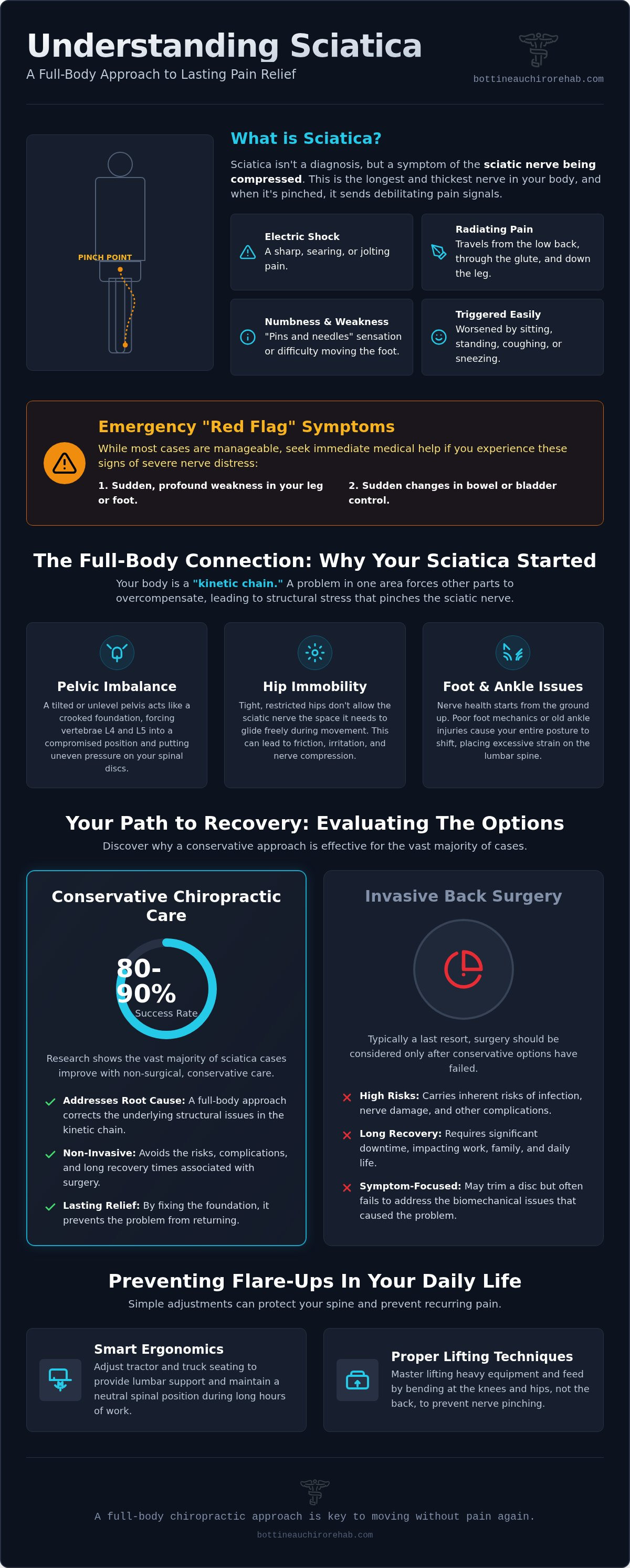
Imagine a bolt of lightning striking your lower back and traveling all the way to your toes. That is the physical reality of living with What is Sciatica?. It isn't just a simple sore muscle; it's the compression of the sciatic nerve, which is the longest and thickest nerve in your body. When this nerve is pinched, it sends a searing, electric-shock sensation through your glutes and thighs. This isn't just uncomfortable. It's exhausting. It steals your sleep and makes sitting through a family dinner feel like an endurance test.
Many patients in our community ask how to tell the difference between "true" sciatica and other types of leg pain. True sciatica involves the nerve roots in your lower spine being compressed by a disc or bone. However, you might actually be experiencing piriformis syndrome. This happens when a small muscle in your hip tightens and pinches the nerve. Both conditions cause significant pain, but the treatment path for each is very different. Distinguishing between the two is vital. If you treat a spinal issue like a simple muscle strain, you won't get lasting relief. We prioritize an accurate diagnosis to stop the guesswork and start your recovery.
Common Symptoms You Shouldn't Ignore
Pain that radiates from your lower spine all the way down to your calf is a classic sign of nerve distress. It often feels like a sharp burn or a dull, persistent ache that won't let up. You might also notice numbness or a "pins and needles" sensation in your foot or toes. These symptoms tend to flare up during simple daily activities. Prolonged sitting, standing up quickly, or even a sudden cough can trigger a wave of intense discomfort. If you find yourself constantly shifting positions just to find a second of peace, your nerve is under significant stress.
When Sciatica Becomes an Emergency
While most sciatica cases respond well to conservative chiropractic care, some situations demand immediate action. You must watch for "red flag" symptoms that indicate severe nerve distress. Sudden, profound weakness in your leg or foot that makes walking impossible is a major warning. If your leg buckles or you can't lift your toes, seek help immediately. The most critical warning signs are sudden changes in your bowel or bladder control. This can signal a rare but dangerous condition that requires urgent medical intervention. Most flare-ups are manageable, but knowing the difference between a temporary ache and a severe disc issue protects your long-term mobility.
The Full-Body Connection: Why Your Sciatica Started
Most traditional treatments focus only on where it hurts. This is a mistake. Your body functions as a single, connected unit called the kinetic chain. When your ankle is unstable or your hip is tight, your lower back must overcompensate to keep you upright. This constant structural stress is one of the primary causes of sciatica. We don't just look at your spine. We evaluate your entire mechanical structure. Achieving total alignment requires a full body chiropractic adjustment to ensure every joint is moving correctly.
If you only treat the symptom, the pain will return. We see this often in patients who have tried "back-only" clinics without success. The nerve is being pinched because the body is out of balance. This imbalance often starts far away from the actual site of the pain. By mapping your movement, we find the structural failure that started the fire in the first place.
The Spine and Beyond: Pelvic Alignment
Your pelvis acts as the foundation for your spine. If it is tilted or unlevel, it forces the L4 and L5 vertebrae into a compromised position. This creates uneven pressure on the spinal discs. Over time, that pressure pinches the nerve roots. Hip mobility also plays a critical role. If your hips are locked or restricted, the sciatic nerve lacks the space it needs to glide freely during movement. Treating only the back is like painting over a crack in a foundation. The pain will return because the structural tilt remains uncorrected.
Extremity Adjusting and Nerve Health
Nerve health starts from the ground up. If your feet lack proper support, your entire posture shifts to compensate. Your foot mechanics directly influence the amount of pressure placed on your lumbar spine. This is why we utilize extremity adjusting to stabilize your foundation. Addressing old knee injuries or chronic ankle instability prevents your lower back from doing extra work. It stops the cycle of sciatica relapses before they begin. You can schedule a full-body assessment to see how your gait affects your nerve health.
Chiropractic Care vs. Surgery: Evaluating Your Options
You don't need a scalpel to find relief. Many patients fear that invasive back surgery is the only way to stop the shooting pain, but the data tells a different story. Research indicates that 80 to 90 percent of sciatica cases improve with conservative care. A study published in the Spine Journal even found that 60 percent of patients who received chiropractic care experienced relief comparable to surgical results. Surgery is a permanent change to your anatomy. It carries risks like "Failed Back Surgery Syndrome," where the pain persists or even worsens after the procedure. Choosing a non-surgical path first is the smartest move for your long-term health.
Managing Sciatic nerve pain shouldn't start in an operating room. Our approach combines precise full-body adjustments with specialized physical therapy in Bottineau. This dual strategy addresses the structural misalignment and the muscular weakness at the same time. It's a faster, more cost-effective solution for local families. You avoid the high costs of hospital stays and the hidden expenses of long-term post-operative care. We focus on getting you back to work and your family without the heavy burden of a surgical recovery.
The Non-Surgical Advantage
The biggest benefit of conservative care is that there's no downtime. You can stay active while you heal. We help you avoid the dangerous cycle of pain medications and dependency. Instead of masking the symptoms, we use spinal rehab to build real core stability. This strengthens your body from the inside out. It ensures your spine can handle the demands of daily life in North Dakota without another flare-up. You keep your mobility and your independence throughout the entire process.
Why Physical Therapy and Chiropractic Work Better Together
Structure and function are two sides of the same coin. Chiropractic adjustments realign your skeletal structure to take the pressure off the nerve. However, if the supporting muscles are weak, your spine won't stay in place. That's where physical therapy comes in. It strengthens the muscles that hold your alignment. We address the neurological and muscular components of sciatica simultaneously. This is especially important for our local athletes and agricultural workers who put high physical demands on their bodies. Our customized plans ensure your recovery is built to last.
Managing Sciatic Nerve Pain in North Dakota
Living in North Dakota requires physical resilience. Our agricultural and ranching work puts heavy demands on the spine every single day. When the temperature drops, your muscles naturally tighten to conserve heat. This increased tension often triggers a sciatica flare-up as tight muscles compress the underlying nerves. You need strategies that fit your actual daily life, not generic advice meant for office workers. Managing your pain means adjusting how you interact with your equipment and the environment.
Proper lifting is non-negotiable when handling livestock feed or heavy equipment parts. Don't just "lift with your legs." Keep the weight as close to your center of gravity as possible. Never twist your torso while holding a heavy load. This shearing force is a primary cause of disc injury and nerve irritation. If you feel a sharp catch in your glutes, stop immediately. Pushing through the pain often turns a minor strain into a long-term mobility issue. Prioritize your structural health so you can stay in the field.
Ergonomics for the Rural Lifestyle
Simple Stretches for Immediate Relief
You can decompress your spine with simple movements throughout the day. Use the "Figure Four" stretch to release the piriformis muscle in your hip. Lie on your back and cross one ankle over the opposite knee. Gently pull your thigh toward your chest until you feel a deep stretch in the glute. Use knee-to-chest movements to open the spinal canal and reduce pressure on the nerve roots. Avoid "toe touches" during an active sciatica flare-up. Stretching a sensitized nerve too aggressively can actually increase your pain levels. Focus on gentle decompression rather than intense stretching. If your daily routine has become a struggle, contact us to build a personalized movement plan that keeps you moving.
Starting Your Recovery: The Boundless $47 New Patient Special
Stop waiting for the pain to disappear on its own. It won't. You need a decisive plan to reclaim your mobility and your life. We've removed the financial barrier to getting started with our chiropractic new patient offer. This special is designed to give you concrete answers without the high cost of a traditional hospital consultation. Dr. Daniel Pozarnsky uses this initial meeting to build a personalized roadmap for your recovery. We move with urgency because we know how much sciatica has already taken from your daily routine.
We understand the frustration of limited movement. Our goal is to transform that physical frustration into hope and momentum. By identifying the root cause of your nerve compression early, we can prevent the need for more invasive interventions later. This introductory offer is your low-risk entry point into a modern, results-driven approach to wellness. Don't let another day pass while you're stuck on the sidelines. Your path to lasting relief is straightforward and easily initiated.
What to Expect at Your First Visit
Your first visit is a deep dive into your physical health. We don't just look at where it hurts. We conduct a comprehensive full-body assessment to find the primary misalignment triggering your sciatica. This includes a thorough review of your medical history and a detailed look at your specific pain triggers. We prioritize clear communication. You will receive a straightforward explanation of our findings and a recommended plan of care. We value your time and your well-being equally, ensuring you leave with a clear understanding of your next steps.
Serving Bottineau and the Surrounding Communities
We are proud to serve the hardworking families of North Dakota. Whether you are traveling from Rugby, Rolla, or Lake Metigoshi, we provide professional care that respects your busy schedule. Our commitment to family chiropractic care ensures that residents of all ages have access to non-surgical recovery options. Pain shouldn't be a baseline for your life. Take the first step toward a pain-free future right now. Call our office or book online to secure your introductory special. We are ready to help you return to your work and your family with confidence.
Reclaim Your Mobility and Life Without Surgery
You don't have to accept shooting pain as your new normal. We've explored how structural failures across your entire body trigger sciatica. Our non-surgical, full-body approach targets the root cause to restore your vitality quickly. Dr. Daniel Pozarnsky offers the decisive care required to end your physical frustration and prevent a recurring cycle of discomfort. Stop masking symptoms with temporary fixes that ignore the underlying mechanical issues. Secure your roadmap to recovery and start moving with confidence again.
Expert relief is available right here for residents in Bottineau, Rugby, and Minot. You deserve to move without restriction and return to your work and family life without the heavy burden of surgical recovery. It's time to transform your physical frustration into lasting momentum. Take the first step toward a pain-free future today. We prioritize your time and your health with an efficient, professional approach that gets results.
Claim Your $47 New Patient Special & End Your Sciatica Pain Today
Your journey toward total alignment starts with a single decision. We're ready to help you thrive.
Frequently Asked Questions
Can a chiropractor really help with sciatica pain in the leg?
Yes, chiropractic care is highly effective for leg pain by realigning the spine and pelvis. Our full-body approach removes the pressure on the nerve roots that cause the shooting sensations. We use specialized adjustments and spinal rehab to ensure the nerve can glide freely. This treatment targets the structural failure rather than just masking the pain with medication. It's a proven way to restore function and long-term health.
How many sessions does it take to feel relief from sciatica?
Most patients notice a reduction in sharp pain within the first few visits, typically between two and four sessions. However, complete healing of the nerve and supporting tissues takes longer. Your specific timeline depends on the severity of the compression and how long you've been symptomatic. We create a personalized roadmap during your initial exam to track your progress toward total recovery and pain-free living.
Is it better to rest or stay active when I have sciatica?
Movement is generally better than prolonged bed rest for recovery. While intense activity should be avoided during a flare-up, gentle walking and specific stretches keep your muscles from tightening further. Inactivity can lead to muscle atrophy and increased stiffness, which often worsens the pressure on the sciatic nerve. We provide specific movement guidelines to keep you active safely while your body heals from the structural imbalance.
What is the difference between a herniated disc and sciatica?
A herniated disc is a physical condition in the spine, while sciatica is the resulting set of symptoms. Up to 90 percent of cases are caused by a disc bulging and pinching the nerve root. Think of the disc as the "cause" and the shooting leg pain as the "effect." Our goal is to address the disc's position to stop the nerve irritation and restore your mobility.
Does the $47 New Patient Special at Boundless cover the first adjustment?
The $47 New Patient Special includes your initial consultation, a comprehensive exam, and your first treatment. This offer allows you to get an expert assessment of your condition without a high financial commitment. It's the most efficient way to discover the true cause of your pain. Dr. Pozarnsky uses this time to determine if our full-body approach is the right fit for your specific recovery needs.
Can sciatica go away on its own without professional treatment?
While some mild symptoms might fade, sciatica often persists or recurs without professional intervention. Ignoring the underlying structural cause can lead to permanent nerve damage or chronic weakness in the leg. Professional care ensures the root issue is resolved, which significantly reduces the risk of future flare-ups. It is always safer to address nerve compression early rather than waiting for the condition to become debilitating.
Is heat or ice better for sciatic nerve pain relief?
Ice is typically better during the first 48 hours of a flare-up to reduce acute inflammation around the nerve. Apply an ice pack for 15 to 20 minutes several times a day. Once the sharpest pain subsides, heat can help relax the tight muscles in your glutes and lower back. Alternating between the two can also improve circulation and speed up the healing process for the affected tissues.
Why does my sciatica feel worse when I drive long distances?
Driving causes prolonged compression on your lower spine and forces your pelvis into a static, often tilted position. This posture increases the pressure on the sciatic nerve, especially if you are sitting on a wallet or have poor lumbar support. The vibration of the vehicle can also irritate a sensitized nerve. We recommend using a lumbar cushion and taking frequent breaks to stand and stretch during long trips.


