

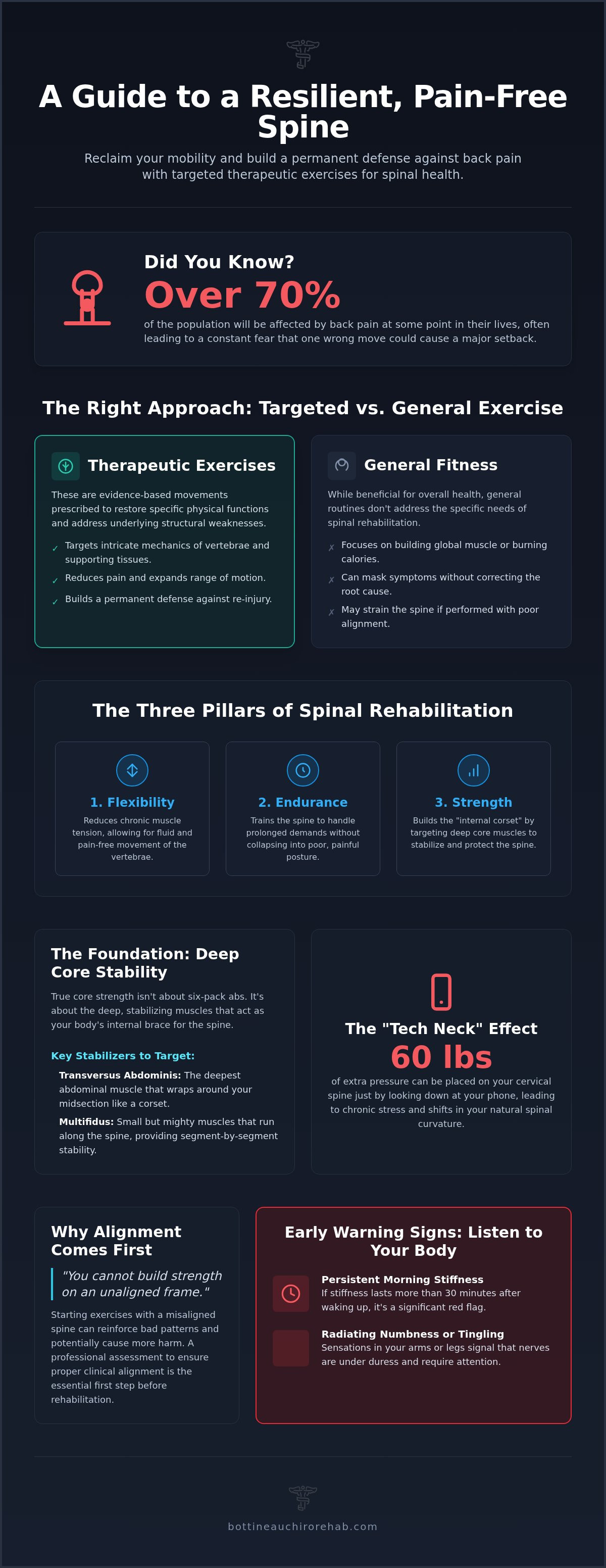
You wake up, reach for the alarm, and feel that familiar, sharp pull in your lower back. It's a frustrating start to the day that leaves you wondering if you'll have to skip the gym or struggle through your shift. You aren't alone. Research shows that back pain will affect over 70% of the population at some point. It's exhausting to live with the constant fear that one wrong move might sideline you for weeks. Implementing targeted therapeutic exercises for spinal health is the most effective way to reclaim your morning and protect your future mobility.
It's time to stop guessing and start moving with confidence. We'll show you how to combine clinical strategies with specific, low-impact movements to eliminate stiffness and restore function. This 2026 guide provides the roadmap you need to strengthen your spine and differentiate between helpful stretches and harmful habits. You will discover the exact protocols used to stabilize your core and keep you active in the sports and work you love. Let's build a foundation that keeps you moving toward the life you want.
Key Takeaways
- Differentiate between general fitness and targeted therapeutic exercises for spinal health to ensure your movements are actively restoring function rather than causing more strain.
- Master the role of deep core stability by focusing on the multifidus and transversus abdominis muscles rather than just surface-level abdominal strength.
- Learn why clinical alignment is the necessary first step before starting rehab to avoid reinforcing poor physical patterns or causing further injury.
- Access a practical daily routine designed for the physical demands of North Dakota lifestyles, prioritizing consistent, low-impact movements for long-term mobility.
- Discover how a professional diagnostic assessment removes the guesswork from recovery, providing a clear and decisive path toward a resilient, pain-free spine.
Understanding Therapeutic Exercises for Spinal Health
Therapeutic exercises for spinal health are evidence-based movements prescribed to restore specific physical functions. They aren't generic gym routines. While general fitness builds global muscle or burns calories, these targeted movements focus on the intricate mechanics of your vertebrae and supporting tissues. Physical therapy often utilizes these clinical protocols to address underlying structural weaknesses rather than just masking surface-level symptoms. The goal is decisive: reduce pain, expand your range of motion, and build a permanent defense against re-injury.
We call this "spinal hygiene." It is the daily maintenance required to keep your joints lubricated and your nerves uncompressed. Without it, the repetitive stress of daily life leads to cumulative damage. You don't wait for a cavity to brush your teeth. You shouldn't wait for a disc herniation to care for your spine. It's a proactive commitment to your future mobility.
The Three Pillars of Spinal Rehabilitation
Effective recovery relies on three distinct physical attributes. First, flexibility reduces chronic tension in the muscles surrounding the vertebrae. This allows for fluid, pain-free movement. Second, strength focuses on building the "internal corset." We aren't just looking for six-pack abs; we are targeting the multifidus and transversus abdominis to lock the spine in place. Finally, endurance is critical. It trains your spine to handle the prolonged demands of a full workday or an intense athletic session without collapsing into poor posture.
Why Spinal Health Matters for Longevity
Your spine is the primary conduit for your central nervous system. It is the highway for every signal your brain sends to your organs and limbs. When spinal health declines, it often triggers a cascade of systemic issues, from decreased energy to impaired balance. Maintaining this structure is essential for long-term wellness and vitality.
Be proactive about early warning signs. If you experience persistent morning stiffness that lasts more than thirty minutes, it's a red flag. Radiating numbness in your arms or legs is another clear signal that your nerves are under duress. These symptoms suggest your spine requires a professional assessment to prevent permanent damage. Consistent therapeutic exercises for spinal health are the most reliable tool for maintaining independence as you age.
Core Stability and Postural Alignment: The Foundation
Your core is far more than just abdominal muscles. It's a complex network of stabilizers. True therapeutic exercises for spinal health prioritize the multifidus and transversus abdominis. These deep muscles act as your body's internal brace. They support individual vertebrae during movement. If these aren't firing correctly, your outer muscles compensate. This leads to fatigue, strain, and eventual pain. You need these deep layers to function before you can build global strength.
Modern life is hard on your posture. "Tech neck" is a perfect example of how daily habits create chronic spinal stress. Looking down at screens adds up to 60 pounds of pressure to your cervical spine. This chronic stress shifts your center of gravity and changes the curvature of your neck over time. You need a stable foundation to reverse this damage. Harvard Health Publishing highlights three moves for better spine health that focus on these essential foundational mechanics.
You cannot build strength on an unaligned frame. If your spine is out of position, exercise often reinforces bad patterns. Full-body alignment is a prerequisite for effective core work. It ensures that every movement you perform is actually therapeutic rather than destructive. If you're feeling stuck, getting a professional spinal rehab assessment can identify these structural roadblocks before you start your routine.
The Role of the Pelvic Floor and Hips
Your hips and lumbar spine are inextricably linked. Tight hip flexors often pull the pelvis forward into an "anterior pelvic tilt." This creates excessive arching in the lower back and compresses the facet joints. Proprioception is your brain's ability to sense your body's position in space, and it's vital for maintaining a neutral pelvis during daily activities. Improving hip mobility directly offloads this pressure and restores balance to your lower back.
Upper Back and Cervical Health
Don't ignore the middle of your back. Thoracic mobility is the key to neck and shoulder health. When your upper back is stiff, your neck has to overwork to compensate. This often manifests as tension headaches or shoulder impingement. Focus on scapular stability to support the upper spine. Exercises like wall slides or rows help pin the shoulder blades back. This creates a stable platform for your cervical spine to move freely and reduces the risk of extremity compensations.
Why Exercise Alone Isn't Enough: The Chiropractic Connection
If you try to strengthen a spine that's already out of alignment, you're essentially locking in a dysfunctional pattern. It's like trying to balance the wheels of a car when the frame is bent. You might build muscle, but you're building it around a crooked structure. This is why a full body chiropractic adjustment is the critical first step. It resets the joints, clears nerve interference, and ensures your vertebrae are positioned correctly before you load them with movement.
We utilize the "Adjustment-Exercise Loop" to create lasting change. First, we align the structure to remove mechanical blocks. Then, we use therapeutic exercises for spinal health to strengthen the supporting tissues that hold that alignment in place. Without the adjustment, exercises often fail to reach the deep stabilizers. Without the exercise, the adjustment may not hold. It's a dual-track approach that turns temporary relief into a permanent solution. Think of chiropractic care as the reset button for your nervous system. It allows your brain to communicate clearly with your muscles again.
Maximizing Results with Spinal Rehab
Professional physical therapy Bottineau North Dakota provides the supervision needed to bridge the gap between adjustment and recovery. It isn't enough to just do the movements. You must do them with clinical precision. For local athletes and high-performance individuals, our sports injury rehab Bottineau protocols integrate these adjustments with dynamic loading. This ensures your body can handle explosive forces without reverting to compensatory habits. We focus on movement quality over quantity.
Overcoming the Plateau in Recovery
Many patients hit a wall where exercise alone stops yielding progress. This plateau often happens because of hidden tension in the extremities. A locked ankle or a misaligned hip creates a chain reaction that keeps the spine under constant stress. Extremity adjustments can unlock these secondary blocks. This allows your therapeutic exercises for spinal health to finally take effect. A multi-disciplinary approach is the most efficient way to resolve chronic cases that haven't responded to traditional fitness routines. Don't let a hidden misalignment stall your momentum.
A Daily Spinal Health Routine for North Dakota Lifestyles
Life in Bottineau demands physical resilience. Whether you're operating a tractor for twelve hours or clearing heavy snow, your spine takes the brunt of the load. Generic advice often fails because it doesn't account for the repetitive stress of rural labor. Successful therapeutic exercises for spinal health rely on consistency, not intensity. A ten-minute daily commitment is more effective than a grueling weekend workout. Focus on moving well rather than moving heavy.
Safety is your priority. Avoid "powering through" sharp pain. If a movement causes a radiating sensation or increased numbness, stop immediately. These cues are your body's way of signaling that a joint is misaligned or a nerve is compressed. Incorporating micro-breaks into your workday is also essential. If you spend hours in a tractor or at a desk, stand up every sixty minutes to reset your posture. This prevents the cumulative compression that leads to chronic stiffness.
The Morning Mobility Warm-up
Start your day by lubricating the joints before you hit the field or the office. These three steps prepare your nervous system for the day's demands.
- Step 1: Pelvic tilts. Lie on your back with knees bent. Gently flatten your lower back against the floor and then arch it slightly. This wakes up the lumbar spine without adding stress.
- Step 2: Gentle neck rotations and chin tucks. Slowly rotate your head side to side. Follow this by pulling your chin straight back to reset your cervical alignment.
- Step 3: Cat-Cow stretch. On all fours, alternate between arching your back like a cat and dropping your belly toward the floor. This promotes segmental spinal mobility.
Strengthening the Posterior Chain
Your back muscles are only as strong as the muscles supporting them from below. Strengthening the posterior chain is the most effective way to offload pressure from your vertebrae. The "Bird-Dog" exercise is a staple for diagonal core stability. Extend your opposite arm and leg while keeping your back as flat as a tabletop. Follow this with glute bridges. Lie on your back and lift your hips toward the ceiling. Glute strength is your best defense against lumbar strain. When your glutes are weak, your lower back has to do all the heavy lifting.
Winter and Labor-Specific Adjustments
North Dakota winters present unique challenges like heavy lifting and prolonged sitting. Always maintain a "neutral spine" position for all lifting tasks. This means keeping your back straight and bending at the hips and knees rather than rounding your shoulders. After long periods of sitting, perform a standing hip flexor stretch. This releases the tension in the front of your hips that often pulls the lower back out of alignment. These small adjustments ensure your therapeutic exercises for spinal health actually translate to real-world protection.
Don't guess when it comes to your recovery. If you want to ensure your form is perfect and your routine is effective, schedule a professional assessment to get a customized plan for your specific lifestyle.
Personalized Spinal Rehab at Boundless Chiropractic
Dr. Daniel Pozarnsky views spinal health as a total-body commitment. At Boundless Full Body Chiropractic & Rehab, we don't just treat symptoms; we identify the root cause of your discomfort. This proactive approach ensures that your therapeutic exercises for spinal health are tailored to your unique anatomy. Whether you're a high school athlete or a grandparent, our chiropractic care Bottineau family focus ensures every generation receives expert attention. We prioritize long-term function over temporary relief, transforming physical frustration into hope and momentum.
We believe in transparency throughout the recovery process. You deserve to know exactly why your mobility has decreased or why stiffness persists after a long day in the field. By combining clinical authority with a supportive environment, we remove the complexity from spinal rehabilitation. We look at the full body, including extremities, to ensure no hidden issue stalls your progress. This comprehensive view is what sets our Bottineau clinic apart from traditional healthcare models. We provide the decisive expert guidance you need to stop guessing and start healing.
What to Expect in Your Spinal Assessment
Your recovery begins with a comprehensive diagnostic process. We perform a detailed posture analysis and range of motion testing to see how your body moves in real-time. This helps us identify "silent" misalignments. These are structural issues that haven't caused significant pain yet but will inevitably lead to future injury. By catching these early, we can intervene before a crisis occurs. We then develop a personalized home exercise program. This plan gives you the exact tools needed to maintain your progress between clinic visits, providing a clear roadmap for your recovery.
Start Your Journey for Just $47
Taking the first step shouldn't be complicated or expensive. Our chiropractic new patient offer provides a low-friction entry point for your recovery. For just $47, you receive a full examination and consultation. This assessment is the perfect way to get a professional evaluation of your therapeutic exercises for spinal health. You'll leave with a clear understanding of your spinal status and a plan to improve it.
Our care is entirely non-surgical and drug-free. We focus on natural restoration and physical reinforcement. There's no need for dense medical theory when simple, effective solutions are available. Stop living with physical frustration and the fear of missing out on your favorite activities. Book your assessment today to secure your spine’s future. Reclaim your mobility and start moving with confidence again.
Take Control of Your Spinal Future
Your path to a pain-free life starts with a single, decisive choice. You now understand that true spinal health requires more than random stretches. It demands a precise combination of clinical alignment and targeted therapeutic exercises for spinal health. By focusing on deep core stability and maintaining a consistent daily routine, you protect your spine from the repetitive stresses of North Dakota labor and sports. Don't let chronic stiffness or the fear of injury dictate your future.
Our non-surgical approach is specifically designed to restore your function and keep you active in the Bottineau community. We've removed the complexity from the recovery process so you can focus on your life rather than your pain. Take the first step toward lasting relief and a professional assessment today. Claim Your $47 New Patient Special and Start Your Spinal Rehab Today. You have the tools and the expert guidance needed to build a resilient, healthy spine. It's time to move with confidence again.
Frequently Asked Questions
Are therapeutic exercises for spinal health safe for everyone?
Yes, but only when they are tailored to your specific clinical needs. Every individual in the Bottineau area has a different structural history. What is helpful for one person might be harmful for another depending on their joint alignment. We recommend a professional assessment before starting any new routine. This ensures that your therapeutic exercises for spinal health are actually addressing your unique weaknesses rather than aggravating an existing issue.
How long does it take to see results from spinal exercises?
Most patients begin to feel a decrease in stiffness within the first two weeks of consistent movement. However, building long-term structural support usually takes six to twelve weeks of regular practice. Your recovery speed depends on the severity of your initial misalignment and your commitment to the routine. Consistency is the most important factor for residents in Rugby and Rolla looking for permanent relief from chronic back pain.
Can I do these exercises if I have a herniated disc?
Yes, and they are often a critical part of a non-surgical recovery plan. Exercises for herniated discs focus on centralizing the pain and offloading pressure from the affected nerve. You must avoid high-impact movements or extreme twisting that could worsen the protrusion. Dr. Daniel Pozarnsky creates specific protocols that stabilize the vertebrae around the disc. This allows the area to heal naturally while maintaining your overall mobility and function.
What is the difference between physical therapy and therapeutic exercise?
Physical therapy is a comprehensive clinical service that includes diagnosis, manual treatment, and supervised rehabilitation. Therapeutic exercise is a specific tool used within that service to restore function. While you can perform exercises at home, physical therapy in Bottineau provides the professional oversight needed to correct your form. This ensures every movement is purposeful. It bridges the gap between passive relief and active, long-term strength for your entire body.
Should I stretch my back if it is currently in acute pain?
No, you should avoid aggressive stretching during an acute flare-up. When your back is in a state of high inflammation, your muscles often spasm to protect the spine. Forcing a stretch can lead to more guarding and increased pain. Instead, focus on gentle, low-impact movements like pelvic tilts to maintain some mobility. Once the acute phase passes, we can transition you into more intensive therapeutic exercises for spinal health to prevent future episodes.
How often should I perform these spinal health routines?
We generally recommend performing your prescribed movements daily for the best results. Short, frequent sessions are more effective than one long workout per week. For busy laborers in Dunseith or St. John, even ten minutes of focused mobility work each morning makes a significant difference. Daily repetition trains your nervous system to maintain better posture. It keeps your joints lubricated and your core muscles engaged throughout your entire workday.
Do I need special equipment for home spinal rehab?
Most effective spinal rehab routines require little to no specialized equipment. You can perform the majority of our prescribed movements using just your body weight and a flat surface. Occasionally, we might suggest using a foam roller or resistance bands to enhance specific stretches. Our goal is to make your recovery as accessible as possible. You don't need a gym membership to build a strong, healthy spine in the Bottineau area.
Can chiropractic adjustments make exercises more effective?
Absolutely. Adjustments reset the joint mechanics, which allows your muscles to fire more efficiently. If you exercise with a misaligned spine, you are essentially strengthening a crooked frame. By clearing nerve interference first, your therapeutic exercises for spinal health become significantly more productive. This synergy between structural alignment and functional movement is the fastest way to reach your goals. It ensures your body is working with you rather than against you.


