

According to NIOSH, commercial truck drivers suffer musculoskeletal injuries at a rate 3.5 times higher than the average American workforce. You feel that physical strain after just four hours behind the wheel. Debilitating lower back tightness sets in, while improper seat pan angles shoot sciatic numbness straight into the pedals. Constant road vibration only worsens neck stiffness with every mirror check. When optimizing ergonomics for truck drivers chiropractor care provides the vital link between daily cab adjustments and true spinal relief.
You shouldn't have to white-knuckle your way through every haul. Cab ergonomics prevent daily breakdown, but professional adjustments restore the misalignments already locked into your spine. This guide delivers actionable cab setup fixes that relieve pressure immediately, shows you when clinical care is necessary, and outlines how to secure pain-free driving shifts through Bottineau County and demanding long-distance freight routes.
Key Takeaways
- Neutralize spinal compression by setting your cab backrest between 100 and 110 degrees and dialing in your pneumatic seat suspension.
- Protect your joints against destructive chassis vibration and the unilateral hip strain caused by heavy pedal operation.
- Master active roadside decompression techniques during rest breaks to safely rehydrate spinal discs without triggering acute back spasms.
- Learn why working with an ergonomics for truck drivers chiropractor restores joint mobility that cab adjustments alone cannot fix.
- Build long-term driving durability by combining preventative spinal adjustments with targeted physical therapy.
The Biomechanics of Driving: Why Cab Vibration Destroys Spinal Alignment
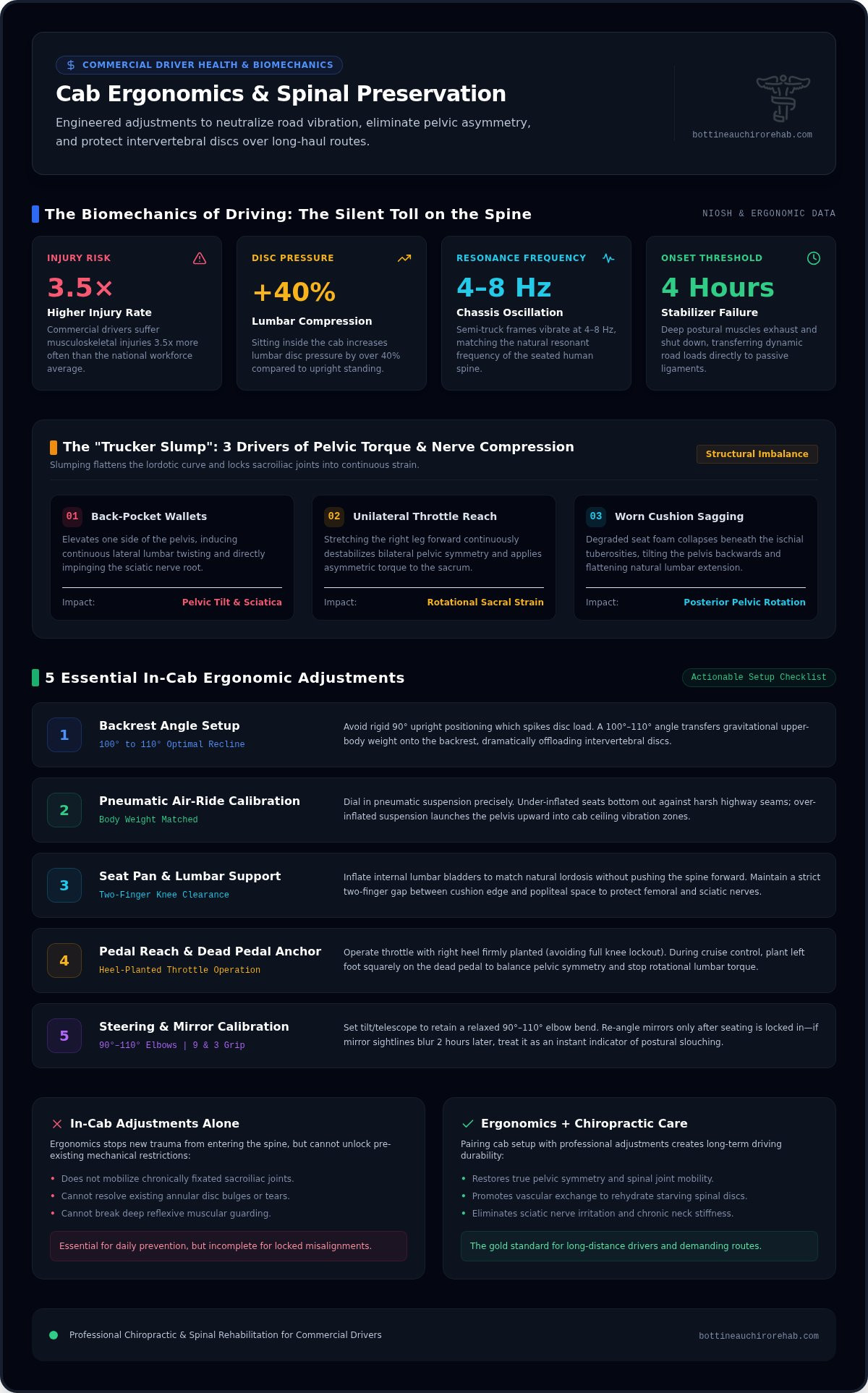
Sitting changes everything for your lower back. When you climb into the cab, lumbar disc pressure jumps by more than 40 percent compared to standing. Commercial truck frames generate mechanical oscillation between 4 and 8 Hz, matching the natural resonance frequency of the seated human spine. Your spinal column absorbs these jarring waves with zero attenuation. Over consecutive hours behind the wheel, deep postural stabilizers fatigue and shut down. This failure transfers dynamic road loads directly onto your passive spinal ligaments. Static positioning also chokes off vascular exchange, starving intervertebral discs of hydration and essential nutrients. Consulting an ergonomics for truck drivers chiropractor addresses these mechanical hazards before daily strain turns into permanent structural damage.
Whole-Body Vibration and Lumbar Disc Degeneration
Road shock transfers through unbuffered floorboards straight into your sacrum. Sustained exposure to whole-body vibration triggers micro-tears within the annulus fibrosus, the tough outer cartilage ring of your lumbar discs. Over time, these tears allow inner nuclear material to bulge outward. Once your core stabilizers exhaust their endurance, they fail to cushion unexpected road bumps. Potholes and frost heaves hammer exposed lumbar nerve roots without restraint, sparking acute sciatic flare-ups and sudden muscular guarding.
The 'Trucker Slump' and Pelvic Misalignment
Exhaustion inevitably leads to the classic trucker slump. Sliding forward rounds the lower back and completely flattens your natural lumbar curve. This forward roll creates posterior pelvic tilting, locking your sacroiliac joints in continuous mechanical strain. Common daily habits compound this imbalance:
- Back-pocket wallets: Sitting on a wallet elevates one side of the pelvis, twisting the lumbar spine and compressing the sciatic nerve.
- Leg extension reach: Stretching one leg continuously toward the throttle destabilizes pelvic symmetry.
- Seat sagging: Worn cushion foam collapses under the ischial tuberosities, tilting the pelvis backward.
Cab changes help stop new injuries, but an ergonomics for truck drivers chiropractor is essential for mobilizing fixated sacroiliac joints and restoring pelvic symmetry after thousands of miles on the highway.
Cab Ergonomics for Truck Drivers: 5 Essential In-Cab Adjustments
Generic office advice fails inside a semi-truck. Sitting bolt upright at 90 degrees spikes lumbar compression, while standard foam cushions do nothing against harsh road vibrations. Applying proper driver seating ergonomics demands deliberate, mechanical changes to your setup. Setting your backrest between 100 and 110 degrees transfers your torso's gravitational weight backward, offloading your intervertebral discs. Pair that recline with proper seat pan tilt so your thighs stay fully supported without cutting off blood circulation behind your knees.
Air-Ride Seat Positioning and Lumbar Support Calibration
Calibrate your pneumatic suspension to your exact body weight. Under-inflated seats bottom out on rough highway joints, while over-inflated seats launch your pelvis upward into the cab roof. Inflate internal lumbar bladders just enough to support your natural lordotic curve without shoving your lower back forward. Always maintain a two-finger gap between the seat cushion edge and the back of your knees to prevent femoral and sciatic nerve compression.
Pedal Reach, Footrest Use, and Throttle Leg Stress
Position your seating depth so your right ankle articulates the throttle without requiring full knee lockout. Keep your heel firmly planted on the floorboard to unload strain from your Achilles tendon and calf. During highway cruise control, place your left foot squarely on the dead pedal. This foot position provides a stable foundation, leveling bilateral pelvic weight and stopping asymmetric torque across your lower back.
Steering Column and Mirror Sightline Adjustments
Adjust the steering wheel tilt and telescoping depth to maintain a relaxed 90- to 110-degree elbow bend. Reaching forward pulls your shoulder blades into protraction, overworking your upper back. Grip the wheel at nine and three to reduce neck strain. Once your seat is locked in, re-angle every side and hood mirror. If your sightlines blur two hours later, your mirrors serve as an immediate checkpoint that you are slouching.
Dialing in your cab provides the essential baseline for daily joint protection. When persistent aches resist these structural fixes, visiting an ergonomics for truck drivers chiropractor helps resolve deep spinal restrictions and restores full mechanical mobility to your driving shifts.
Extremity and Spinal Strains: Moving Beyond Lumbar Pain
Long hauls do not just punish your lower back. Driving forces your body into asymmetric joint mechanics that wear down peripheral joints over time. Stomping heavy manual clutches triggers repetitive unilateral hip impingement and sacroiliac inflammation. Resting your elbows on hard window ledges or holding your arms high on the steering wheel chokes blood flow through shoulder bursae. These asymmetrical physical demands are direct drivers of work-related musculoskeletal disorders across commercial transport. Reviewing our extremity adjusting chiropractor guide shows how targeted peripheral corrections relieve stubborn joint pain when cab adjustments alone fall short.
Clutch Knee, Throttle Ankle, and Piriformis Syndrome
Repetitive pedal work creates localized dysfunction across your lower extremities:
- Clutch knee: Stomping stiff pedals pulls the patella off-track and inflames anterior hip flexor tendons.
- Throttle ankle: Holding steady pedal tension locks the talocrural joint, straining the plantar fascia and calf muscles.
- Piriformis impingement: Spasming deep gluteal tissues pinch the sciatic nerve, sending sharp, burning pain down your leg that mimics a herniated lumbar disc.
A seasoned ergonomics for truck drivers chiropractor evaluates your entire lower kinematic chain to free locked ankle mortise joints and restore proper hip mobility.
Steering Strain, Rotator Cuff Tension, and Neck Stiffness
Constant steering control places intense, static isometric stress on your upper body. Reaching overhead toward CB radios or pulling heavy fifth-wheel pins pinches rotator cuff tendons. Sustained forearm pronation while gripping wheel rims compresses the median and radial nerves, triggering wrist numbness and outer elbow tenderness. Low-frequency cab vibrations traveling up the steering column cause deep suboccipital spasms, locking the upper cervical vertebrae and provoking stubborn tension headaches behind the eyes. Working with an ergonomics for truck drivers chiropractor ensures these strained peripheral joints and cervical segments receive precise mobilization before chronic inflammation grounds your rig.
Roadside Decompression: Fast Protocols for Pre-Trip and Rest Breaks
Stepping out of your cab and bending down to touch your toes is the most dangerous stretch you can perform. After hours of seated flexion, your lumbar discs deform backward. Bending forward immediately after a haul spikes posterior disc pressure and can trigger acute tears. You must reverse this mechanical creep. Standing extension maneuvers utilize hydraulic pressure to guide displaced disc fluid back into neutral alignment. Combine targeted roadside decompression with guidance from an ergonomics for truck drivers chiropractor to protect your spine during mandatory FMCSA rest breaks.
The 3-Minute Post-Shift Extension Protocol
Reset your spinal column immediately after cutting the engine:
- Standing lumbar extensions: Place your palms across your lower back. Gently extend backward ten times, holding the peak stretch for two seconds to decompress the L4-L5 lumbar segments.
- Trailer chest openers: Rest your forearms against the trailer side rail or cab doorway. Step forward gently until your chest muscles stretch, reversing upper-body steering hunch.
- Fifteen-minute load delay: Never pull fifth-wheel release pins, crank landing gear, or hoist heavy cargo during your first fifteen minutes out of the cab. Give your passive spinal ligaments time to regain stability.
Rest-Stop Stretches for Hips, Hamstrings, and Calves
Shortened hip flexors lock your pelvis into severe tilt the moment you stand up. Use the truck itself as your rehabilitation station at the fuel island:
- Running board lunges: Place one foot up on the bottom cab step. Drive your hips forward while keeping your torso upright to lengthen tight psoas muscles and restore pelvic balance.
- Tire-wall calf mobilization: Place your toes against the curve of a steer tire with your heel firmly planted on the pavement. Lean forward to stretch your calf muscles and pump pooled blood back toward your heart.
- Cervical retractions: Pull your head straight back horizontally without tilting your chin down. Ten slow repetitions reset forward head carriage after long night hauls.
Roadside routines maintain mobility, but they cannot unlock spinal joints that have seized under chronic vibration. When persistent pain follows you across state lines, consult an ergonomics for truck drivers chiropractor who understands commercial freight demands. Schedule your full-body evaluation today to restore pain-free driving performance.
Chiropractic Rehabilitation: Restoring Alignment for North Dakota Drivers
Cab adjustments stop future trauma, but they cannot unlock joints that have already seized. After thousands of miles hauling freight across North Dakota, mechanical fixations require direct clinical intervention. Combining proactive cab ergonomics with an ergonomics for truck drivers chiropractor bridges the gap between daily symptom management and structural recovery. At Boundless Full Body Chiropractic & Rehab, Dr. Daniel Pozarnsky pairs targeted joint manipulation with active physical therapy in Bottineau. This integrated approach restores joint play and builds durability for long shifts. Drivers learn how a comprehensive full body chiropractic adjustment resets compensation patterns extending from the neck down to the feet.
Why Commercial Drivers Need Full-Body and Extremity Care
Spinal joints do not operate in isolation. A jammed right ankle from hours of throttle pressure rotates your knee inward, destabilizes your pelvis, and twists your lumbar spine. Specialized extremity adjusting frees these restricted peripheral joints in your ankles, knees, shoulders, and wrists. Once peripheral motion is clear, structured spinal rehab retrains deep core muscles. Rebuilding postural endurance allows your musculoskeletal system to absorb ongoing vehicle vibration without dumping dynamic shock onto passive spinal ligaments.
Get Back on the Road Pain-Free in Bottineau, ND
Haulers running the Highway 5 corridor between Minot, Rugby, and Belcourt need efficient care that works around demanding freight schedules. Dr. Pozarnsky creates focused, non-surgical recovery plans tailored directly to commercial driving realities. You don't have to accept radiating nerve numbness or burning lower back tightness as part of the job. Partnering with an ergonomics for truck drivers chiropractor targets the root mechanical source of your pain. Take decisive control of your health on the road and start your evaluation with our affordable new patient offer.
Drive Pain-Free on Every Highway Haul
Your cab setup and roadside habits determine how your body handles the open road. Setting your backrest angle, calibrating air-ride seat suspension, and performing standing extensions during rest breaks directly counteract hours of spinal vibration. Proactive cab ergonomics protect against new injuries, but when long miles lock your joints into chronic patterns, consulting an ergonomics for truck drivers chiropractor restores the mobility your equipment cannot fix.
At Boundless Full Body Chiropractic & Rehab, Dr. Daniel Pozarnsky delivers specialized full-body and extremity adjusting techniques tailored to the physical demands of commercial freight. Conveniently located for rural North Dakota commercial drivers, our clinic provides direct, non-surgical relief that keeps you moving comfortably. You don't have to push through chronic nerve tingling or lower back tightness. Take decisive action for your physical durability today. Schedule your comprehensive driver evaluation with our $47 New Patient Special and experience the difference true joint alignment makes behind the wheel.
Frequently Asked Questions
How can a truck driver adjust their seat to prevent lower back pain?
Recline your backrest to an angle between 100 and 110 degrees to immediately reduce lumbar disc pressure. Next, adjust your seat height so your hips sit level with or slightly higher than your knees. Ensure a two-finger gap remains between the front cushion edge and the back of your knees. Finally, tune your air-suspension damper to match your body weight so the seat cushions harsh road impacts without bottoming out.
Can a chiropractor help with pain caused by whole-body vehicle vibration?
Yes, a chiropractor directly restores joint mechanics disrupted by persistent cab resonance. Working with an ergonomics for truck drivers chiropractor realigns vertebrae locked by vibrational micro-trauma and releases guarding spinal muscles. At Boundless Full Body Chiropractic & Rehab, Dr. Daniel Pozarnsky combines gentle spinal adjustments with physical therapy exercises. This non-surgical approach restores spinal fluid motion, relieves irritated nerves, and retrains postural stabilizers to handle long stretches on rough North Dakota roads.
Why does driving a truck cause sciatica and shooting leg numbness?
Sciatica occurs when the sciatic nerve gets compressed by a bulging lumbar disc, an inflamed sacroiliac joint, or a spasming piriformis muscle. Prolonged cab sitting combined with continuous throttle pressure flattens your lower back and tightens deep gluteal tissues. Additionally, sitting on a back-pocket wallet tilts the pelvis unevenly. This sustained asymmetry pinches nerve roots, sending sharp pain, tingling, and numbness down the back of your leg and into your foot.
What should truck drivers avoid doing immediately after finishing a long shift?
Never bend forward to stretch or lift heavy cargo during the first fifteen minutes out of your cab. Extended sitting causes spinal ligaments to stretch and deform, temporarily reducing disc stability. Forward bending or immediately cranking landing gear under this state can trigger acute disc herniations or intense muscle spasms. Instead, stand upright, place your hands on your lower back, and perform gentle standing backward extensions to safely re-center intervertebral disc fluid.
How often should long-haul commercial drivers see a chiropractor?
Most long-haul drivers benefit from preventative maintenance adjustments every four to six weeks to counteract ongoing cab vibration. If you manage active pain, sciatica, or joint stiffness, an initial care plan of one to two visits per week may be necessary to restore mobility. Drivers passing through Bottineau, Minot, or Belcourt can schedule targeted tune-ups that align with freight turnaround times, preventing minor mechanical fatigue from turning into career-threatening chronic injuries.
Can extremity adjustments relieve pain in the clutch knee or shifting shoulder?
Yes, extremity adjustments restore normal joint mechanics in peripheral joints strained by repetitive driving tasks. Heavy clutch resistance misaligns the knee joint and foot bones, while continuous steering wheel reaches pinch delicate shoulder structures. By consulting an ergonomics for truck drivers chiropractor, drivers receive specialized manipulations for the knees, ankles, wrists, and shoulders. Freeing restricted peripheral joints removes mechanical strain, reduces local inflammation, and restores smooth joint motion without surgery or downtime.
What is included in the new patient chiropractic exam in Bottineau?
At Boundless Full Body Chiropractic & Rehab, our $47 New Patient Special provides an accessible, thorough physical assessment. Dr. Daniel Pozarnsky performs a comprehensive musculoskeletal evaluation, examining spinal alignment, joint range of motion, and nerve function. We investigate how your specific driving posture and equipment setup contribute to your discomfort. You will receive a clear diagnosis alongside a practical, non-surgical treatment plan tailored to keep you driving safely across rural North Dakota.


