

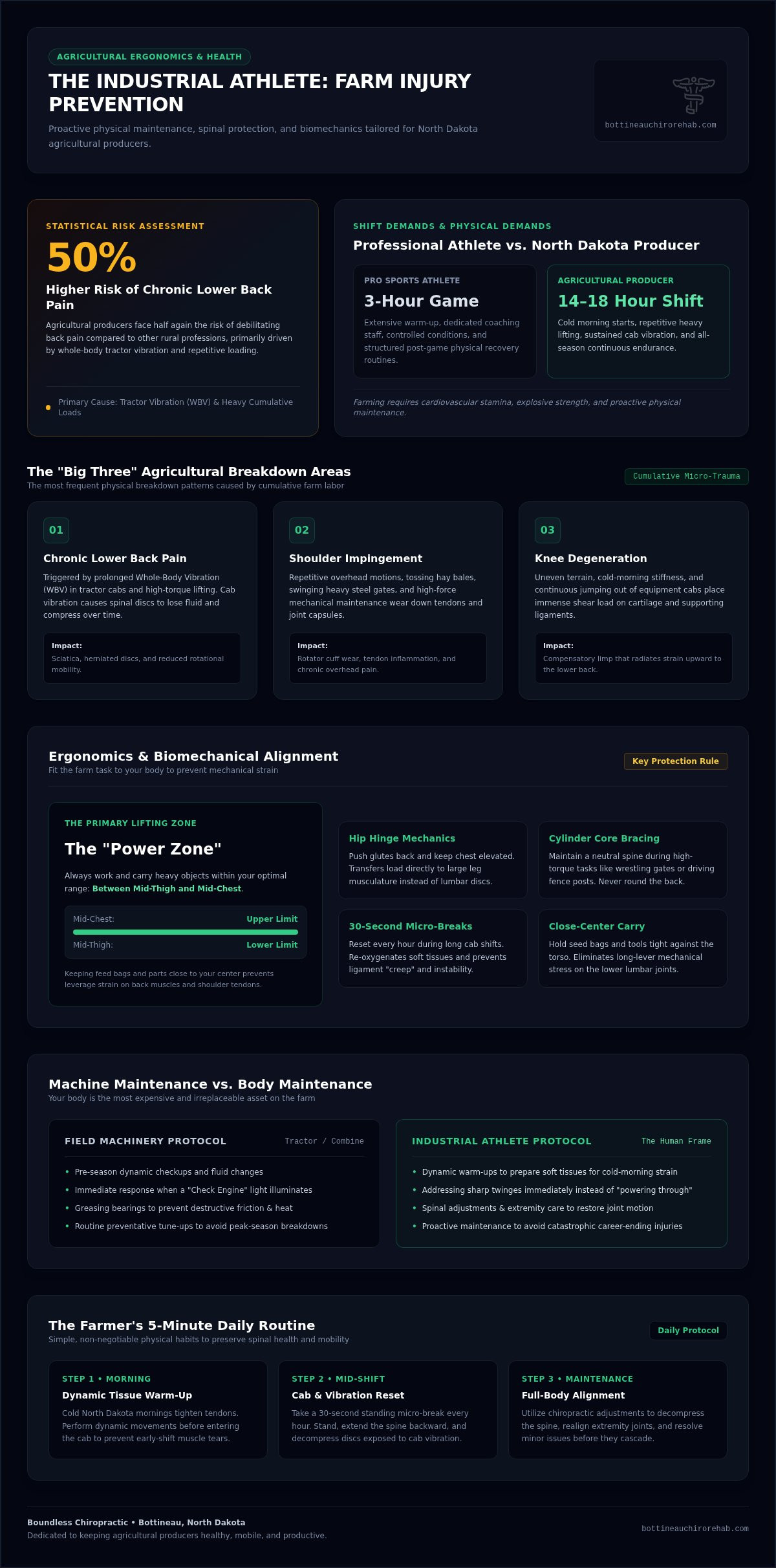
You wouldn't expect a professional athlete to play a 14-hour game without a warm-up, yet North Dakota producers do it every single day. You know the drill. The sun isn't up yet, but you're already in the cab, ignoring that sharp twinge in your shoulder or the dull throb in your lower back. Farming near Bottineau demands an industrial athlete mindset, but the stoic habit of powering through until an injury becomes debilitating is a direct threat to your livelihood. Research indicates that agricultural workers face a 50% higher risk of chronic lower back pain compared to other rural professions, largely due to tractor vibration and repetitive loading.
This guide changes the narrative. You'll learn exactly how to prevent farming injuries by treating your body with the same rigorous maintenance you provide your most expensive machinery. We're moving beyond basic safety lectures to offer proactive physical strategies and ergonomic adjustments tailored for the North Dakota landscape. We will preview practical movements to reduce daily pain, strategies to neutralize spinal compression, and simple habits that ensure your career longevity. It is time to stop reacting to pain and start protecting your most valuable asset so you can stay in the field for years to come.
Key Takeaways
- Adopt the Industrial Athlete mindset. Protect your back, shoulders, and knees by treating your body like your most valuable piece of equipment.
- Master the Power Zone lifting technique. These ergonomic adjustments significantly reduce strain when handling livestock or heavy machinery.
- Learn how to prevent farming injuries through proactive maintenance. Regular body tune-ups are more effective and less expensive than emergency repairs.
- Use a five-minute daily checklist. Dynamic warm-ups and mid-day cab resets maintain your mobility during grueling harvest shifts.
- Access specialized full-body care. Professional adjustments and extremity work resolve chronic pain before it becomes a career-ending issue.
The Physical Toll of North Dakota Farming: Why You Are an Industrial Athlete
Farming is an elite endurance sport. Most professional athletes train for a three-hour game; you prepare for an eighteen-hour shift. The demands of North Dakota agriculture require cardiovascular stamina, explosive strength, and incredible grit. Without a coaching staff or a formal recovery plan, your body absorbs the impact of every heavy lift and long day. This constant pressure often leads to the "Big Three" of farm injuries: chronic lower back pain, shoulder impingement, and knee degeneration. Understanding these risks is the first step in learning how to prevent farming injuries before they sideline you during a critical window.
The seasonal cycles in Bottineau County create a unique stress profile. During planting and harvest, your body operates in a state of high-intensity overdrive. Cold North Dakota mornings tighten soft tissues, making them more prone to tears and strains. If you ignore a sharp twinge in your knee, your body naturally compensates. You shift your weight, strain your lower back, and create a painful secondary injury. Proactive care addresses these imbalances before they cascade. Citing agricultural safety and health hazards helps us understand that musculoskeletal disorders are the most common unrecognized physical toll on the modern producer.
Think of yourself as an industrial athlete. Your "game day" lasts all season. When you view your work through this lens, you realize that your body is a high-performance machine. It needs fuel, maintenance, and specific alignment to function. Ignoring a "check engine light" in your hip or shoulder leads to catastrophic failure. Learning how to prevent farming injuries means acknowledging that your physical health is tied directly to your farm’s productivity and your family's future.
The Cumulative Effect of Repetitive Motion
Small actions add up over time. Tossing hay, swinging heavy gates, and handling livestock involve repetitive patterns that wear down your joints. These micro-traumas don't always hurt immediately. They simmer beneath the surface until a major breakdown occurs. For a North Dakota rancher, repetitive strain is the progressive wear on muscles and tendons caused by performing the same high-force movements, like wrestling calves or hauling seed bags, day after day.
Tractor Vibration and Spinal Compression
Sitting in a cab feels like rest, but it is actually a source of physical trauma. Whole-Body Vibration (WBV) from heavy machinery sends constant shocks through your spine. This vibration causes the discs between your vertebrae to lose fluid and compress. Over time, this leads to debilitating conditions like sciatica or herniated discs. Long hours in the seat without a reset can ruin your posture and your mobility. A Full Body Chiropractic Adjustment helps decompress these areas and restores proper alignment after a long week in the field.
Ergonomics and Biomechanics: Working Smarter on the Farm
Ergonomics isn't just for office workers. On the farm, it means fitting the task to your body. Don't force your frame to adapt to poor movements. This is a critical part of how to prevent farming injuries during the high-stakes harvest season. Utilizing ergonomic solutions for farm workers reduces mechanical stress on your joints. Always aim for the "Power Zone." Work between your mid-thighs and mid-chest. This is where you are strongest. Keep heavy feed bags or equipment parts close to your center. Prevent the leverage-based strain that snaps tendons and pulls muscles.
Maintain a neutral spine during high-torque tasks. Don't round your back when driving fence posts or wrestling gates. Brace your core. Think of your torso as a solid, stable cylinder. Take micro-breaks. Reset for thirty seconds every hour during long shifts. This allows your tissues to re-oxygenate. It stops the "creep" of spinal ligaments that leads to instability. These small pauses prevent long-term damage. Stay mobile. Stay functional.
Proper Lifting Techniques for Heavy Farm Loads
Stop bending at the waist. Use the hip hinge instead. Push your glutes back and keep your chest up. This movement transfers the load to your powerful leg muscles. It protects your vulnerable lumbar discs from herniation. If you carry asymmetrical loads like heavy buckets or toolboxes, switch sides often. Don't let your torso tilt to one side. Never twist while under load. Pivot with your feet. Move your whole body as one unit. This is a primary strategy for how to prevent farming injuries in the barn or the shop.
Optimizing the Operator’s Seat
Your tractor seat is your primary workstation. Adjust the height. Ensure your knees are slightly lower than your hips. This opens the pelvis and maintains the natural curve of your lower back. Use the lumbar support. If your seat lacks it, even a rolled-up towel helps. Keep both feet flat on the floor or footrests. Stabilize your pelvis against the machine's vibration. Proper extremity alignment while using pedals and levers prevents repetitive strain in your ankles and wrists. If your joints feel stiff after a day in the cab, a quick consultation for full-body wellness can help reset your alignment.
Machine Maintenance vs. Body Maintenance: A Comparison
You wouldn't run a tractor with a bent axle or a leaking hydraulic line. You shouldn't run your body that way either. A tractor's wheel alignment ensures operational efficiency and prevents premature tire wear; your spinal and extremity alignment does the same for your nervous system and joints. Proactive body maintenance is a "Body Tune-Up." It is the most effective way to address the prevention of musculoskeletal disorders in the workplace. Waiting for "emergency repairs" like surgery is a high-risk gamble. Proactive care is cheaper, faster, and keeps you in the field when it matters most.
Pay attention to your internal warning lights. Numbness in your fingers, sharp pain in your shoulder, or a sudden loss of range of motion are not things to "walk off." These are signs of mechanical failure. Stoicism has its place in North Dakota, but ignoring these signals isn't a sign of strength. It's a risk to your entire operation. Real professionals prioritize maintenance to ensure their equipment and their bodies don't fail during the busiest weeks of the year. Watch for these specific signs of physical breakdown:
- Reduced grip strength when handling tools or livestock.
- Sharp, electric sensations when turning your head or reaching.
- Persistent stiffness that doesn't "warm up" after the first hour of work.
- A noticeable change in your gait or balance when climbing off machinery.
The Cost of Downtime: Injury vs. Prevention
If your combine breaks down in October, you lose money. If you break down, the cost is even higher. Being unable to work during peak harvest can devastate a farm's bottom line. Learning how to prevent farming injuries through regular checkups is a professional necessity. A quick chiropractic visit takes thirty minutes. Recovery from a herniated disc or a torn rotator cuff takes months. Consider the Boundless $47 New Patient Offer as a low-cost inspection for your musculoskeletal system. It is a small investment to prevent a total mechanical shutdown.
Why Extremities are the 'U-Joints' of the Body
Your spine is the frame, but your extremities are the U-joints. Ankle, knee, and wrist health are critical for supporting your spinal column. A misaligned ankle can cause a 'chain reaction' of hip and back pain. If an ankle is locked up from a slip on a tractor step, it forces your hip to rotate, which eventually creates debilitating lower back pain. You can't fix the frame without checking the joints. Working with an Extremity Adjusting Chiropractor ensures every moving part is synchronized. This holistic view is a key component of how to prevent farming injuries that start in the feet and end in the neck.
The Farmer’s Daily Maintenance Routine: A 5-Minute Checklist
Success on the farm starts with a pre-flight check for your body. You wouldn't skip checking the oil in your sprayer; don't skip checking your joints. A 3-minute morning warm-up is the most effective way to prime your nervous system for heavy labor. Use dynamic movements like arm circles, torso twists, and leg swings to increase blood flow. Save static stretching for the end of the day. Holding a deep stretch when your muscles are cold can actually increase your risk of a tear. Learning how to prevent farming injuries requires this strategic timing.
Fueling is the next step. An industrial athlete cannot survive a 12-hour harvest shift on black coffee alone. Dehydration is a leading cause of muscle fatigue and poor reaction times. Drink water consistently throughout the day. Eat small, protein-rich snacks to maintain steady energy levels and focus. When the sun goes down, perform an end-of-day reset. This prevents the cumulative stiffness that makes the next morning a struggle. A few minutes of intentional movement tonight ensures you're ready to go tomorrow.
Essential Stretches for Back and Hip Health
Focus on the areas that take the most abuse. The 'Cat-Cow' and 'Bird-Dog' exercises are gold standards for spinal mobility and core stability. They wake up the small muscles supporting your vertebrae. If you spend hours in a cab, your hip flexors are likely tight and shortened. A simple kneeling hip flexor stretch counteracts this seated posture and relieves lower back tension. Don't forget your extremities. Perform wrist and forearm releases to prevent carpal tunnel symptoms after a day of handling livestock or heavy tools. These micro-habits are essential for how to prevent farming injuries in the long term.
The 'Pre-Season' Conditioning Plan
Winter isn't just for shop work. It's the time to build the core strength you'll need for planting. A strong core acts as a natural weight belt, protecting your spine during heavy lifts. Practice balance exercises to stay steady on uneven North Dakota terrain. This reduces your risk of slips and falls when climbing on and off equipment. If you've had a previous injury, consider Physical Therapy in Bottineau to build a custom conditioning plan. Proactive strength is your best defense against seasonal breakdowns. Schedule your body maintenance check today to stay ahead of the pain.
Professional Support: How Boundless Chiropractic Protects Bottineau Farmers
Dr. Daniel Pozarnsky understands the physical toll of North Dakota labor because he was raised near the Turtle Mountains. He knows that a Bottineau farmer's body faces different stresses than an office worker's frame. Boundless Full Body Chiropractic & Rehab uses a "Full Body" model that goes beyond simple spinal checks. We analyze how a misaligned neck limits your shoulder's range of motion when reaching for controls. We look at how a tilted pelvis creates the knee strain that makes climbing into a cab painful. This comprehensive view is a vital part of how to prevent farming injuries that start as minor tweaks and evolve into chronic failures.
Alignment is only half the battle. To ensure long-term results, we integrate chiropractic adjustments with targeted Spinal Rehab. This combination retrains your muscles to support your skeleton during high-torque tasks. It builds the durability needed for the long haul. Our approach is fast, efficient, and decisive. We respect your time and your need to stay in the field. Getting started is straightforward. Our $47 New Patient Special provides a complete consultation, exam, and initial treatment to identify your specific needs.
Custom Care for the Whole Family
Farm safety is a multi-generational priority. Everyone from the kids helping in the barn to seniors managing the homestead faces unique physical demands. We offer Chiropractic Care for the Whole Family to keep every resident moving safely. Pediatric care supports healthy growth during active farm chores. Geriatric care focuses on balance and joint mobility to prevent dangerous falls on uneven terrain. Our techniques are gentle and tailored to the individual. We ensure that every member of your operation remains a functional part of the team.
Non-Surgical Recovery for Farm-Related Injuries
Field injuries are essentially "sports injuries" in an agricultural setting. A sudden twist while jumping off a trailer or a shoulder strain from a stubborn headgate requires specialized attention. We provide Sports Injury Rehab in Bottineau to facilitate fast, non-surgical recovery. We focus on restoring function to your extremities and spine so you can return to work quickly. Don't wait for a tweak to become a debilitating tear. Visit our Bottineau clinic for a comprehensive evaluation and stop the cycle of pain. We are your partners in maintaining the most important asset on your farm: your health.
Secure Your Future in the Field
Your body is the most sophisticated piece of machinery on the farm. Protecting it isn't just about comfort; it's about protecting your legacy. By shifting to an industrial athlete mindset and mastering ergonomic "Power Zones," you have already taken the first steps in learning how to prevent farming injuries. Proactive maintenance ensures you aren't sidelined when the harvest window opens. Small daily resets and proper biomechanics are the essential tools that build a long, pain-free career.
Dr. Daniel Pozarnsky provides expert care tailored to the unique demands of Bottineau, Rugby, and our surrounding rural communities. You wouldn't ignore a grinding gear in your tractor, so don't ignore the warning signs in your back, knees, or shoulders. Claim your $47 New Patient Special and keep your body farm-ready today! This introductory special is your professional body tune-up, offering a clear path to recovery and function. It is time to move with confidence, reduce your daily pain, and stay productive for years to come.
Frequently Asked Questions
What are the most common farming injuries in North Dakota?
The most common farming injuries in North Dakota include chronic lower back pain, rotator cuff strains, and knee degeneration. These often stem from long hours in high-vibration tractor cabs and repetitive lifting during intense planting and harvest cycles. Sprains and strains from slips on uneven terrain or machinery steps are also frequent. Addressing these issues early is a critical part of how to prevent farming injuries from becoming permanent disabilities for Bottineau area producers.
How can I prevent back pain when driving a tractor for 10+ hours?
To prevent back pain during long shifts, adjust your seat to maintain a natural lumbar curve and keep both feet flat on the floor to stabilize your pelvis. Whole-body vibration is a major stressor; so utilize any built-in suspension features and take thirty-second micro-breaks every hour to reset your posture. These small adjustments decompress the spine and reduce the cumulative fatigue that leads to debilitating sciatica or disc issues during the busy season.
Is it safe to see a chiropractor if I already have a diagnosed disc issue?
Yes, it is safe and often recommended to seek chiropractic care for diagnosed disc issues. Our clinical approach focuses on non-surgical spinal rehab to reduce pressure on the affected discs and restore proper mobility. Dr. Daniel Pozarnsky performs a comprehensive evaluation to ensure the treatment plan is appropriate for your specific condition. We prioritize restoring function and stability to help Bottineau farmers avoid invasive surgical procedures and return to their daily operations.
Can chiropractic care help with 'Farmer's Elbow' or wrist pain?
Chiropractic care is highly effective for "Farmer's Elbow" and wrist pain through specialized extremity adjusting. These conditions often result from repetitive gripping or handling heavy equipment, which misaligns the small joints in the arm. By restoring proper alignment to the elbow and wrist, we reduce inflammation and improve grip strength. This full-body approach ensures that your extremities don't become the weak link in your daily labor near Rugby or Rolla.
What should I do immediately after a minor farm-related strain?
If you experience a minor strain, stop the activity immediately to prevent further tearing. Apply ice to manage inflammation and perform gentle, pain-free range of motion exercises to keep the tissue from locking up. Avoid the temptation to "walk it off" without an assessment. Seeking a professional evaluation quickly is a primary strategy for how to prevent farming injuries from escalating into chronic problems that require weeks of downtime or expensive repairs.
How often should a farmer get a chiropractic adjustment for prevention?
Preventive adjustment frequency depends on your current workload and physical state. During the high-demand planting and harvest seasons, bi-weekly or monthly "body tune-ups" are often necessary to manage the increased physical stress. In the winter months, less frequent visits may suffice to maintain alignment. Regular maintenance keeps your musculoskeletal system synchronized. It ensures you are physically prepared for the unique endurance demands of North Dakota agriculture throughout the entire year.
Does the $47 New Patient Special include an exam and adjustment?
The $47 New Patient Special is a comprehensive introductory offer. It includes a full consultation, a detailed physical exam, and your initial test treatment. This session allows Dr. Daniel Pozarnsky to identify misalignments and develop a targeted plan for your recovery. It is an accessible way for farmers in Bottineau and surrounding areas like Minot to start a proactive maintenance routine without a large upfront financial commitment or any long-term contract.
How do I know if my hip pain is coming from my back or my boots?
Hip pain is often a "chain reaction" injury. It can stem from poor arch support in your boots or a misalignment in your lower back that forces the hip to overcompensate. A full-body assessment is the only way to pinpoint the root cause. We examine your gait, foot mechanics, and spinal alignment together. This ensures we aren't just treating a symptom while the actual mechanical failure remains unaddressed in another part of your body.


