

In North Dakota, the golf season is a high-speed sprint that leaves no room for injury. When recurring lower back pain hits after 18 holes at the Bottineau Country Club, you don't have months to wait for a slow recovery. You need to get back to the tee box before the season ends. It's common to feel frustrated by physical limits or confused about whether you need a physical therapist or a chiropractor. You want to play without fear of that next sharp twinge during your follow-through.
This guide provides the roadmap you need for effective golf injury rehab ND. You'll discover how a strategic combination of swing analysis, physical therapy, and full-body chiropractic care targets the root cause of your pain. We'll walk through the steps to achieve a pain-free, full-range swing that lasts. You'll also gain actionable exercises to prevent re-injury and keep your performance strong on the greens in Minot, Rugby, and throughout the region. Stop managing the pain and start mastering your recovery.
Key Takeaways
- Understand the kinetic chain to identify how movement "leaks" in your swing lead to chronic pain and reduced power.
- Discover why lower back pain and golfer's elbow dominate the North Dakota season and how to address them without surgery.
- Follow a proven 5-step process for golf injury rehab ND that combines functional screening with full-body chiropractic adjustments.
- Master a 5-minute dynamic warm-up designed to prime your nervous system and protect your joints before you reach the first tee.
- Learn how to utilize a $47 New Patient Special to get a professional evaluation and a clear path back to the greens.
The Biomechanics of Golf Injuries: Why North Dakota Golfers Struggle
Golf is not a gentle sport. It is a high-velocity, asymmetrical movement pattern that places massive torque on the spine and joints. Every swing requires your body to rotate explosively in one direction while maintaining a stable base. If your mechanics are off, this repetition becomes a recipe for physical breakdown. Most golfers think the swing is just about the arms, but it actually involves your entire body working in a specific sequence.
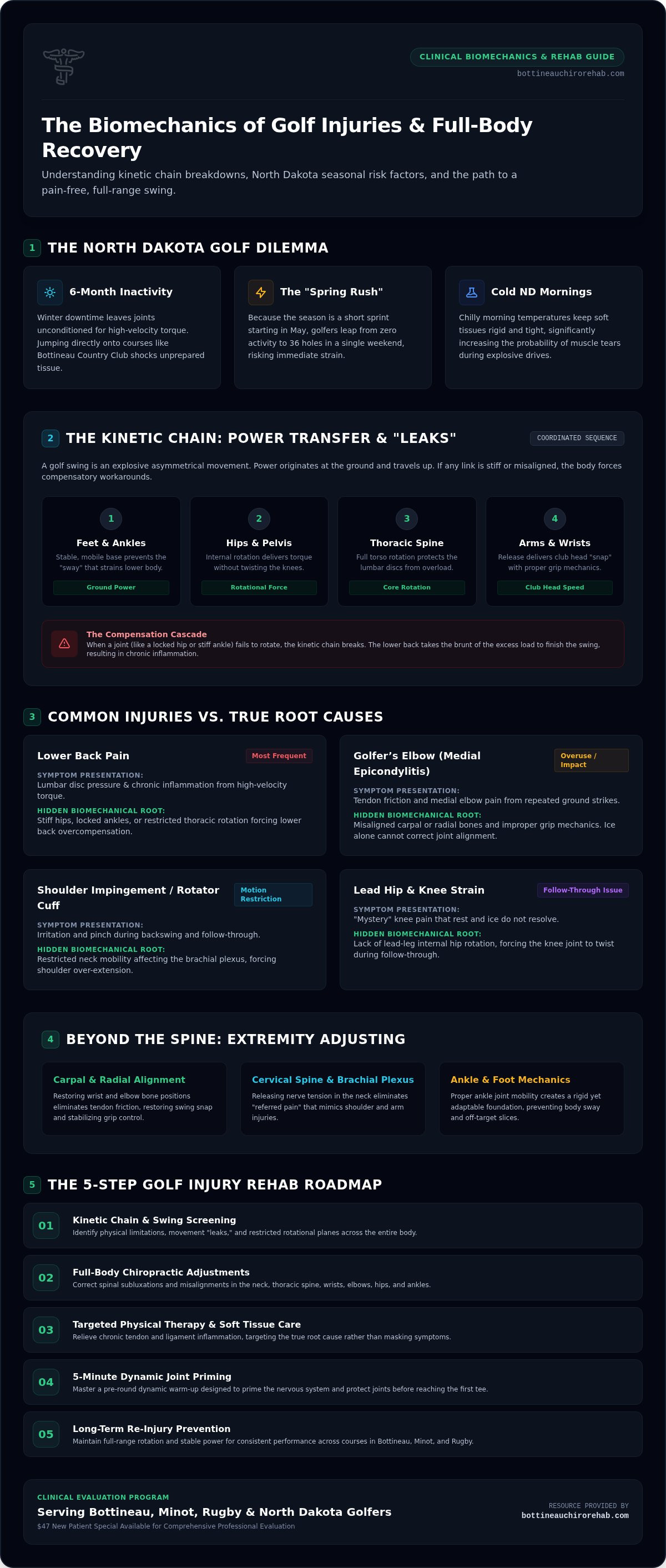
The kinetic chain is the coordinated movement of joints to produce swing power. Power starts in the feet, moves through the hips and spine, and finally explodes through the club head. If one link in this chain fails, the whole system suffers. In North Dakota, golfers face a unique challenge. After six months of winter inactivity, the body isn't primed for explosive rotation. Local weekend warriors often jump back onto the course at the Bottineau Country Club without proper conditioning.
If you have a single stiff joint, like a locked ankle or a tight hip, your body doesn't just stop. It finds a workaround. Usually, your lower back takes the hit, overcompensating for the lack of mobility elsewhere. This is where the need for golf injury rehab ND begins. When you force a restricted joint to perform at high speeds, you risk immediate strain or long-term wear.
The Body-Swing Connection: Alignment Matters
Spinal subluxations, or misalignments, are silent performance killers. When your vertebrae aren't moving correctly, they limit thoracic rotation. You can't turn your torso fully, so you start "swinging with the arms." This creates a slice and puts extreme stress on the elbows and shoulders. Proper extremity alignment is equally vital for a consistent game. If your wrists or shoulders are restricted, you can't maintain a consistent grip or release. Your swing loses its "snap" and your scores climb. Full-body adjustments ensure every joint in the chain is ready to contribute to your power.
North Dakota's Short Season and the 'Spring Rush' Risk
The ND golf season is a sprint. When May arrives, there's a desperate rush to play as much as possible. Going from zero activity to 36 holes in a single weekend is a massive shock to the system. Cold North Dakota mornings add another layer of risk. Chilly temperatures keep soft tissues tight, making them far more prone to tears during a high-speed drive. Because the season is so short, many players feel intense pressure to ignore pain signals. They play through the "twinge" to avoid missing a single weekend. Seeking professional golf injury rehab ND early helps you stay on the course instead of watching from the sidelines.
Common Golf Injuries Treated with Physical Therapy and Chiropractic
Lower back pain remains the most frequent complaint on the course. Repetitive, high-speed rotation puts immense pressure on the lumbar discs. Without proper golf injury rehab ND, this strain leads to chronic inflammation and missed tee times. Golfer’s elbow, or medial epicondylitis, is another common hurdle. It usually stems from an improper grip or repeated ground impact. While ice helps, it doesn't address the underlying joint dysfunction. Fix the root. Don't just mask the symptom.
Shoulder impingement often surprises players because the root cause is frequently found elsewhere. Restricted neck mobility forces the shoulder to over-extend during the backswing. This compensation irritates the rotator cuff. Similarly, hip and knee strains are rarely isolated incidents. The lead-leg pivot during your follow-through requires significant hip internal rotation. If that hip is locked, the knee twists to finish the movement. This creates "mystery" pain that rest cannot resolve. You need a strategy that restores movement to the entire chain.
Beyond the Spine: Extremity Adjusting for Golfers
Wrist and elbow pain often persist because the problem isn't just soft tissue. Misaligned carpal or radial bones create mechanical friction. Standard rest fails because the joint remains out of place. This is where extremity adjusting becomes essential. By restoring proper alignment to the limbs, we remove the stress on tendons and ligaments. Ankle mobility is also a priority. A stable, mobile base prevents the "sway" that ruins accuracy and strains the lower body. If you're struggling with persistent joint pain, scheduling a full-body evaluation can pinpoint these mechanical leaks.
Identifying 'Referrer Pain' in the Golf Swing
Pain isn't always honest about its origin. Your shoulder pain might actually be a neck issue affecting the brachial plexus. Nerves exiting the cervical spine control the strength and sensation in your arms. If these are compressed, no amount of shoulder massage will fix the problem. We also see hip tightness manifest as knee pain on the lead leg. A locked hip joint forces the knee to act as a primary rotator, which it isn't designed to do. A full-body diagnostic approach is the only way to find the silent culprit behind your discomfort. Effective golf injury rehab ND looks at the whole player, not just the painful spot.
How-to: The 5-Step Golf Injury Rehab Process in Bottineau
Recovery isn't a guessing game. It requires a systematic approach that bridges the gap between clinical treatment and the first tee box. Our 5-step process for golf injury rehab ND ensures you don't just feel better; you play better. We look at your body as a complete unit. If your ankle is stiff, your back will pay the price. We stop that cycle of pain through precise, non-surgical intervention that respects your time and your game.
Step 1 & 2: Assessment and Realignment
We start with Step 1: Functional Movement Screening. This identifies the "leaks" in your kinetic chain where power is lost and injury is born. Step 2 involves a full-body chiropractic adjustment to restore joint play and spinal alignment. We use orthopedic testing to differentiate between simple muscle strain and deeper joint dysfunction. Spinal rehab creates a stable platform for the explosive rotation required in a drive. Adjustments remove nerve interference, allowing muscles to fire correctly during a swing.
Step 3 & 4: Strengthening and Swing Correction
Once the joints move properly, we must stabilize them. Step 3 focuses on targeted physical therapy in Bottineau to strengthen the core and stabilizing muscles. Many golfers suffer from "glute amnesia." Their hips "forget" how to fire, forcing the lower back to handle the heavy lifting. We correct this by re-educating those powerful muscles. Step 4 is a golf swing analysis. We look for specific movements that aggravate your injury. Simple swing tweaks, like a slight foot flare, can significantly reduce torque on a sensitive lead knee.
Effective golf injury rehab ND concludes with Step 5: a gradual "Return to Play" protocol. This isn't a generic plan. It's tailored to the demands of North Dakota courses like the Bottineau Country Club or Rugby Golf Club. We guide you from the putting green to the driving range, and finally back to a full 18 holes. This structured progression prevents the "Spring Rush" injuries that often sideline players in May. You gain the confidence to swing hard without hesitation, knowing your body is ready for the impact.
Preventing Re-Injury: Maintaining Performance on ND Courses
In North Dakota, every weekend counts. When the weather finally breaks in May, you want to be on the course, not in a waiting room. Preventing re-injury is about more than just luck. It requires a proactive maintenance plan that keeps your kinetic chain fluid and responsive. If you've already completed a course of golf injury rehab ND, staying healthy is the next priority. Maintenance is the key to longevity on the greens.
The "Dynamic Warm-Up" is your best defense. Spending just five minutes at the Bottineau Country Club or Rugby Golf Club to prime your nervous system can prevent a season-ending strain. Unlike static stretching, which can actually decrease muscle power before a round, dynamic movements prepare your joints for the explosive torque of a swing. You want your muscles "awake," not relaxed, when you reach the first tee.
The Ultimate 5-Minute Pre-Round Routine
Stop doing static "hold" stretches before you tee off. They temporary weaken the muscles you need for explosive power. Instead, use these dynamic movements to activate your body:
- Leg Swings: Hold onto your cart and swing each leg forward and back to lubricate the hip joints.
- Arm Circles: Start with small circles and gradually increase the size to activate the shoulder stabilizers.
- Thoracic Rotations: Place a club across your shoulders and gently rotate your torso from side to side to "wake up" the mid-back.
These movements ensure your mid-back is ready to rotate without forcing your lower back to overcompensate. It's a simple way to protect your spine before the first drive.
Post-Round Recovery for the Mature Golfer
ND heat can be brutal during July and August. Dehydration leads to increased inflammation and joint stiffness, making you more prone to injury during your next round. After you finish 18 holes, don't just head straight to the clubhouse for a seat. Active recovery, like a light 10-minute walk, helps flush metabolic waste from your muscles and prevents post-round locking.
Knowing when to use ice or heat is critical. Use ice for acute, sharp pain to reduce swelling. Use heat for chronic stiffness to increase blood flow and flexibility. Many local players use sports injury rehab as a preventative "tune-up" rather than a last resort. Regular maintenance adjustments keep the kinetic chain fluid and prevent small misalignments from becoming major injuries. If you want to ensure your body is ready for the full season, schedule your full-body maintenance check today.
Start Your Recovery: Why Boundless is the Choice for ND Golfers
Dr. Daniel Pozarnsky leads Boundless Full Body Chiropractic & Rehab with a single focus: getting you back to peak performance. He understands that for a golfer, movement is everything. His deep experience with athletes allows him to look past the surface pain and address the underlying mechanics of your swing. We don't just treat symptoms. We restore function. This non-surgical approach is often the fastest path back to the green because it works with your body's natural healing process. You don't have time for long, drawn-out recovery cycles when the season is in full swing.
If you are looking for effective golf injury rehab ND, you need a team that understands the local landscape. We know that North Dakota summers are short and every round of golf is a priority. Our clinic provides the decisive care required to turn your physical frustration into momentum. We prioritize immediate solutions over dense medical theory. We want you back on the course, not stuck in a treatment room.
A Local Partnership in Your Health
We aren't just a clinic; we are part of the Bottineau, Rugby, and Minot communities. We understand the specific physical demands of our local courses and the urgency of our short season. Whether you are a junior golfer working on your first drive or a senior player maintaining a lifelong passion, our care is tailored to you. Our clinic serves the whole family with a focus on sports injury rehab and full-body adjustments. We've seen local athletes return to play faster than they expected because we focused on the root cause of their limitations. We remove the complexity from the recovery process so you can focus on your game.
Claim Your $47 New Patient Special Today
Starting your recovery shouldn't be a gamble. We offer the $47 New Patient Special as the "first tee" to your recovery. It's designed to provide professional clarity without the high cost or wait times of traditional specialty care. This is a low-risk entry point for any golfer currently struggling with pain or restricted movement. Stop guessing about your injury and get a professional roadmap to improvement.
Your special includes:
- A comprehensive consultation with Dr. Pozarnsky to discuss your history and goals.
- A full-body orthopedic and neurological exam to pinpoint joint dysfunction.
- A personalized recovery plan focused on achieving a pain-free, powerful swing.
Don't let another weekend pass while you sit on the sidelines. Take control of your health and your performance today. You can easily access this offer by visiting our new patient offer page. Call our Bottineau office now to secure your spot. Start your journey back to the greens today.
Master the Greens with Pain-Free Performance
Golf is too short in North Dakota to spend it on the sidelines. You've learned how biomechanical leaks and spinal misalignments can derail your swing. By addressing the root cause through a coordinated 5-step process, you can restore your kinetic chain and regain lost power. Don't let recurring back pain or joint stiffness dictate your season. It's time to stop managing pain and start improving your performance.
Boundless Full Body Chiropractic & Rehab offers over 15 years of experience in North Dakota. As non-surgical sports rehab experts, we focus on getting you back to the tee box faster and stronger. Our approach combines clinical expertise with a deep understanding of the local golfer's needs. We prioritize immediate results so you can enjoy every weekend on the course.
Take the first step toward a better game today. Claim Your $47 New Patient Special & Get Back on the Course to receive a full consultation and personalized recovery plan. This is your "first tee" to effective golf injury rehab ND. We're ready to help you rediscover the joy of a fluid, powerful swing. See you on the course.
Frequently Asked Questions
How long does golf injury rehab typically take in Bottineau?
Recovery timelines vary based on the severity of the injury and how long you've been playing through the pain. Most patients see significant functional improvement within four to six weeks of consistent care. Our goal is to get you back to the Bottineau Country Club as fast as possible. We focus on non-surgical sports injury rehab to ensure your return is both quick and sustainable for the remainder of the ND season.
Can a chiropractor help with my golfer's elbow or just my back?
Yes, we specialize in extremity adjusting which directly addresses golfer's elbow. While many people associate chiropractors only with spinal care, we treat the entire kinetic chain. By realigning the joints in your wrist and elbow, we remove the mechanical stress that causes inflammation. This approach often provides relief where standard rest has failed. It ensures your grip and follow-through remain fluid and pain-free during every round of golf in Rugby or Bottineau.
Is it safe to keep playing golf while I'm in rehab?
It depends on the specific phase of your recovery and the nature of your discomfort. During the initial inflammatory stage, we may recommend a short break or a modified practice schedule to prevent further tissue damage. As your strength returns, we encourage a gradual return to play protocol. This allows us to monitor how your body handles the torque of a full swing. We want you on the course, but only when it's safe.
What is the difference between physical therapy and chiropractic for golf injuries?
Chiropractic care focuses on the alignment and mobility of the joints, ensuring the hardware of your body is in the right place. Physical therapy focuses on the software, which includes strengthening muscles and improving endurance. At our clinic, we combine both to provide comprehensive golf injury rehab ND. This dual approach ensures your joints move correctly while your muscles provide the necessary stability to protect those joints during the high-velocity movements required for a long drive.
How much does a golf swing analysis cost at your clinic?
We include a functional movement screening as part of our comprehensive evaluation process for every athlete. New patients can take advantage of our $47 New Patient Special, which covers your initial consultation and exam. This session helps identify the mechanical leaks in your swing that lead to injury. While we don't list individual prices for every standalone service, this introductory offer is the most cost-effective way to get a professional assessment of your movement patterns.
Do I need a doctor's referral for golf injury rehab in ND?
No, you don't need a referral to begin golf injury rehab ND at our practice. Chiropractors are primary contact providers in North Dakota, meaning you can book your appointment directly with us today. This allows for faster intervention, which is crucial during our limited summer season. Starting care immediately helps prevent minor strains from turning into chronic issues that could sideline you for the rest of the year in Bottineau, Rugby, or Minot.
What happens if I ignore my golf-related back pain?
Ignoring pain signals usually leads to compensatory injuries that are harder to treat. When your lower back is stiff, your body forces other joints, like your hips or shoulders, to work harder. This creates a domino effect of dysfunction throughout your kinetic chain. Over time, what started as simple soreness can evolve into disc issues or chronic joint degeneration. Addressing the problem early ensures you don't end up needing more invasive treatments later in life.
Can chiropractic care actually increase my driving distance?
Yes, by restoring full range of motion to your spine and extremities. When your joints are properly aligned, you can achieve a deeper backswing and a more explosive follow-through. Improved thoracic rotation allows for greater clubhead speed without adding extra physical strain. Many golfers in the Minot and Bottineau area find that after their adjustments, their swing feels more effortless. Better mechanics naturally lead to more power and increased distance off the tee box.


