

A lifting injury isn't just a back problem; it's a full-body failure that requires more than just rest to fix. That sudden, sharp snap in your lower back wasn't a fluke. It was a sign that your body's kinetic chain reached its limit. You're likely feeling the weight of it now through localized pain or a numbing sensation that makes every movement a chore. It's frustrating to feel sidelined from work, wondering if you've caused permanent damage. Treating injuries from heavy lifting requires a decisive, expert approach that looks beyond the spot where it hurts.
You deserve a recovery plan that's as high-performance as your training. We're here to help you understand that healing is possible through proactive, non-surgical care. This guide outlines how specialized chiropractic techniques and targeted rehabilitation restore full-body function. You'll discover how to achieve immediate pain relief and build a foundation that prevents future setbacks. We'll walk through the specific roles of spinal rehab and extremity adjustments in your recovery timeline. It's time to stop managing the pain and start fixing the underlying cause so you can move with confidence again.
Key Takeaways
- Understand why lifting injuries are kinetic chain failures rather than simple back problems.
- Identify the specific symptoms of lumbar strains and extremity injuries caused by improper lifting.
- Learn why passive rest can delay recovery and how movement restores long-term mobility.
- Discover the immediate steps for treating injuries from heavy lifting and recognizing neurological warning signs.
- Explore how our $47 New Patient Special offers a clear, non-surgical path to total restoration.
Understanding the Mechanics of Injuries from Heavy Lifting
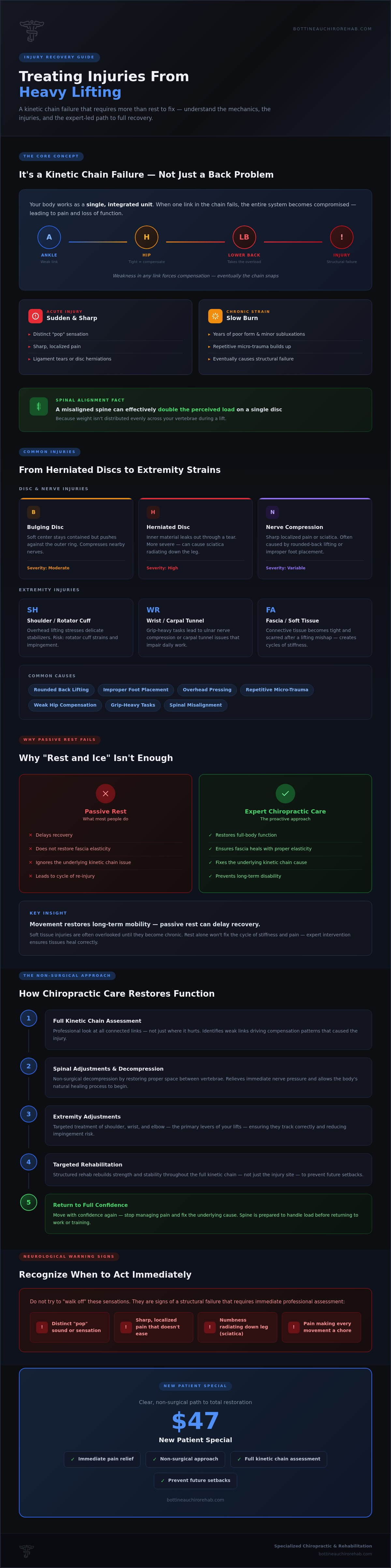
Heavy lifting injuries occur when the mechanical load placed on the body exceeds the structural integrity of your muscles, tendons, or ligaments. It isn't always about the total weight on the bar. Often, it's about how that weight is distributed through your frame. A lifting injury is a disruption in the body's kinetic chain. When one link in this chain fails, the entire system becomes compromised, leading to pain and loss of function.
The kinetic chain concept is vital for anyone serious about their physical health. Your body works as a single, integrated unit. If you have a weak ankle or a tight hip, your lower back must compensate to complete the movement. This compensation creates a "weak link" that eventually snaps. Treating injuries from heavy lifting requires a professional look at these connected links rather than just focusing on the localized pain. Remember that repetitive micro-trauma is just as dangerous as a single heavy lift. Small, improper movements performed hundreds of times wear down your joints, making a major injury inevitable.
Acute vs. Chronic Lifting Strains
Acute injuries happen in a split second. You might feel a distinct "pop" followed by sharp, localized pain. These are clear signs of sprains and strains from heavy lifting that often involve ligament tears or disc herniations. You shouldn't try to "walk off" these sensations. Chronic strains, however, are a slow burn. They represent years of inflammation caused by poor form and minor subluxations. Every minor "tweak" you ignore adds up over time. Eventually, your body loses its ability to compensate, leading to a major structural failure. Ignoring these small warnings is the fastest way to end up with a long-term disability.
The Role of Spinal Alignment in Weight Distribution
Your spine is the primary support beam for every lift you perform. When your vertebrae are misaligned, they create weak links in your lifting posture. This isn't just a matter of comfort; it's a matter of physics. A misaligned spine can effectively double the perceived load on a single disc because the weight isn't distributed evenly. Proper alignment ensures that the force of a lift travels through your bones and joints as intended. Without this foundation, your muscles have to work overtime to stabilize your frame. Restoring natural alignment is a critical component in treating injuries from heavy lifting and preventing future setbacks. We focus on ensuring your spine is ready to handle the load before you get back to work.
Common Lifting Injuries: From Herniated Discs to Extremity Strains
Lifting heavy objects places immense stress on your structural system. While most people immediately think of the back, your shoulders, wrists, and elbows are often the first to fail during high-intensity press movements or repetitive yard work. Treating injuries from heavy lifting involves identifying exactly which tissues have been compromised. This includes assessing soft tissue damage like sprains, strains, and fascia tears that can restrict your movement for weeks. Following established treatment guidelines for sprains and strains is essential for a fast and safe recovery.
Soft tissue injuries are often overlooked until they become chronic. Fascia, the connective tissue surrounding your muscles, can become tight and scarred after a lifting mishap. This creates a cycle of stiffness and pain that rest alone won't fix. Expert intervention ensures that these tissues heal with proper elasticity, allowing you to return to full-body function without the fear of a sudden re-tear.
Disc Issues and Nerve Compression
Lifting with a rounded back or improper foot placement often leads to significant disc injuries. A bulging disc occurs when the soft center of the spinal disc stays contained but pushes against the outer ring. A herniated disc is more severe; the inner material actually leaks out through a tear. Both conditions can compress nearby nerves, leading to sharp, localized pain or sciatica that radiates down your leg. You don't always need surgery to fix this. Chiropractic adjustments provide non-surgical decompression by restoring proper space between the vertebrae. This relieves the immediate pressure and allows the body to start its natural healing process without invasive procedures.
Shoulder and Wrist Vulnerability
Your extremities are the primary levers of your lifts. If they aren't tracking correctly, you're at high risk for rotator cuff strains or debilitating wrist instability. Overhead lifting is especially taxing on the shoulder's delicate stabilizers, often leading to impingement. Grip-heavy tasks can also lead to ulnar nerve compression or carpal tunnel issues that make daily work impossible. This is where extremity adjusting becomes a game-changer for athletes and laborers alike. By realigning the joints in your limbs, we ensure they move smoothly and absorb force correctly rather than passing it onto your tendons.
If you're noticing a lingering ache in your joints after a workout, it's a clear sign that your mechanics are off. Don't wait for a total tear to seek help. A quick evaluation at Boundless Full Body Chiropractic & Rehab can identify these kinetic imbalances before they become career-ending injuries. We focus on the whole body, ensuring every joint from your neck to your ankles is functioning as it should to keep you moving.
Why 'Rest and Ice' Isn't Enough for Lifting Recovery
The old advice to simply "rest and ice it" is often the worst thing you can do for a lifting injury. While a day or two of reduced activity is necessary for acute inflammation, total inactivity is a trap. Passive rest leads to the formation of disorganized scar tissue and a permanent loss of mobility. When you stop moving, your muscles begin to atrophy and your joints stiffen, making the eventual return to lifting much more dangerous. Treating injuries from heavy lifting requires a shift from passive waiting to active, controlled intervention.
Active recovery is the key to restoring function. Controlled movement acts as a pump, driving nutrient-rich blood into injured tissues to accelerate healing. Structural issues like misaligned vertebrae or joint tracking errors won't fix themselves with time alone. These mechanical failures require physical intervention to reset the system. Organizations like OSHA highlight the severity of musculoskeletal injuries from heavy lifting because they understand that these conditions often become chronic without the right rehabilitation strategy. You need a plan that addresses the root cause rather than just waiting for the clock to run out.
The Dangers of Masking Pain with Medication
It's tempting to reach for a bottle of NSAIDs to get through the day. However, masking pain with medication hides the vital "warning signs" your body uses to prevent further damage. If you can't feel the pain, you're likely to overexert yourself and turn a minor strain into a major tear. There's a massive difference between suppressing a symptom and fixing a structural cause. Our goal is to build a recovery plan that doesn't rely on a pill bottle. We want you to feel your progress through improved movement, not just a numbed nervous system.
Spinal Rehab: Restoring the Foundation
The foundation of any lifting program is a stable and mobile spine. Effective spinal rehabilitation focuses on three critical pillars: stability, mobility, and strength. We don't just tell you to "strengthen your core." We re-train your deep stabilizer muscles to protect your spine during every lift you perform. It's vital that alignment precedes strengthening. If you build strength on top of a misaligned frame, you're simply reinforcing muscle imbalances that will lead to future injuries. We ensure your foundation is level before we ask you to put weight back on the bar.
Immediate Steps for Treating Injuries from Heavy Lifting
The moment you feel a sharp twinge or a dull pop during a lift, your priority must shift from performance to preservation. Stop the activity immediately. Many lifters make the mistake of trying to "finish the set" or "work through the stiffness." This often turns a minor grade one strain into a significant tear. Treating injuries from heavy lifting starts with a decisive halt to all mechanical stress on the affected area. Once you've safely put the weight down, assess your neurological status. If you experience tingling, numbness, or a sudden loss of strength in your limbs, your nervous system is under duress. These symptoms require professional attention to prevent long-term nerve damage.
Your next step is identifying the specific failure in your kinetic chain. A full body chiropractic adjustment is the most effective way to pinpoint the root cause of the injury. While you may feel the pain in your lower back, the actual culprit could be a restricted ankle or a misaligned hip. After the initial diagnosis, we implement a customized physical therapy and spinal rehab plan. This dual approach ensures that we aren't just chasing symptoms but are actively rebuilding your structural integrity from the ground up.
Home First Aid vs. Professional Care
During the first 24 hours, use ice to manage acute inflammation and dull sharp pain. Apply it for 15 to 20 minutes at a time. After the initial inflammatory phase, heat can help relax guarded muscles and encourage blood flow to the injured tissues. Avoid total bed rest. Instead, perform gentle mobility movements like cat-cow stretches or pelvic tilts to prevent your joints from "locking up." However, if you experience a loss of bowel or bladder control, extreme weakness, or pain that prevents you from standing, seek professional care immediately. These are red flags that indicate a serious structural emergency.
The Boundless Approach to Sports Injury Rehab
We specialize in getting you back to your routine without the need for invasive surgery. Our sports injury rehab in Bottineau is designed to accelerate the healing process for everyone from local farmers to competitive athletes. By combining precise chiropractic adjustments with targeted physical therapy, many patients report significantly faster recovery times compared to rest alone. We don't believe in one-size-fits-all treatments. Your care plan is built around your specific goals and the demands of your daily life. If you're ready to stop the pain and start your recovery, schedule your initial assessment at Boundless Full Body Chiropractic & Rehab today.
Start Your Recovery with Our $47 New Patient Special
Expert diagnosis is the first step toward a pain-free life. You shouldn't have to guess why your back or shoulders are failing. Treating injuries from heavy lifting requires a professional eye to identify exactly where the kinetic chain broke down. At Boundless Full Body Chiropractic & Rehab, we remove the guesswork. We've designed our introductory special to be a low-risk gateway to recovery. Our goal is to help you take decisive action today. Waiting only allows a minor tweak to settle into a permanent structural failure. We serve our neighbors from Bottineau to Minot and the surrounding regions with high-impact care that prioritizes your time and your results. You're a vital part of this community. You deserve to function at your absolute best.
What to Expect at Your First Visit
Your recovery starts with a one-on-one consultation with Dr. Daniel Pozarnsky. We don't just look at the spot where it hurts. We perform a comprehensive physical assessment to find the underlying subluxations causing your discomfort. This often includes detailed digital imaging or specialized orthopedic tests to see exactly how your spine and joints are aligned. You'll receive a clear, transparent explanation of what's wrong and how we plan to fix it. We believe in providing you with a roadmap so you understand your recovery timeline from day one. It's about restoring function, not just masking symptoms. We show you the weak links in your movement patterns so you can avoid re-injury in the future.
Claim Your Special Offer in Bottineau
Our $47 New Patient Special is designed for North Dakota families who value efficiency and expertise. This offer includes your initial exam, consultation, and a personalized report of findings. It's the most straightforward path to treating injuries from heavy lifting without the need for surgery. We're proud to support the hardworking individuals in our community who keep this region moving. Whether you're a farmer, a laborer, or a dedicated athlete, you deserve care that matches your work ethic. Locking in your chiropractic new patient offer is simple and fast. Visit our website or call our office to secure your spot. Don't let another day of pain sideline you from the life you enjoy. Take the first step toward total alignment and claim your special today. We're ready to help you move without limits and return to the activities you love.
Take the First Step Toward Total Restoration
Your journey back to the gym or the field doesn't have to include surgery or permanent physical limitations. We've established that lifting injuries are often failures in the kinetic chain and that passive rest can actually hinder your long-term mobility. Treating injuries from heavy lifting effectively requires a proactive, non-surgical approach that restores alignment and builds lasting stability. You have the power to stop the cycle of physical frustration and reclaim your movement.
Expert care by Dr. Daniel Pozarnsky provides the clinical authority you need to recover with total confidence. Our specialized non-surgical spinal rehabilitation and full-body adjustments ensure every joint functions as intended. We're proud to serve Bottineau and our surrounding rural communities with accessible, results-driven healthcare. Don't let a single lifting mishap dictate your future. Take decisive action now to protect your body and your livelihood.
Claim Your $47 New Patient Special & Start Your Recovery Today. It's time to move beyond the pain and return to the activities you love with strength and vitality.
Frequently Asked Questions
How do I know if my lifting injury is serious?
A lifting injury is serious if you experience neurological symptoms such as sharp, radiating pain or numbness in your arms or legs. These signs suggest nerve compression. Other red flags include sudden muscle weakness or a loss of bowel and bladder control. If your pain is so intense that you cannot stand or walk, you need an immediate professional evaluation. Our team in Bottineau provides the diagnostic expertise to determine the severity of your condition quickly.
Can a chiropractor help with a herniated disc from lifting?
Yes, chiropractic care is a highly effective non-surgical option for managing herniated discs. By performing precise spinal adjustments, we restore proper alignment and reduce mechanical pressure on the affected disc. This process allows the disc to begin healing naturally while relieving nerve compression. Treating injuries from heavy lifting through these methods helps many patients avoid invasive surgical procedures. We focus on long-term stability to ensure the disc remains protected during future physical activities.
How long does it take to recover from a heavy lifting back injury?
Recovery timelines depend on the specific tissue damaged and the severity of the strain. A minor muscle pull might resolve in two to four weeks with active rehabilitation. However, a significant disc injury or ligament tear can take several months of consistent care. Your recovery speed increases when you prioritize active movement over passive rest. At Boundless, we provide a clear recovery timeline after your initial assessment so you know exactly what to expect during your healing journey.
Is it better to see a chiropractor or a physical therapist for lifting pain?
You don't have to choose between the two. The most effective approach to treating injuries from heavy lifting often involves a combination of both disciplines. Chiropractic adjustments correct the structural alignment of the spine and extremities; meanwhile, physical therapy strengthens the supporting muscles. We integrate these services in Bottineau to ensure your body is both correctly aligned and strong enough to handle future loads. This comprehensive strategy leads to faster, more sustainable recovery results for our patients.
What is the best way to sleep with a lower back injury?
The best sleeping position for a lower back injury is one that maintains the natural curve of your spine. If you prefer sleeping on your side, place a pillow between your knees to keep your hips level. For back sleepers, tucking a pillow under your knees reduces the strain on your lumbar region. Avoid sleeping on your stomach, as this often increases spinal torsion and can worsen existing inflammation or disc pressure during the night.
When can I start lifting heavy weights again after an injury?
You can return to heavy lifting once you have regained a full, pain-free range of motion and demonstrated core stability. It's vital to clear a professional assessment before adding significant weight to the bar. We typically recommend a protocol that starts with bodyweight movements and gradually increases load. Rushing back too soon often leads to re-injury. We help our patients in the Minot and Bottineau areas build a safe, progressive transition plan for their return.
Does the $47 new patient special include an adjustment?
The $47 New Patient Special is designed as a comprehensive diagnostic first step. It includes a thorough consultation with Dr. Daniel Pozarnsky, a physical exam, and a detailed report of our findings. While the special covers the evaluation necessary to identify subluxations and kinetic chain failures, actual adjustments or physical therapy sessions are separate. This introductory offer ensures you receive a clear, affordable diagnosis and a personalized recovery plan before beginning your specific treatment program at our clinic.


