

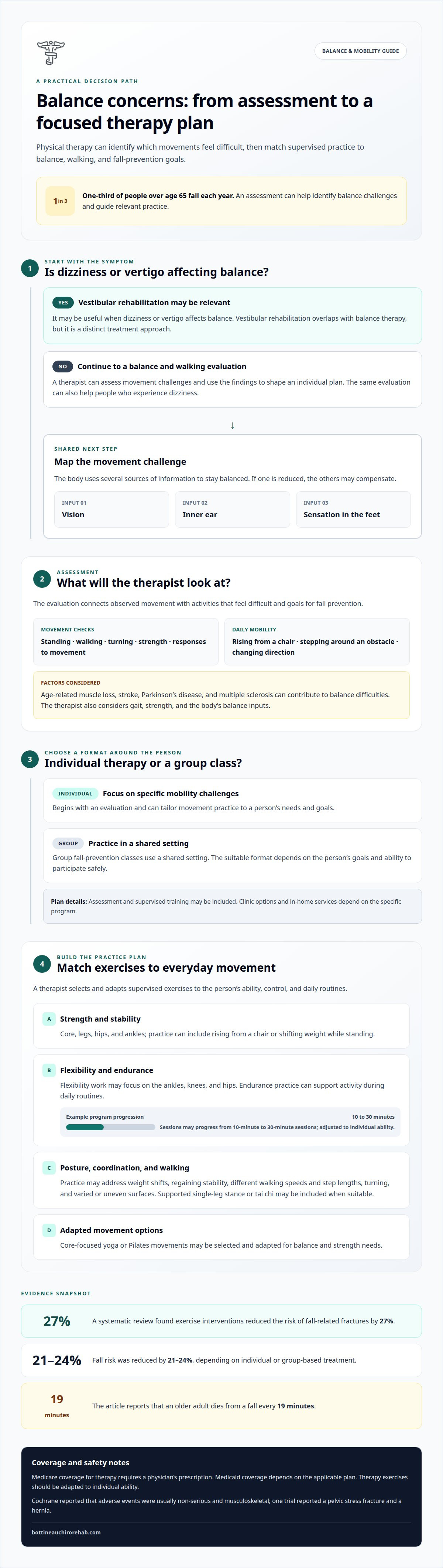
One-third of people over age 65 fall each year. Balance therapy for seniors in Dunseith can help address factors that raise fall risk by assessing how the body maintains balance and training the skills needed for steadier movement.
Changes in balance can make everyday activities feel less certain, especially when walking or changing direction. The body relies on vision, the inner ear, and nerves in the feet to stay balanced. When one source of information is reduced, the other two may compensate.
Physical therapy can assess balance and walking limitations, then use the findings to guide an individual plan. You’ll learn what an assessment may involve, which exercises and coordination drills can support steadier movement, and when vestibular rehabilitation may be relevant if dizziness or vertigo affects balance. The practical goal is to understand what makes movement difficult and discuss appropriate professional care to help you move with greater confidence.
Key Takeaways
- Professional assessment can identify balance challenges and guide reaction-time practice and fall-prevention strategies suited to daily movement.
- Strength, flexibility, and endurance exercises can target the core, legs, hips, and ankles to support stability.
- Postural training and coordination drills can build control through walking practice at different speeds, step lengths, and on varied terrain.
- Vestibular rehabilitation may be useful when dizziness or vertigo affects balance; it overlaps with balance therapy but is a distinct treatment approach.
How will physical therapy help reduce my fall risk?
Physical therapy evaluates movement challenges that may increase fall risk and connects the findings with prevention goals. For balance therapy for seniors Dunseith residents may be considering, an evaluation can look at walking, turning, standing, strength, and responses to movement. This helps identify which activities feel difficult and which skills may benefit from focused practice.
Fall Risk and Mobility Challenges
Falls can affect everyday mobility, from rising from a chair to stepping around an obstacle. One-third of people over age 65 fall each year. Age-related muscle loss, stroke, Parkinson’s disease, and multiple sclerosis can contribute to balance difficulties. The body also relies on vision, the inner ear, and sensation in the feet. A therapist considers these factors alongside gait and strength to shape relevant fall-prevention goals.
Therapy Options and Group Classes
Individual therapy starts with an evaluation and can tailor movement practice to a person’s needs. Group fall-prevention classes use a shared setting, while individual programs can focus on specific mobility challenges. The suitable format depends on the person’s goals and ability to participate safely. For balance therapy for seniors Dunseith families are considering, asking how the evaluation guides the plan can clarify what care involves.
Balance services may include assessment and supervised training, while clinic options and in-home services depend on the specific program. Medicare coverage for therapy requires a physician’s prescription; Medicaid coverage depends on the applicable plan. To arrange an evaluation, contact the chosen program through its scheduling process and describe relevant mobility concerns. Therapy exercises should be adapted to individual ability. Cochrane reported that adverse events were usually non-serious and musculoskeletal, though one trial reported a pelvic stress fracture and a hernia.
A physical therapy evaluation can identify balance and walking limitations that may affect fall risk. The therapist assesses movement and uses the findings to shape an individual plan, including strategies for practicing reactions and preventing falls.
A systematic review found exercise interventions reduced the risk of fall-related fractures by 27%. Fall risk was reduced by 21-24%, depending on individual or group-based treatment; an older adult dies from a fall every 19 minutes.
Therapist exercises for senior balance
Therapist-led balance training may combine strength, flexibility, and endurance work. An individual plan connects exercises to movement goals and can be adapted as control develops. For balance therapy for seniors in Dunseith, exercise choices should reflect each person’s abilities and daily routines.
Strength and Stabilization Exercises
A therapist may work on the core, legs, and hips to support posture and stability. Hip and ankle strength can also help the body manage shifts in balance. Exercises may practice movements such as rising from a chair or shifting weight while standing. The therapist selects an appropriate challenge and observes how each movement is performed. Supervised exercises are tailored to function rather than relying on one routine for every older adult.
Gait and Stability Exercises
Walking practice can focus on step length, pace, turning, and moving across uneven surfaces. A therapist observes which parts of walking need attention, then adapts practice to the person’s balance and stability. Supported single-leg stance practice or tai chi may be included when suitable. For balance therapy for seniors in Dunseith, ask how walking exercises relate to the movements that feel difficult.
Flexibility work may focus on the ankles, knees, and hips. These joints contribute to balance and walking, so a therapist can select movements suited to the person’s available range of motion. The aim is to make everyday steps and weight shifts easier to control, not to push beyond comfortable movement.
Endurance exercises can help sustain activity during daily routines. One example program may progress from 10-minute sessions to 30-minute sessions. The therapist adjusts the plan to individual ability. Core-focused yoga or Pilates movements may also be selected and adapted for balance and strength needs.
Choose exercises that connect to meaningful daily movement. Physical therapy for balance and mobility can help shape supervised practice around those goals.
Postural training and coordination drills
Posture and coordination practice can build control during standing and walking. A therapist uses evaluation findings to link each exercise with a specific movement challenge.
Postural Control and Balance Training
Postural control is the ability to keep the body steady as position changes. A therapist may assess how someone stands, shifts weight, and regains stability after movement. The plan can then include supervised exercises for specific difficulties. For example, a therapist may practice controlled weight shifts before introducing a more demanding movement. The aim is to support balance during everyday tasks, not only while standing still.
Walking Coordination and Gait Training
Walking practice focuses on the coordination needed to move safely. A therapist may work on different speeds, step lengths, and surfaces, adjusting the challenge to the person’s movement. These tasks can show where coordination becomes difficult, such as changing pace or walking across uneven ground. The therapist observes stability and walking, then uses those findings to guide further practice.
Balance and walking practice can complement each other. An evaluation helps identify whether the main challenge occurs while standing, starting to walk, turning, or changing direction. The therapist can choose exercises for those specific movements instead of relying on one general activity. This keeps the plan relevant to the tasks that matter in daily life.
Coordination exercises may ask a person to shift attention while moving. A therapist can observe how posture and walking change as a task becomes more complex. The challenge should match the person’s current control and fall risk. The therapist can adapt an activity if posture becomes less steady or a movement is difficult to complete.
Dizziness can affect stability and confidence while walking. If symptoms suggest a vestibular concern, an evaluation can help determine whether vestibular rehabilitation is appropriate. Balance therapy and vestibular therapy overlap, but they are not the same treatment. A therapist considers symptoms and movement findings when choosing the focus of care.
Vestibular rehabilitation
Vestibular rehabilitation addresses balance difficulties linked to the inner ear and movement-related symptoms. A therapist considers dizziness, unsteadiness, and how these symptoms affect walking and daily activities.
Vestibular Disorders and Dizziness
Vestibular disorders can affect the body’s sense of position and motion. Vertigo may feel like spinning, while dizziness can make standing or walking feel unsteady. These symptoms may increase concern about falling, especially when turning or moving through daily routines. During an evaluation, a therapist considers when symptoms occur and how they affect balance, walking, and endurance. Falls are a leading cause of injury and hospitalization among older adults.
Describe the sensation clearly, including whether symptoms occur while turning, standing, or walking. A therapist can consider this information alongside movement observations to understand how dizziness affects stability. New or severe symptoms may also need medical attention, since balance therapy does not identify every cause of dizziness.
Vestibular and Balance Rehabilitation
Vestibular rehabilitation, also called vestibular rehabilitation therapy, is a subspecialty of neurologic physical therapy. It may address specific vestibular symptoms, while broader balance therapy can focus on strength, walking, posture, and stability. The approaches overlap, but they are not the same treatment. A therapist uses the evaluation to determine which movement goals belong in the plan.
Rehabilitation may include supervised movement practice tailored to the symptoms and balance challenges identified. The therapist observes the person’s response and adjusts the plan to support steadier movement in daily life. Sessions should connect with practical goals, such as walking with less unsteadiness or turning more comfortably. An individual approach matters because dizziness and balance limitations affect people differently.
If dizziness or vertigo is affecting mobility, discuss physical therapy options for an evaluation and guidance on appropriate next steps.
Boundless Full Body Chiropractic & Rehab: Physical Therapy
Boundless Full Body Chiropractic & Rehab provides Physical Therapy in Bottineau, North Dakota, for people with movement and mobility concerns. If balance difficulties affect walking, turning, or daily activities, physical therapy can be a next step for discussing those challenges and exploring care suited to your needs.
Describe the movements that feel difficult and share any relevant injury history. The care team can discuss whether Physical Therapy is appropriate for your concerns. For injury-related mobility needs, Sports Injury Rehab may also be relevant. Extremity Adjusting and Full-Body Adjustments are additional services for musculoskeletal concerns.
Choose a next step when balance problems are making everyday movement harder or limiting independence. Contact Boundless Full Body Chiropractic & Rehab to discuss your mobility concerns.
Take the Next Step Toward Steadier Movement
Start with a clear, personal goal. You might want to walk through your home with more confidence, keep up with a familiar routine, or feel steadier when changing direction. Naming the movement that matters can help focus a professional conversation on how balance challenges affect everyday life.
For seniors in Dunseith, balance therapy can be a step toward addressing movement concerns with professional guidance. Share what feels difficult, when it happens, and how it affects daily activities. These details can help shape a discussion about your needs and appropriate care. Progress varies from person to person, so focus on meaningful movement and achievable steps.
Ready to discuss your mobility concerns? Contact Boundless Full Body Chiropractic & Rehab to take the next step at your own pace.
Frequently Asked Questions
Isn’t this just part of getting older?
No. Age-related changes can affect strength, but new or worsening unsteadiness deserves attention. Notice which situations feel harder, such as standing from a chair, turning, or walking across a room. Sharing specific examples with a healthcare professional can help clarify whether balance limitations need assessment and whether another health concern should also be considered.
Why Balance Therapy?
Balance therapy offers a structured way to address movement concerns that interfere with daily routines. It may be useful when someone feels unsteady during everyday tasks, avoids activities because of a fear of falling, or has trouble moving confidently. An evaluation connects these challenges with suitable therapy goals. The focus is practical function, not simply completing exercises without a clear purpose.
What balance and fall-prevention exercises are used in senior therapy?
Exercises may include controlled weight shifts, supported standing practice, walking drills, and movements to strengthen the legs and hips. A therapist chooses activities based on the person’s abilities and balance concerns. For example, someone who feels unstable while turning may practice controlled direction changes during supervised movement. The therapist can adjust the challenge as the person performs each activity.
What conditions can balance therapy treat in older adults?
Balance therapy may address movement difficulties associated with age-related muscle loss, stroke, Parkinson’s disease, multiple sclerosis, or vestibular problems such as vertigo and dizziness. It focuses on balance, walking, and related function, not on curing an underlying neurological or vestibular condition. An evaluation considers how symptoms affect movement and whether medical assessment is also needed.


