

What if the best next step for outer-elbow pain isn’t simply resting it or pushing through? Gripping a mug, lifting a bag, or moving your wrist can become uncomfortable when the tendons near the elbow are irritated. A search for tennis elbow treatment Kenmare ND should lead to more than generic advice, especially when pain keeps getting in the way of daily tasks.
Outer-elbow pain can fit tennis elbow, but other problems may cause similar symptoms. An assessment can help clarify what may be going on and guide care around your symptoms, activities, and goals. This guide covers common signs, when to seek an assessment, and how activity adjustments and progressive rehabilitation can support a return to function without promises of a quick fix.
Physical therapy and extremity care can be part of an individualized rehab plan. Based in Bottineau, Boundless Full Body Chiropractic & Rehab serves Kenmare and nearby communities with sports injury rehabilitation focused on restoring function and mobility.
Key Takeaways
- Outer-elbow pain can have different causes. Note how symptoms began and which movements bring them on before settling on a treatment plan.
- Compare care options against your daily demands and recovery goals. The right approach depends on your symptoms, health history, and activities.
- Use a practical progression: track aggravating tasks, adjust the load, seek an assessment when needed, and build activity back gradually.
- For tennis elbow treatment Kenmare ND, an individualized rehab plan can support comfortable function without promising a fixed recovery timeline.
- Boundless Full Body Chiropractic & Rehab serves Kenmare-area communities from Bottineau, offering physical therapy, extremity care, and sports injury rehabilitation.
Tennis Elbow Treatment Near Kenmare, ND: Recognize the Problem First
Outer-elbow pain can make ordinary movements challenging. A firm grip, lifting a pan, using tools at work, or enjoying a favorite activity may all hurt. If you’re looking for tennis elbow treatment Kenmare ND, start by understanding what the term describes and why similar symptoms can have different causes.
Tennis elbow is irritation and pain involving tendons that connect forearm muscles to the outer elbow. It is one possible cause of elbow pain, not a label for every sore elbow. The medical term is lateral epicondylitis. Despite its name, you don’t have to play tennis to experience it. Repeated gripping and forearm use can also stress these tendons. Tennis elbow, also known as lateral epicondylitis, is a useful overview, but it can’t determine what’s causing your individual symptoms.
What does tennis elbow feel like?
People often describe tenderness near the bony area on the outside of the elbow. Gripping, carrying, or lifting may bring on discomfort, as can some wrist or forearm movements. The pattern and impact vary. One person may notice pain only during a demanding task; another may find routine activities uncomfortable. These signs can point to a tendon problem, but they don’t confirm a diagnosis.
Notice what brings on the pain and how it affects your day. Symptoms that resemble tennis elbow can overlap with other elbow or arm problems. An assessment can consider your symptom history, movement, and daily demands instead of relying on a symptom list alone.
When should persistent elbow pain be assessed?
Arrange an assessment if elbow pain persists, worsens, or starts limiting ordinary tasks. Guidance can help clarify the likely cause and identify an appropriate next step. Seek prompt medical attention after a major injury, with severe swelling, or if you develop concerning new symptoms. Don’t use an online description as a substitute for an individual examination.
For Kenmare-area readers, tennis elbow treatment starts with understanding the problem and its effect on function. That gives care a clearer focus, whether your goal is to grip more comfortably, manage work tasks, or return to recreation.
Tennis Elbow Treatment Options for Kenmare-Area Readers
There isn’t one plan that fits every sore elbow. Care may start by changing how you do a painful task, then build toward comfortable strength and function. The right mix depends on an assessment, how long symptoms have lasted, health history, and the demands of work and recreation. The American Academy of Orthopaedic Surgeons outlines several treatment options for tennis elbow, including non-surgical approaches and situations where other care may be discussed.
Which conservative approaches may support recovery?
Temporarily reduce or adapt tasks that sharply aggravate symptoms, such as forceful gripping or repeated lifting. That doesn’t necessarily mean avoiding all arm movement. Comfortable activity may help maintain function, while clinician-guided mobility and progressive strengthening can be adjusted to your response. Physical therapy can structure exercises and help build a gradual path back to daily tasks. A brace or other support may suit some situations, but it shouldn’t replace an individualized plan.
Keep self-care changes practical and pay attention to how your elbow responds. Medication choices are personal, so consider your health history and discuss them with an appropriate clinician or pharmacist rather than relying on a general online recommendation.
| Approach | Purpose | Consider reassessment when |
|---|---|---|
| Activity adjustment | Reduce strain from aggravating tasks while preserving comfortable movement. | Pain continues to interfere with work or daily routines. |
| Guided exercise or physical therapy | Progress mobility, strength, and task-specific function at a suitable pace. | Exercises worsen symptoms or progress is difficult to judge. |
| Support | Offer added support during selected activities. | It doesn’t help function or symptoms remain limiting. |
| Injections or surgery | Options a clinician may discuss for selected cases after considering the full picture. | Symptoms remain substantial despite an appropriate care plan. |
When might a person discuss other treatment options?
Persistent or substantial pain calls for reassessment, not repeated guesswork. Injections or surgery aren’t required in every case, and they aren’t decisions to make from symptoms alone. An appropriate clinician can consider the diagnosis, symptom course, health history, and response to conservative care before discussing whether either option is suitable.
For tennis elbow treatment Kenmare ND, focus on a plan that connects symptom management with the activities you want to resume. Kenmare-area residents can access individualized physical therapy and sports injury rehabilitation through Boundless care based in Bottineau, with a focus on restoring function rather than promising a particular result.
How to Compare Tennis Elbow Care by Goals and Daily Activities
A useful care plan starts with what you need your arm to do. Maybe you want to grip a steering wheel comfortably, lift supplies at work, prepare meals, or return to a recreational activity. These goals give an assessment a practical focus. Along with elbow discomfort, consider when symptoms began, which movements bring them on, and which tasks you’ve had to change or avoid.
What should an individualized care plan address?
Your symptom pattern and daily demands help shape the plan. Someone whose pain flares during repetitive work may need different activity adjustments than someone who notices it during sports. Depending on the assessment, care may combine education, progressive exercise, and hands-on approaches. Extremity adjusting can be part of broader care alongside rehabilitation focused on function. Learn more about extremity adjusting beyond the spine.
Physical therapy and sports injury rehabilitation connect movement work with tasks that matter in daily life. Exercises should be selected and progressed to suit the person and their response, not copied from a generic routine. The National Center for Biotechnology Information reviews physiotherapy techniques for tennis elbow, offering further context on rehabilitation approaches.
How can you recognize useful progress?
Track a few meaningful activities instead of judging progress by a single moment of pain. Note whether gripping, lifting, or completing a work task feels more manageable, and whether you can do it with less discomfort or fewer adjustments. Changes in tolerated activity can show whether the plan is moving in a useful direction. They don’t guarantee a specific timeline or mean every task should immediately feel pain-free.
If function isn’t changing as expected, or symptoms worsen, bring that information into reassessment. Your plan may need adjusting based on how you respond. For tennis elbow treatment Kenmare ND, look for care that connects assessment, activity goals, and rehabilitation. Boundless Full Body Chiropractic & Rehab provides sports injury rehabilitation from its Bottineau practice and serves communities that include Kenmare.
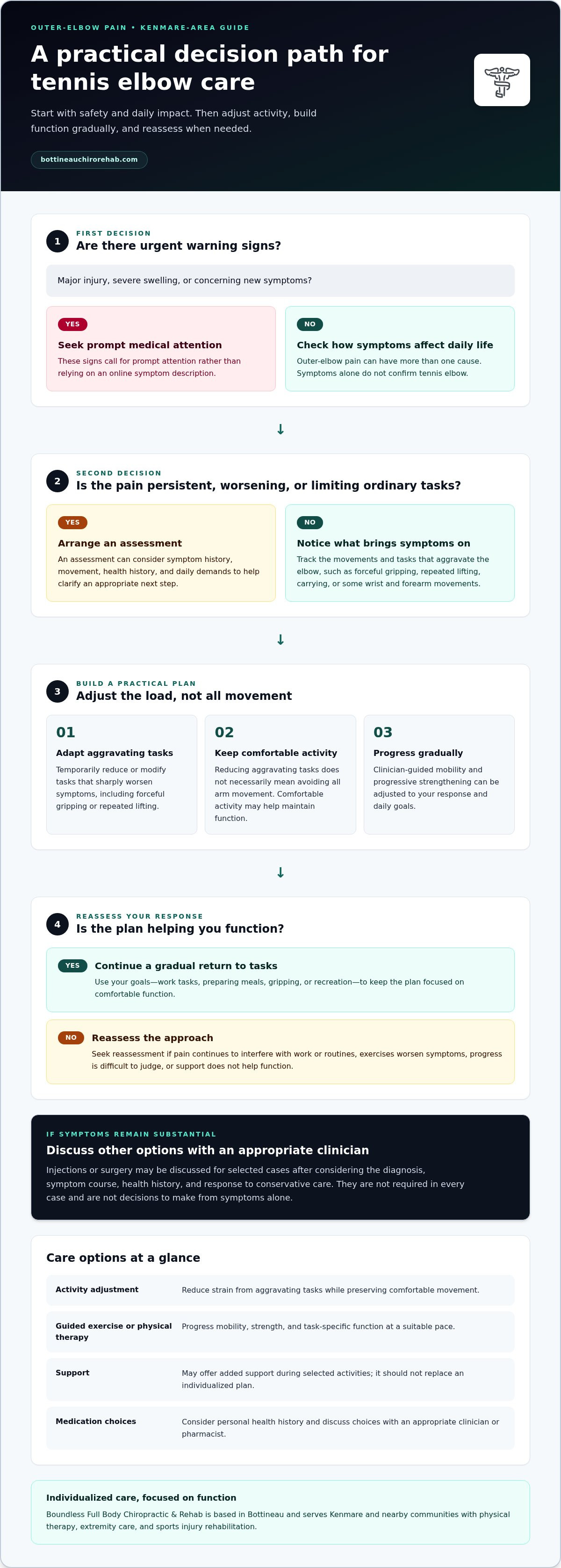
A Practical Tennis Elbow Recovery Plan for Everyday Life
Recovery is easier to navigate when you focus on what your arm can tolerate, not on a fixed calendar. Use this simple framework as a starting point. It doesn’t replace an assessment or a plan tailored to your needs.
- Notice your triggers. Track which tasks bring on symptoms, such as repeated gripping, lifting, or a particular work or sports movement. Notice how your elbow responds during the task and afterward.
- Adjust the load. If a task reliably aggravates your elbow, consider changing how often or how intensely you do it. Avoid pushing through sharply increasing pain. Stop the activity and seek guidance if symptoms flare sharply.
- Seek an assessment when needed. If pain persists, worsens, or limits daily activities, an individual assessment can help clarify what may be contributing and guide your next steps.
- Build activity back gradually. Progress from comfortable movement toward the gripping, lifting, work, or recreational tasks you want to resume. Let your response guide the pace rather than following a universal schedule.
How can you modify gripping and lifting while symptoms settle?
Start with the tasks you identified. You might reduce repeated bouts of a provoking activity or break a demanding task into smaller parts. These are general ideas, not a prescription. Work duties, home tasks, and sports each place different demands on the arm, so professional guidance can help you adapt activity without unnecessarily avoiding all movement.
How should activity build back over time?
Rehabilitation may move from comfortable motion toward exercises and everyday tasks that match your goals. Keep a simple record of what you tried and how the elbow felt during and after it. If symptoms sharply increase or function isn’t progressing as expected, pause and seek guidance before increasing the demand. Guided physical therapy and rehabilitation can support a gradual return to activity.
For tennis elbow treatment Kenmare ND, connect your symptom pattern with the activities you want to regain. Boundless Full Body Chiropractic & Rehab is based in Bottineau and serves Kenmare-area communities. Explore rehabilitation care with Boundless to learn about an individualized plan focused on restoring function.
Tennis Elbow Care Serving Kenmare, ND: Your Next Step with Boundless
Kenmare-area residents can access rehabilitation-focused care through Boundless Full Body Chiropractic & Rehab, based in Bottineau, North Dakota. Care is shaped around your symptoms and the activities you want to manage, rather than a one-size-fits-all routine.
How Boundless approaches elbow-related rehabilitation
Boundless provides extremity adjusting, physical therapy, and sports injury rehabilitation. An individualized assessment helps shape a broader plan around your presentation and functional goals. Care can focus on comfortable movement and building capacity for tasks that matter to you. An adjustment isn’t automatically the answer for every person; care should fit the individual.
Assessment helps guide the next step, but elbow pain can have different causes. If symptoms call for medical evaluation, rehabilitation should not take its place. Progress also varies. The plan can be shaped around how your elbow responds and whether everyday function is changing, without promising a specific result or recovery timeline.
How can Kenmare-area readers take the next step?
Think about what you want to do more comfortably, such as gripping, lifting, completing work tasks, or returning to recreation. Contact the Bottineau practice to discuss an assessment and the activity goals you’d like your care to address. Sharing what aggravates symptoms and what you’ve already adjusted can make the conversation specific and useful.
If you’re looking into tennis elbow treatment Kenmare ND, you don’t have to guess at the next step alone. Boundless can help you explore an individualized approach that connects assessment with extremity care, physical therapy, and sports injury rehabilitation. Take the next step with Boundless.
Take a Practical Next Step Toward Comfortable Movement
Outer-elbow pain can have more than one cause, so an assessment can help clarify what’s behind your symptoms. From there, care can be matched to your activity goals, with thoughtful adjustments to aggravating tasks and rehabilitation that progresses according to your response. There’s no one-size-fits-all plan or guaranteed recovery timeline.
If you’re exploring tennis elbow treatment Kenmare ND, Boundless Full Body Chiropractic & Rehab provides physical therapy, extremity adjustments, and sports injury rehabilitation through its Bottineau practice. Care can be tailored to an individualized plan focused on restoring function and helping you work toward the movements that matter to you.
Take the next step with Boundless to discuss your elbow symptoms and activity goals. A clearer plan can help you move forward with confidence, one practical step at a time.
Frequently Asked Questions
What is the fastest way to treat tennis elbow?
There’s no guaranteed fastest treatment, because the right approach depends on the cause of pain and how it affects you. A useful first step is to reduce or adapt tasks that clearly aggravate symptoms, then get an assessment if pain persists or limits daily activities. A clinician can help guide appropriate activity changes and rehabilitation. Be cautious of promises of instant relief or a fixed recovery timeline.
Can tennis elbow improve without surgery?
Yes. Tennis elbow can be managed without surgery, often with conservative approaches such as modifying aggravating activities and progressing suitable exercises. The plan should fit your symptoms, health history, and daily demands. If pain continues or function remains limited, seek reassessment to discuss what may be contributing and whether other options are appropriate. Surgery isn’t automatically needed, and no treatment can guarantee a particular outcome.
How do I know if my elbow pain is tennis elbow?
You can’t confirm tennis elbow from symptoms alone. It often involves tenderness at the outer elbow and discomfort with gripping, lifting, or some wrist and forearm movements. Other conditions can cause similar pain. An individual assessment considers how symptoms started, which activities provoke them, and how movement is affected. Seek prompt medical attention after a major injury, with severe swelling, or for concerning new symptoms.
Can chiropractic care help with tennis elbow?
Chiropractic care may be part of an individualized plan, but that doesn’t mean every person needs an adjustment. Boundless Full Body Chiropractic & Rehab provides extremity adjustments, physical therapy, and sports injury rehabilitation. An assessment can help determine how rehabilitation and extremity care fit your presentation and functional goals. The aim is to support movement and function, not promise a specific result or replace medical evaluation when needed.
Should I rest completely if I have tennis elbow?
Complete rest isn’t automatically necessary. Consider modifying tasks that reliably increase symptoms while maintaining comfortable movement where appropriate. For example, you may adjust how often you grip or lift rather than avoid all arm use. Don’t push through sharply increasing pain. If work, home activities, or sport are difficult to adapt, a clinician can help you find an approach suited to your needs.
How long does tennis elbow take to heal?
Recovery time varies. It can depend on symptom duration, the activities that stress the elbow, your health history, and how your function responds to care. Avoid relying on a universal timeline or a promise of pain-free movement by a certain date. Track changes in tasks that matter to you, such as gripping or lifting. If symptoms persist, worsen, or keep limiting daily activities, seek reassessment.
Where can I get tennis elbow treatment near Kenmare, ND?
Boundless Full Body Chiropractic & Rehab is based in Bottineau and serves Kenmare-area communities. For tennis elbow treatment Kenmare ND, you can explore individualized assessment and rehabilitation-focused care, including physical therapy, extremity adjustments, and sports injury rehabilitation. The practice also serves Rugby, Rolla, Rollette, Dunseith, St. John, Sherwood, Mohall, Willow City, Lake Metigoshi, Belcourt, Minot, and Velva.


